

10. European Pottery to the Fall of the Romans
| 1023 Page: 261 of 418 Go To Page: |  |
◁◁ First | ◁ Previous | Next ▷ | Last ▷▷ |
From 1,075 to 900 BC, a new style called “Protogeometric” emerged in Attica, again based on early Mycenaean stylised motifs, although only the geometric ones, with the decoration initially confined to the handle zone. Now the motifs are very precise versions, so loose spirals became neat concentric circles drawn with a pair of compasses having multiple brushes, on a thick, black, lustrous background, or with black paint on a pale background. Other motifs were wavy lines, arcs, triangles and bands. Body shapes were based on previous sub-Mycenaean ones, but improved so drinking vessels have high conical feet and closed vases have graceful ovoid bodies. As well as in Athens, the Protogeometric style was also found in the other major Greek cities, and spread through the Aegean Region.
Throughout their history the ancient Greeks reflected their advanced civilisations in their pottery. They showed their love of purity of form and detail in their domestic and ornamental wares. The shape of their vases, urns and bowls have changed little to the present day. Each distinct shape they produced had a name and a special function in Greek society and ritual. The amphora was a two-handled storage vessel for wine, olive oil, corn or honey; the hydria was a three-handled water jug; the lecythus was a perfume and oil flask with a long, narrow neck used for anointing in funeral rituals; the oenochoe was a wine jug with a pinched lip; the krater was a large bowl to mix wine and water and the cylix was a double-handled drinking cup with a foot; the skyphos a drinking vessel with horizontal handles; the pyxis was a cylindrical box for women’s cosmetics & jewellery and there were smaller bottles, perhaps 3” high, for perfumed ointment usually for men, called aryballos. Amphorae with handles attached to their shoulders were used to contain the remains of dead males for burial, whereas for females the handles were attached to the middle.
In the early 9th century BC the Athenian potters developed the “Geometric” style, on slimmer shaped bodies, using rectangular rather than circular motifs and popularising the “key’ or “meander” pattern. Other motifs often in bands were swastikas, herringbone and triangles.
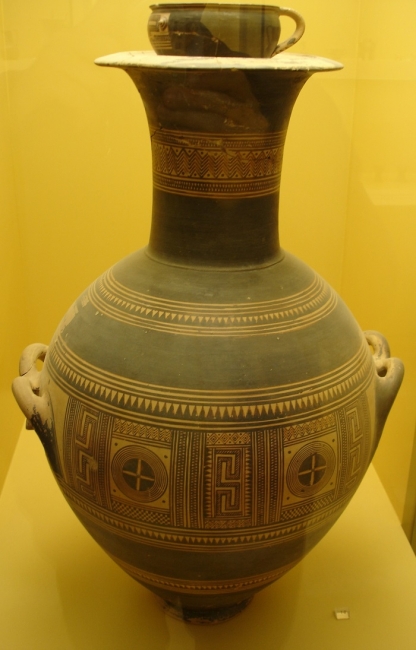
Early geometric burial urn of
wealthy woman 850 BC - source
Archaeological Museum, Athens
Later in the 9th century BC decoration included birds and horses. Initially the area reserved by the extensive lustrous black paint was small, but more decorated zones became added until a balance was reached between light and dark. Great care was taken over the shapes of vessels, with set ratios of height to girth and neck length, together with the placement of decoration on the vessel. In the middle of the 9th century BC, after centuries of wholly geometric decoration on pots, animals and flowers reappeared, albeit primitive, angular versions. The animals included horses, deer, goats and geese. The decoration started as bands of identical figures separated by bands of geometric patterns. This banding was the major change from Mycenaean decoration, which had large figures extending over most of the pot. The decoration became much more complex – some examples magnificently so.
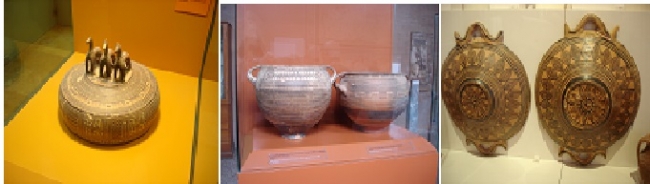
Geometric vessels, pyxis for food offerings – the lid
probably representing status of the dead, Kraters
as burial urns for infants, and platters, 750-720 BC
- source a and c Archaeological Museum,
Athens, b Olympia Museum
Many examples were found in the cemetery near the ruins of the “Dipylon” or double gate in Athens. Other wares were of red clay covered in a yellowish slip and painted in lustrous black. Euboean potters made significant pottery exports to Cyprus between 900 and 700 BC, including semi-circular pendant plates that were particularly popular there and in the Levant.
| Page: 261 of 418 Go To Page: | |
◁◁ First | ◁ Previous | Next ▷ | Last ▷▷ |
Author: Dr. Stan Jones © Copyright 2010 -