

10. European Pottery to the Fall of the Romans
| 1024 Page: 262 of 418 Go To Page: |  |
◁◁ First | ◁ Previous | Next ▷ | Last ▷▷ |
Also early in the 9th century BC the settlements that were to become the autonomous City-States (Polis as in metropolis) started to emerge. At first their inhabitants were tribal, but because of their skills as traders, seafarers, militarists and bureaucrats, they grew to become mixed communities of up to 250,000 people. In the 8th century BC there was sufficient wealth available for the inhabitants of these new City-States to start to build monumental public buildings. Wealth started to become the measure of a person’s status, so much so that at the end of the 8th century BC status was literally based on ownership of “measures” of corn or oil.
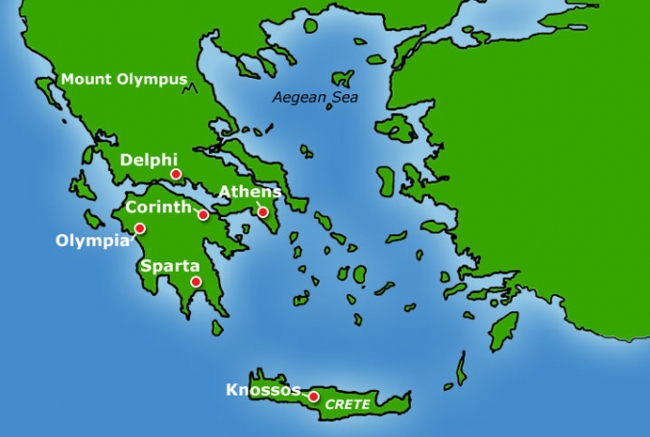
Map of Greek city states - source BBC
Outside contact increased, especially by the Euboeans, facilitated by the Phoenicians. The poor land was unable to support the growing population, so the Greeks expanded by emigration. It had started around 1,050 BC when they joined the Phoenicians who were also plying the Mediterranean. The Greeks settled along the Levantine Coast and the Phoenicians welcomed them into new towns set up for trade. They also traded with Egypt for grain, papyrus, oil, wine and pottery. The Greeks started to colonise Southern Italy and then Sicily from around 770 BC, creating a significant Greek presence. By 750 BC the Greeks had also colonised Crete, the Western Anatolian coast, Rhodes most of Cyprus and numerous city colonies dotted throughout the Mediterranean coastline.
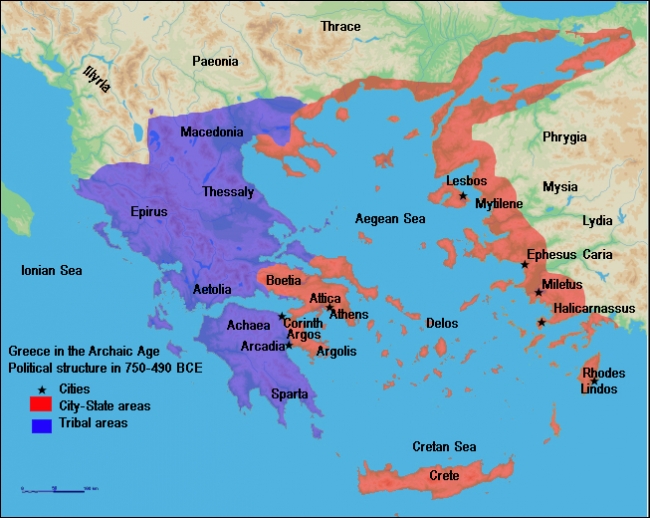
Map of Archaic Greece 750-490BC -
Wikipedia via megistias
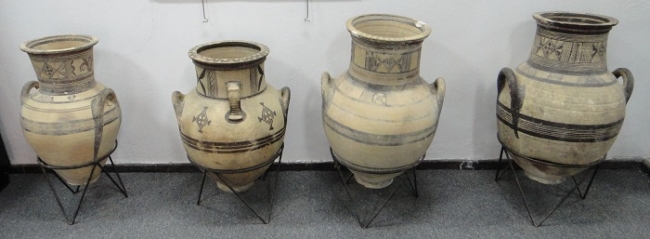
Decorated amphorae in Cyprus 750-650 BC -
source St Barnabas Antiquities Museum
These colonies were set up by various individual mainland Greek cities, such as the Spartans setting up Tarentum (Sicily) and the Achaeans Metapontum and Croton (both in Italy). These in turn set up daughter cities. These cities became as important a contributor to Greek development as mainland ones. As mentioned earlier, Pythagoras was born on the Samos Island, which is part of Anatolian Ionia and spent from 520 to 500 BC in Metapontum. They also formed the contact with Rome, passing on Greek philosophy, science and art that so impressed the Romans. By the 6th century BC the Greeks also had settlements in North Africa, such as Cyrene, 200 miles west of Egypt (populated from Thera), and along the Black Sea coast, including Byzantium, on the European side of present Istanbul (originally settled by the weaker Magaran State).
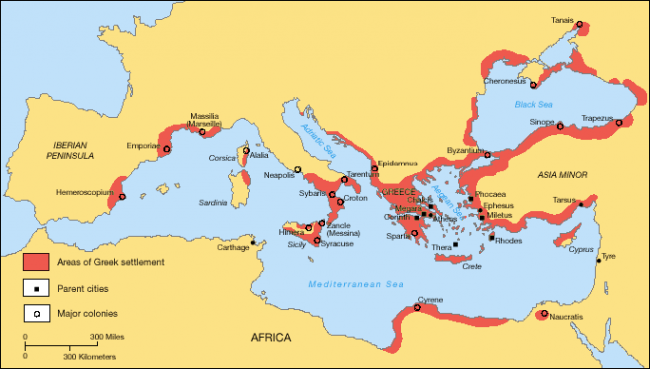
Map of Greek colonies - source Wikipedia
These overseas City-States considered themselves “Hellenic”, some more so than the mainland. The Greek trading posts or colonies were collectively known as “Magna Graecia, a name given to them in the Hellenic Period by the Romans. Also Greek coinage had come into use to support the widespread trading.
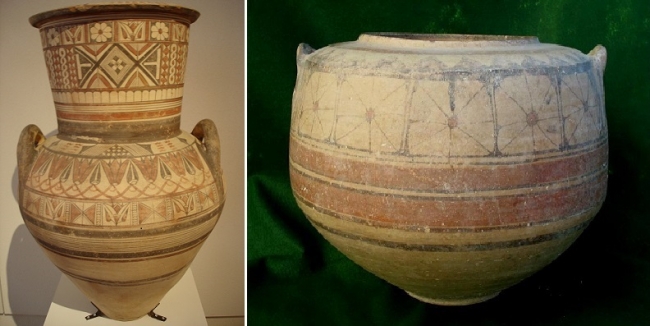
Cypriot amphora, source Archaeological
Museum, Athens, and stamnos, source
Collector-Antiquities, both 750-600 BC
Imported luxury wares such as ivories, metalwork and embroideries influenced the decoration on pots. Human figures also appeared a little later, but they were distorted with triangular torsos and wasp waists. The geometric patterns became very busy as if all gaps had to be filled. By about 750 BC the bands of birds and animals, including double triangle representations of butterflies, became rather better laid out and balanced. This was also the time of Homer and painted pottery started to use themes from epic poetry such as the Iliad and Odyssey as their subject matter. These heroic stories were important for the Greek sense of identity. The account of the Trojan Wars in particular provided a focus as the first united Greek expedition against an “eastern enemy”.
| Page: 262 of 418 Go To Page: | |
◁◁ First | ◁ Previous | Next ▷ | Last ▷▷ |
Author: Dr. Stan Jones © Copyright 2010 -