

10. European Pottery to the Fall of the Romans
| 1025 Page: 263 of 418 Go To Page: |  |
◁◁ First | ◁ Previous | Next ▷ | Last ▷▷ |
Written messages were inscribed on pottery from about 750 BC indicating the donor, owner or the occasion depicted. As an example, a pot made in Rhodes around 735 BC with inscriptions in Euboean dialect script – one of the oldest existing examples of Ancient Greek writing - went via Euboea (the traders and transporters) to the Italian island of Pithecusae, off Naples. Here it was thrown into the flames of a cremation pyre of a young boy and all the remains deposited in the family plot in the necropolis at Valle di san Mantari. It is known as the Nestor Cup as the inscription contains a reference to the golden Mycenaean cup of the same name referred to in Homer’s Iliad. Another example, dated to 700 BC, is an inscription on a Lecythus by a child, stating, “I am Tataia’s flask and whoever steals me shall become blind”. Much of the written material from the many parts of the Greek world prior to 400 BC and especially the first generation of writing prior to 650 BC was text on pots.
Towards the end of the geometric period (around 725 BC), the human figures became rather more natural. Up to this time other Greek cities followed Athens lead in pottery design, but now they started to diverge. The decoration was modified to suit their Culture, such as grotesque winged figures from Sparta (the Doric influence). Sparta, as with other Doric cities, had very strict military rules to live by, very focussed on physical training and they used slaves for reading and arithmetic. This vigorous Culture transferred its dynamism into its pottery decoration. In Athens, their potters painted large ambitious compositions, which might have laid the foundation for the subject matter of later Attic black-figured vases. Some pots were decorated with scenes of pottery making, showing the potter’s wheel and other contemporary equipment. Other pots were decorated with scenes of chariots with two then four horses, horsemen, sea battles with biremes (warships with two rows of oars) and ostentatious funeral processions. Athenian patrons commissioned potters to decorate pots with themes referring to aristocratic activities such as horse training or battles on land or at sea, especially for grave goods, but also they sought fine pottery for their feasts.
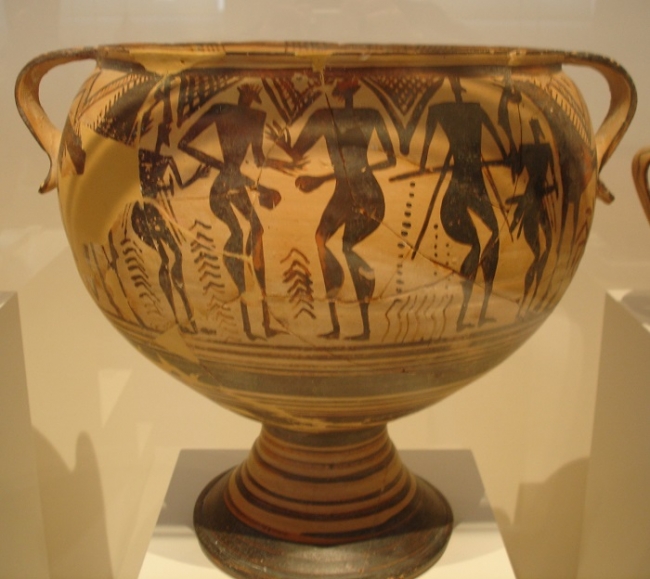
Pedestal krater depicting a boxing match
690-670 BC - source Archaeological Museum,
Athens
Quantities of large amphora and krater masterpieces, decorated in the Geometric style, were set up as markers for the graves of Athenian noblemen, as at the Dipylon cemetery. These designs established the figural painting that continued to the end of the Classical Period (480-330 BC).
After about 725 BC, the renewed contact with the Middle East, which started at the beginning of the 8th century, stimulated the designs of the Greek potters. At this time their export emphasis was particularly focussed on vessels for eating and drinking together with ones for ceremonial use.
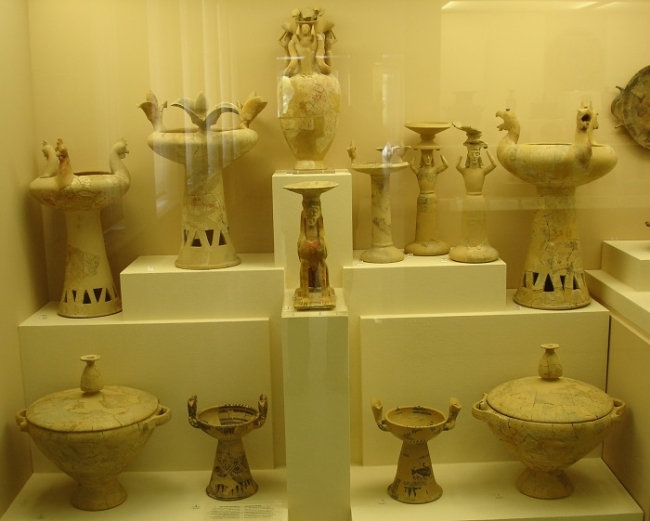
Funerary offering discovered in a ditch,
660-650 BC - source Kerameikos Museum
Around this time, however, probably because of its geographic position between two seas, Corinth took the lead from Athens in this “oriental” trade and its influence on art, producing rather heavy, but well shaped, large decorated vessels.
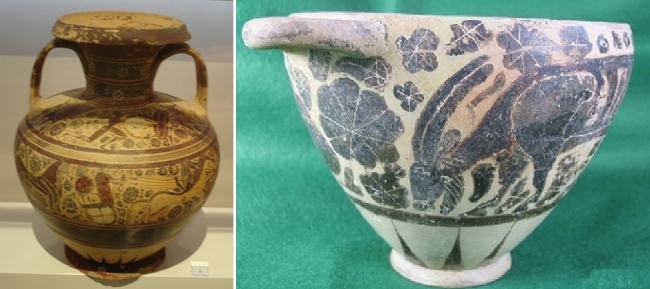
Corinthian amphora and skyphos, 600 BC -
source Archaeological Museum, Athens and
Collector-Antiquities (reproduction)
The Corinthian potters also specialized in smaller vessels, especially the scent bottle or aryballos that found a receptive market throughout the Mediterranean region. Accordingly, the decoration of these miniatures was more oriental, based on flora and fauna of Levantine art.
| Page: 263 of 418 Go To Page: | |
◁◁ First | ◁ Previous | Next ▷ | Last ▷▷ |
Author: Dr. Stan Jones © Copyright 2010 -