

10. European Pottery to the Fall of the Romans
| 1026 Page: 264 of 418 Go To Page: |  |
◁◁ First | ◁ Previous | Next ▷ | Last ▷▷ |
It also appears that some designs were based on Syrian/Phoenician metalwork. Friezes were made up of processions of real and mythical animals such as griffins, sphinxes, eagles and lions, with subsidiary lotus flowers and palmettes.
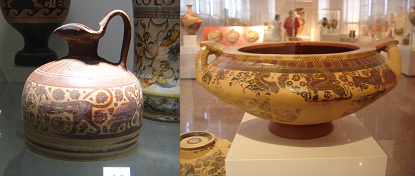
Earthenware wine jug, Corinth 600 BC - Image
courtesy of the Potteries Museum and Art Gallery,
Stoke-on-Trent and an “Anagyrous” from
the late 7th century, source Archaeological
Museum, Athens
There was also greater use of colour. It was on these “proto-Corinthian” vases that the first examples of “black-figure” style decoration were seen. The local Corinthian clay was buff and they used this to great effect. The figures were drawn in black on the buff body together with red, white (kaolin) and purple painted details; other details were incised with a sharp tool into the black painted areas when leather hard (but not too dry or the incisions would crack and become rough), to expose the buff body beneath. The white is used for linen garments, shiny parts of armour, nude females and objects such as white horses, but was not robust and tends to wear and flake off. Heavy drapery was emphasised by applying the black paint more thickly, producing a purplish or green tint, whereas thinly painted areas came out red/brown.
Similar styles arose in other regions but in time they diverted from the standard as they became politically independent city-states. Athenian potters continued to do their best work on large funerary vases and their emphasis remained human figures. By 600 BC pottery with black painted figures was being produced throughout Attica.

Black figure painted pottery, 600 BC -
source Olympia Museum
Now Athens had again become the principal centre of Greek pottery manufacture having taken over Corinthian overseas trade. The potter’s area in Athens was called the “Kerameikos” where there were a number of workshops, small and large. The Athenian potters had improved their technology, including enhancing the red body surface by adding ochre to their clay. They also had improved the shiny black, pigmented slip so that it was more lustrous than anything achieved before. This slip was a development of the very pure, fine clay mentioned earlier that, because of its iron and alkali content and the previously described firing regime, acquired its lustrous black colour. The Greeks made good use of various slips, mainly black, red and buff. Their magnificent painted pottery vases were initially decorated in the “black figure” style, in which the decorative design was painted in shiny black slip onto the orange/reddish clay.
Workshops were set up with strong Attic influence to serve local markets, notably in South Italy and Etruria – described later. Vessels from Rhodes were known as “wild goat” after their favourite frieze animal. In Eastern Greece during the ‘archaic” period (around 650 to 480 BC), the potters also made interesting grave goods and painted terracotta sarcophagi for burials, together with some magnificent ceramic architectural items.
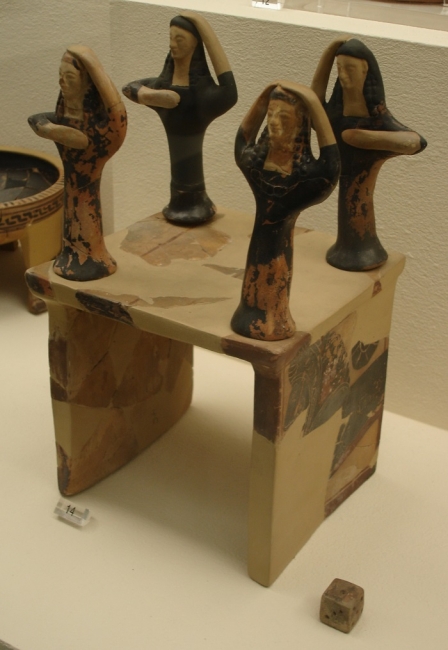
Miniature gaming table and dice, four
mourners on corners, 580 BC - source
Kerameikos Museum
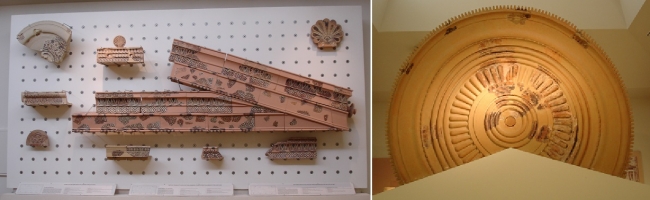
Large ceramic architectural items, from the façade
of the treasury building and the 8ft diameter apex of
the Hera temple 600 BC - source Olympia Museum
By 550 BC astounding developments in art, literature and philosophy began to develop and Greece started to enjoy a golden age. Artists produced beautiful statues and finely fashioned and painted ceramic vases. Greek philosophers started to think about the nature of the universe and develop theories in mathematics, physics, acoustics and astronomy. Around 600 BC Thales of Miletus (Ionia) had not only developed theories in geometry, but was also the first to record his observations of the generation of an electric spark when he rubbed ebony with fur. Thales and Pythagoras visited Egypt, absorbing and subsequently developing Egyptian science and philosophy.
| Page: 264 of 418 Go To Page: | |
◁◁ First | ◁ Previous | Next ▷ | Last ▷▷ |
Author: Dr. Stan Jones © Copyright 2010 -