

10. European Pottery to the Fall of the Romans
| 1027 Page: 265 of 418 Go To Page: |  |
◁◁ First | ◁ Previous | Next ▷ | Last ▷▷ |
The practice of signing vessels probably started in the 8th century BC but became more common in the 6th. The signature was of the potter, painter or both. In particular one of the first Attic black-figured vases with inscriptions of the maker and painter gave the earliest evidence that the tasks were usually split. It occurred on a large krater called the Francois Vase dated to 575 BC that was found in Italy in an Etruscan tomb. It contained two signatures Ergotimos (the potter) and Kleitias (the painter) and it was decorated with 200 figures in friezes. It resides in the Archaeological Museum, Florence. There were probably twice as many pieces signed by potters as by painters, so if the painter’s name is not known it is conventional to refer to him after the potter he usually partnered, for example the Amasis painter or the Antimenes painter.
These vases were decorated to show figures – particularly heroes and gods, especially Heracles (Hercules), Theseus and Dionysus.
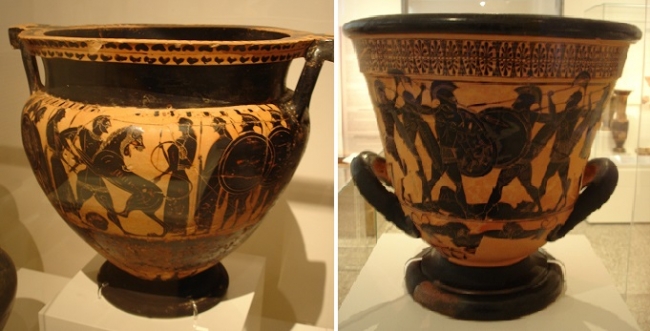
Attic black figure vases, Hercules and lion, and a
Homeric battle 550-530 BC - source Archaeological
Museum, Athens
They also depicted events and a multitude of daily happenings, so they are exceptional sources of information on Greek life, especially in Athens. Large-scale mural paintings adorned great buildings, now almost totally lost, but can be imagined from depictions on the durable pottery. The finest of the Athenian (Attic) black figure vessels were made between 550 and 520 BC, influenced by contemporary sculpture. The greatest potter of this time was Exekias who managed to portray figures with action, mood and emotion.
In the late 6th century BC Athenian potters invented “red figure” style, in which the design was outlined or reserved in the red body and the surface outside the design filled in with black slip, leaving the figures red. To start, the vase painter incised, or drew with charcoal, the preliminary drawing on the vase in its leather state. These contours might then be finely drawn over with the black slip. Whereas for black-figure style the figures were filled with black slip leaving the background unpainted, for red-figure style the background was painted black and details on the unpainted figures made with a fine brush. The brushstrokes were more precise and amenable to the artist’s skill than the incisions used with black figure style. Additional colours were obtained from selected clays to produce white, red, violet and yellow, which were reasonably resistant to firing, although faded with time. Further colours added after firing providing green, blue and pink. These forms of decoration were usually limited to the amphora, kylix, krater and hydria body shapes. These vases were so popular they were also made within Greek colonies and outside the Greek World.
With the introduction of this red-figure technique around 530 BC the best artists transferred to it, as it permitted more natural treatment of human bodies. After 500 BC only a few important black-figure vessels were made, although black figure pottery continued to be made up to the 2nd century BC. During the black figure period many potters might also be painters, however, the crafts increasingly split for red figure ware, possibly because of the greater volume needed. Some painters even restricted themselves to certain body shapes, such as cups.
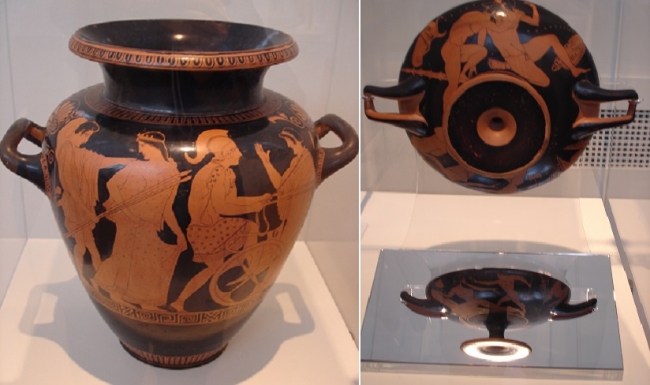
Attic red figure vessels, funerary urn with Helen’s
abduction by Theseus and Hercules fighting a giant,
500 BC - source Archaeological Museum, Athens
The red figure technique allowed the red-figure artists to achieve more lively and realistic results, as different figural perspectives were feasible other than profile, and they even became adept at conveying the illusion of a third dimension in their depiction of figures in elaborate drapery. The best red figure work was carried out between 500 and 480 BC, depicting a wide variety of poses in scenes recording daily life as well as subjects as diverse as athletics and drinking parties incorporating mythical satyrs. The painters strove to achieve perfect proportions in their figures, and anatomical details became amazingly accurate. Figures now fill the vase and are portrayed with great expressiveness and power.
| Page: 265 of 418 Go To Page: | |
◁◁ First | ◁ Previous | Next ▷ | Last ▷▷ |
Author: Dr. Stan Jones © Copyright 2010 -