

10. European Pottery to the Fall of the Romans
| 1028 Page: 266 of 418 Go To Page: |  |
◁◁ First | ◁ Previous | Next ▷ | Last ▷▷ |
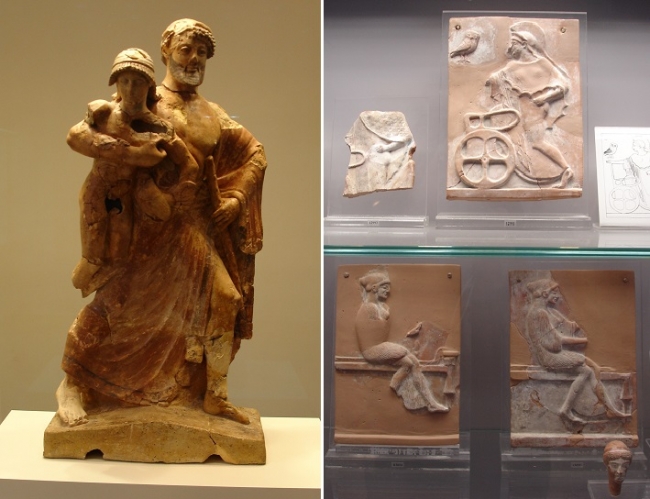
Large figure group of Zeus and Ganymede,
Corinthian, 500 BC source Olympia Museum,
and mould made plaques, 500-480 BC, source
Archaeological Museum, Athens
During this “Late Archaic” period new shapes appeared including the psykter (a bulbous wine container with tall foot to stand in a krater full of ice) and pelike (a two handled vase with a wide mouth), and large decorated kraters and amphorae became popular. Around 500 BC the Greek potters used a lathe to “turn” slender pots such as lecythoi to form them when leather hard, as if wood, and a small indentation would be visible at the centre of the base where it was fixed to the lathe. A yellow ochreous wash would then be brushed over them to produce a glossy red/orange colour. Some decorative banding would also be applied in the lathe. A huge amount of the Athenian decorated pottery was exported and avidly collected by the richer people throughout the Mediterranean. As an indication of the volume some 40,000 Athenian red figure vases and major fragments survive today. In the majority of houses of the 5th century BC, apart from wooden furniture and a few bronze trinkets, almost all household goods from lamps to cooking pots, tiles, figures and toys were made of pottery.
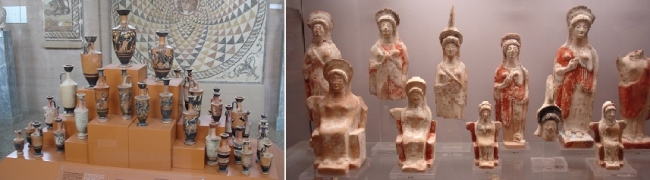
Corinth Attic funerary pottery, 5th century BC,
source Olympia Museum and white slipped and
brightly painted offerings for poorer people,
520-480 BC, source Archaeological Museum, Athens
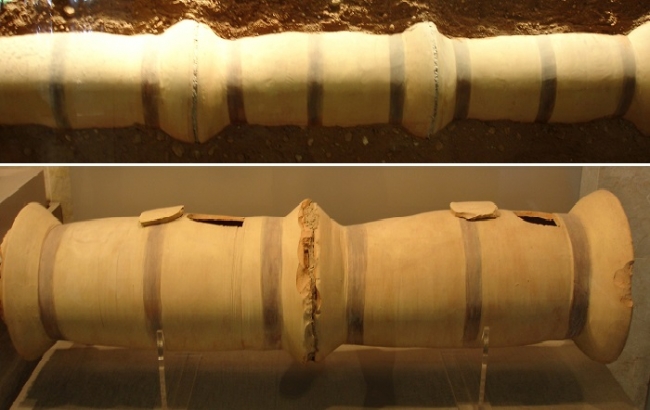
Pottery aqueduct pipes with inspection
holes, end 6th century BC
Grave goods and temple offerings were appropriate to status with sizeable collections of the best pottery for the rich, with fewer and cheaper items for the poor. The water supply system was very sophisticated using pottery pipes.
On mainland Greece, around 500 BC, democracy included a voting system that included all “adult male Citizens”, who voted for many issues, including government posts. The voting was implemented by a Citizen writing his wish on a pottery shard, (the Greek “ostracon”), as the cost of scrolls of papyrus from Egypt was so high. Sometimes the issue was to banish a certain Citizen, as he had become unpopular – hence the term “ostracise”! Typically of the 30,000 voters some 6,000 in favour would get someone excluded from Athens for 10 years. Also juries were introduced into the legal process.
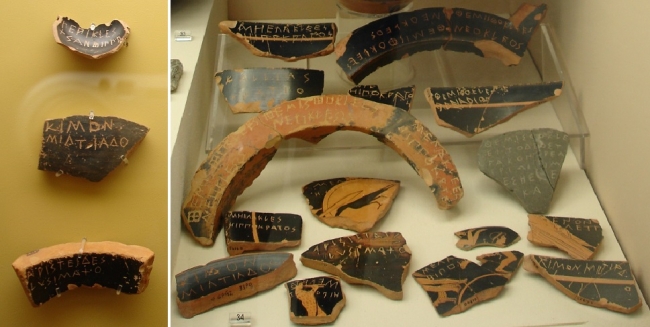
Ostracism sherds, 5th century BC - source
Archaeological Museum, Athens and
Kerameikos Museum
There were still battles between the city-states, and eventually two major ones ruled all the others, Sparta, with its exceptional prowess in fighting land battles, and Athens specialising in sea warfare. These two continually squabbled unless they had a common enemy when they joined as formidable allies. The first Persian invasion of Greece was in 490 BC and was repelled at the battle of Marathon. In 480 BC the Persian Empire sent a second huge army to invade Greece with a vast fleet of ships. Key to the defence was the 300 Spartans, supported by some 1,000 Thebans and Thespians who held back the entire Persian army at the narrow Thermopylae pass for three days, while the Athenian navy routed their fleet. However, during the battles the Persians were able to sack Athens twice, in 480 and 479 BC, albeit after its population had left. In spite of this, Athens went on to became the most powerful city-state with its large navy that was financed by tribute from city-states representing some 260 towns, which were all part of an anti-Persian Confederation. In the resulting peace the Classic Age took off. In this Classic period (478-330 BC) artistic achievement in pottery was surpassed by sculpture, and tableware in precious metals was the most prized by the rich, however Attic vase production continued apace. Compositions became simpler, but details such as the folds of clothing appeared more natural.
| Page: 266 of 418 Go To Page: | |
◁◁ First | ◁ Previous | Next ▷ | Last ▷▷ |
Author: Dr. Stan Jones © Copyright 2010 -