

10. European Pottery to the Fall of the Romans
| 1029 Page: 267 of 418 Go To Page: |  |
◁◁ First | ◁ Previous | Next ▷ | Last ▷▷ |
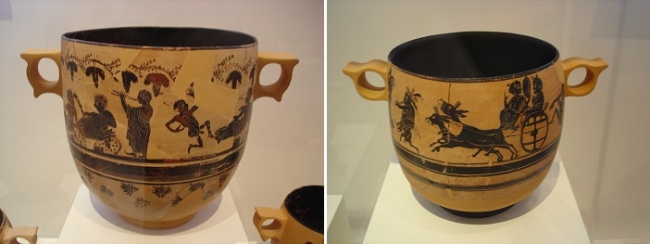
Black figure skyphos from Kabeiric, Boeotia, 400 BC
- source Archaeological Museum, Athens
Later, depictions of emotional and erotic scenes became popular together with the striking use of white and gold. In Athens, concurrent with producing red figure wares, they also produced white ground wares at the end of the 6th century BC. By the middle of the 5th century BC the white lecythus, the small one-handled jug for funeral oil that was placed on graves, became very popular. The whole vessel was slipped in the primary white clay, kaolinite, while the pot was still on the wheel. It was a good surface to carry colours so the lecythoi were decorated in matt polychrome, and the subject matter often referred to the dead person.
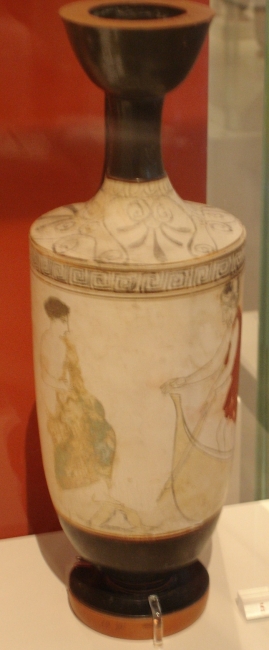
White Attic lecythus,
425-400 BC, part of
mature classic period
- source Archaeological
Museum, Athens
Several further battles took place against the Persians, but individual city-states continually wanted to regain their independence by leaving the Confederation. The Athenians would not permit this and so the other city-states were forced to submit to them, and by 454 BC the Confederation had transformed into the Athenian Empire.
A large chryselephantine (gold and ivory) statue of Zeus was made by Pheidias in 432 BC that had large parts of the clothing made of glass, using ceramic moulds. Similarly moulds were used to produce pottery plaques.
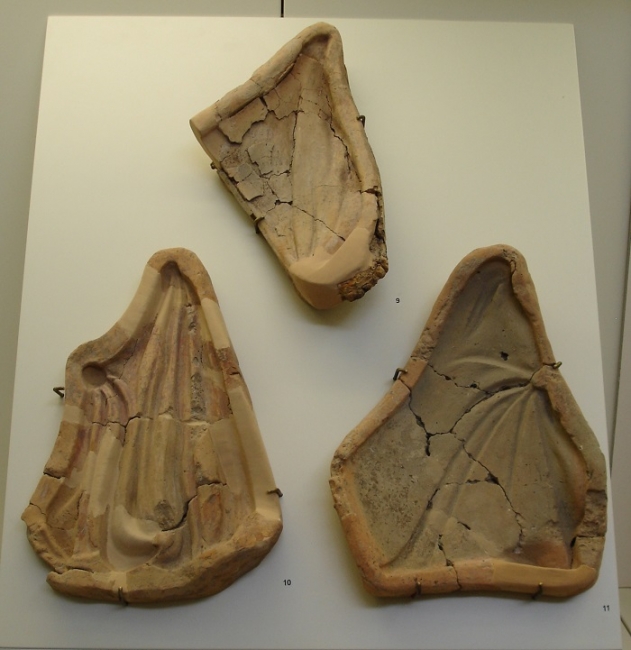
Moulds for Chryselephantine statue of
Zeus, 432 BC - source Olympia Museum
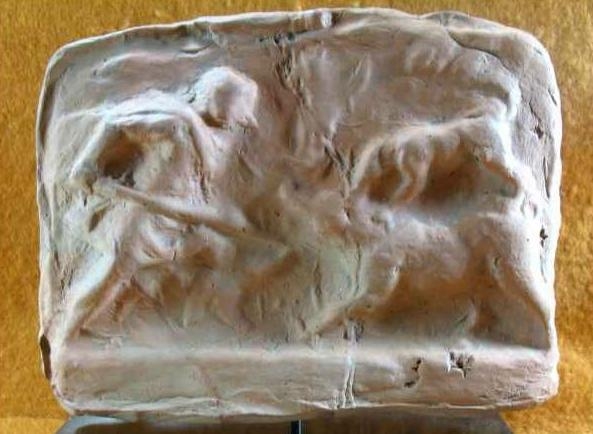
Plaque of boar hunt 4th-3rd centuries BC
- source Collector-Antiquities
Although Greater Greece was huge and potentially powerful, the continued desire for independence by its city-states made it difficult to unite against their common enemies, and Greece continually suffered from fragmentation and internal fighting. There were further confrontations between Athens and Sparta, referred to as the Peloponnesian War, which seriously weakened them both, killing tens of thousands of Greeks. (This constant disruption from 431 to 404 BC had a deleterious impact on the quality of pottery). In 404 BC Sparta defeated Athens with the help of the Persians! – ending the Athenian Empire. However, the Spartans were not equipped to run an Empire and so they sued for peace with the Persians. This “Kings Peace” of 387/6 BC gave Persia control of all Asiatic Hellenic city-states and Cyprus, (putting their Satraps in charge), making the other islands autonomous, and the Persian ruler became “Arbiter of Greece”.
From 370 to 340 BC a style of painted pottery called “Kerch” dominated that now had richly ornate, crowded compositions, usually of tall elegant people, and some added colours such as blue and green. Scenes from female life became common, and thin, applied relief figures were attached to the vase body. However, vase painting then became rather more mundane and not long after 330 BC red-figural painting had died out altogether in Attica, possibly because it was then controlled by Alexander, but continued for some time in South Italy, where it was produced in large quantities to adorn the palaces and villas of Roman nobles.
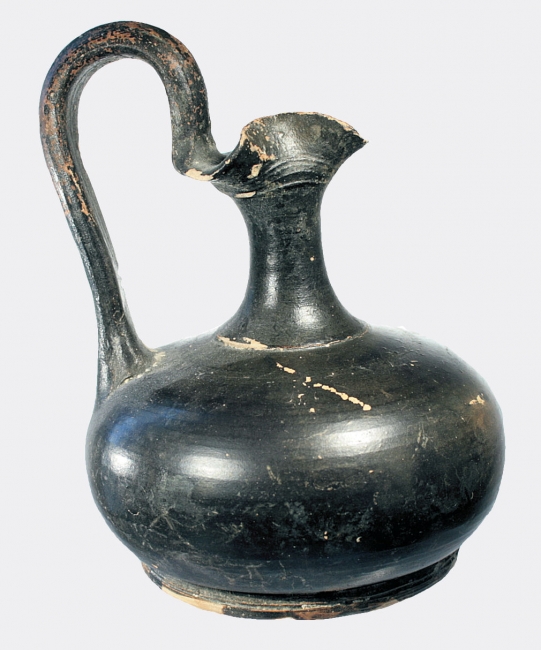
Black lecythus, 4th century BC - source
Helios Gallery Antiquities
Athenian potters also produced great quantities of plain black painted wares. Building materials such as floral tiles to cover the ends of rafters used in temple roofs (antefixes), loom weights and even beehives were made out of pottery in the 4th century BC.
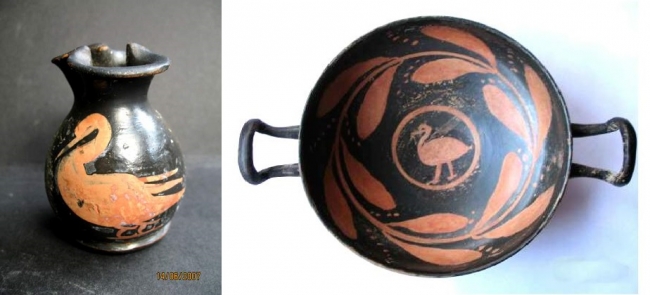
Italian red figure, miniature oenochoe,
early 3rd century and Kylix, 325 BC
- source Collector-antiquities
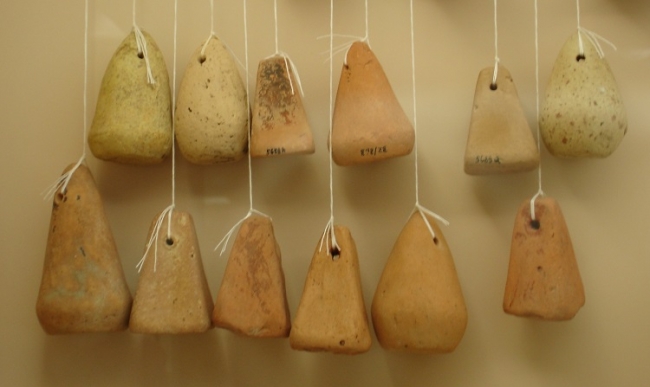
Loom weights 430-200 BC - source
Kerameikos Museum
| Page: 267 of 418 Go To Page: | |
◁◁ First | ◁ Previous | Next ▷ | Last ▷▷ |
Author: Dr. Stan Jones © Copyright 2010 -