

10. European Pottery to the Fall of the Romans
| 1037 Page: 275 of 418 Go To Page: |  |
◁◁ First | ◁ Previous | Next ▷ | Last ▷▷ |
Early in the first millennium BC, the decoration on some pottery vessels was by raised designs (appliqué), applying separately made ornamentation such as “knops” (decorative knobs) to the vessels prior to firing. A bull-shaped pouring vessel from the 7th century BC from Bologna had on its back a horse-mounted warrior – clearly ritualistic. The incised, early Greek-like decoration of lines and circles on this and other pots indicates a possible common ancestry from Central Europe. Double vessels probably contained food offerings for the dead.
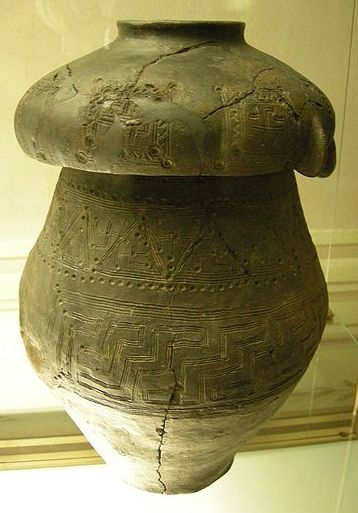
Villanovan bi-conical cinerary urn,
Chiesi, Italy, 9-7th centuries BC - source
Wikipedia Sailco
The Villanovans were an early phase of, or were replaced in the Tuscan Region, around the 8th century BC by one of the great ancient Cultures, the Etruscans, although Villanovan Culture continued in the Po Valley into the 6th century BC. Their origin and development is obscure as they were not Indo-European but had a language and Culture very different from the other Italian tribes at that time. Their language has still not been deciphered and there are no surviving literary works, so information on them is from Greek, Roman, Egyptian and Middle Eastern written accounts. Etruscan was the third most significant language to be used in Italy after Latin and Greek. The few written records that do survive only exist as inscriptions on funerary objects, cremation ash urns, in tombs, on coins and pottery. There are many pots with inscribed names, numbers and symbols using the Greek alphabet. The longest text found contained 1,300 words of text in black ink on linen, but it was found in Egypt cut into strips and wrapped around a mummy! There is also a useful bi-lingual text of 40 words in Etruscan and Phoenician on gold plaques; however, it is still impossible to understand the meaning of the text, as it is so different from other languages. Accounts from later Greeks suggest that the Etruscans might have migrated to Italy from Lydia, Anatolia, possibly around 1,100-1,000 BC, to escape famine. Very recent genetic studies indicate that the Etruscan people and their cattle have similarities to those in the Middle East rather than Central Europe.
Another Italian tribe that became important as a maritime trader and later colonist was the Veneti, who lived in the area around Venice in North East Italy. They were trading ceramics, glass and amber round the Adriatic coast around 1,000 BC. They traded with the Etruscans, from whom they obtained their alphabet, and traded for horses north of the Alps with the Celts.
The Etruscans became rich from farming and trade, and between 700 and 500 BC became the most powerful nation in Italy before the Romans expanded, and its first great Civilisation. They were organised as a confederation of the twelve most important city-states, and they had contacts with a variety of external peoples including the Greeks. We would know a lot more about their culture if the 20-volume history of the Etruscans that Emperor Claudius is reputed to have written existed, but it is lost. One thing we are aware of is that Etruscan women were far more liberated than Greek or Roman women.
| Page: 275 of 418 Go To Page: | |
◁◁ First | ◁ Previous | Next ▷ | Last ▷▷ |
Author: Dr. Stan Jones © Copyright 2010 -