

10. European Pottery to the Fall of the Romans
| 1038 Page: 276 of 418 Go To Page: |  |
◁◁ First | ◁ Previous | Next ▷ | Last ▷▷ |
A major reason for the development of the Etruscans into a significant Empire was the plentiful supply of indigenous metal ores (notably copper, iron and tin), their embracement of the Iron Age and a plentiful supply of wood for smelting and shipbuilding – they were rather notorious pirates! Agriculture was also a substantial industry. They expanded in this period with mighty city-states as far north as Mantua and south as far as Naples, including their domination of Rome, which was ruled as a kingdom. The Etruscan kings erected great buildings in Rome and around 600 BC created a sewer system to drain the marshes and get rid of waste that is still in use today. They attempted to expand further, but were prevented by the Celts in the north and by the other Italian tribes in the south. Etruscans were noted for their developments in cities that, in addition to the sewers, had public buildings, water systems and broad roads; particularly the development of the North/South road grid system at the end of the 6th century BC, which was later adopted by the Romans for their new cities. They were also noted for their metalwork and pottery.
Their buildings were decorated with painted, press-moulded ceramic panels, an Etruscan specialty copied later by others, together with the terracotta antefixes (mentioned earlier and used to mask the ends of wooden beams) that were moulded with various motifs including faces, and painted in bright colours.
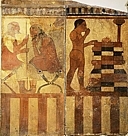
Etruscan wall cladding
- source Huntfor
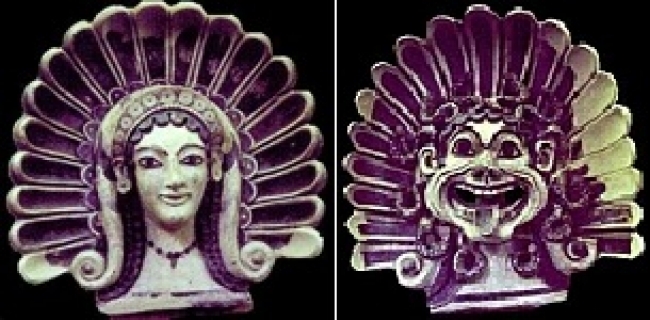
Etruscan antefixes - source Huntfor
There were also many painted (probably after firing) or gilded terracotta statues adorning the pediments surrounding the ceramic tiled roofs of temples. These included life-sized hollow ones of males, females and other animals such as those found in the site of a huge building near Sienna. Producing these large figures would have been a huge problem for the potters. They would have been moulded in pieces and joined together. Large models used to decorate sarcophagi were very realistic, took great skill and some were of remarkable quality.
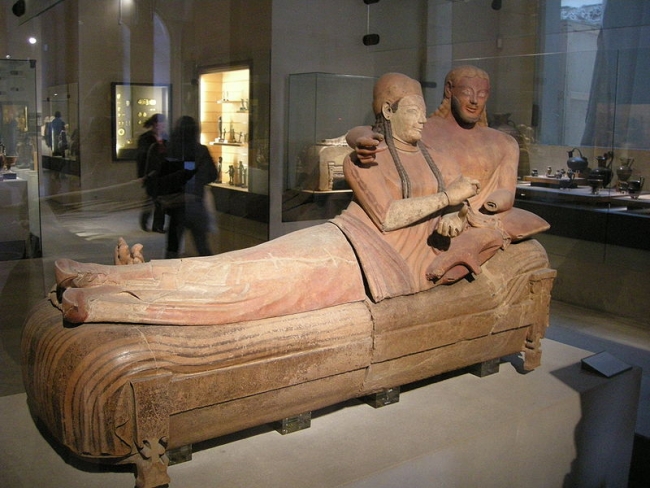
Etruscan sarcophagus, 520 BC” source
Louvre Museum
Later, the Etruscans made ceramic “death masks” that were very realistic, based on a plaster mould made from the face of the deceased, such realism was not a characteristic of the Greeks, who influenced other aspects of their pottery. Architectural and statuary ceramics was a large industry, and mass production techniques were developed in the 3rd century BC especially for tomb decoration.
Probably the first significant Etruscan ware dated to the 8th century BC was called “bucchero”, which was fired under reducing conditions resulting in the clay becoming dark grey throughout. The surface that fired black or grey was carefully hand burnished before firing to impart the characteristic shine, resembling metal. It required great skill to achieve the quality of wares discovered, and they were often expensive funerary gifts. The earliest examples from the 8th century BC were decorated with incised or engraved geometric patterns.
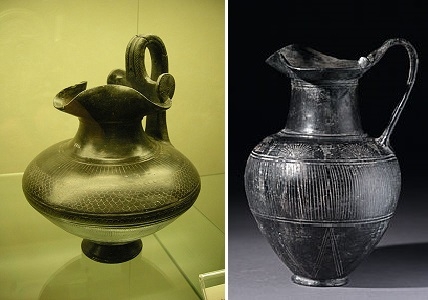
Etruscan bucchero oenochoe 8-7th centuries
BC - source Wikipedia Sailco, and another
7-6th centuries BC
Bucchero ware started by being hand made then it was made on a wheel with thinner walls. As time went on they were influenced partly by Greece, particularly the new shapes, but also from further east via Carthaginian traders. By the 6th century BC, engraved decoration included birds, animals, hunting scenes and banquets, often as friezes, as well as geometric patterns such as spirals. Body shapes were imaginative, such as jugs depicting cocks, with a small pierced handle on their backs for hanging, and vessels with models of animals or birds on their lids. It is likely that Greek potters had workshops in the major Etruscan cities by this time.
| Page: 276 of 418 Go To Page: | |
◁◁ First | ◁ Previous | Next ▷ | Last ▷▷ |
Author: Dr. Stan Jones © Copyright 2010 -