

10. European Pottery to the Fall of the Romans
| 1039 Page: 277 of 418 Go To Page: |  |
◁◁ First | ◁ Previous | Next ▷ | Last ▷▷ |
The Etruscans are also noted for decorating their pottery vessels with relief ornamentation by rolling the soft clay with a cylinder having the “negative” design recessed in its surface (a roulette). The principle is similar to the Sumerian cylinder seals. They also stamped decoration onto the leather-hard body, using wood or ceramic stamps, sometimes using “oriental” style fabulous animals. They produced vases with covers in the shape of a human head with arms threaded through fixed ring handles. These were used for funerary purposes until the mid-6th century BC. At about this time they also adopted the Greek black pigment to paint their pots.
Around 770 BC, Greek traders from the Euboean Island to the East of mainland Greece established a settlement at the previously mentioned Pithecusae on Ischia, the largest island in the Bay of Naples, to trade with the Etruscans. Evidence exists of a previous Mycenaean settlement there. There was also evidence of iron working at Pithecusae, supporting the idea that the Greeks were looking for sources of metals. These settlers were the first lasting contact between the Etruscans, the later Romans, and the Greeks. It was from the time of the first Greek settlers that more information on the Etruscans was forthcoming. Their contact with the Greeks, and similarly with the Phoenicians, encouraged new ideas, technology and materials, such as the potters wheel and faience. The Greek alphabet was introduced and adapted to Etruscan phonetics. It spread throughout Italy, later being adapted by the Romans for Latin. The Euboean Greeks from Cyme also set up a city on the Italian mainland called Cumae around 750 BC that became one of the greatest cities of the Greek world. Even Sparta set up Taras (Taranto) in South Italy that was to become an important centre of resistance against the Romans. Greek style pottery was produced in these cities with Proto-Corinthian ware being copied with great accuracy as early as 700 BC. By 650 BC there were at least 15 Greek sponsored city-states in Italy.
The Euboeans also set up Naxos in Sicily in 735 BC, and the Dorians of Corinth set up Syracuse on Sicily in 734 BC. The Phoenicians had settlements on West Sicily, but there was peaceful co-existence until 565 BC when a Carthaginian army landed but was repulsed, and a much greater army of 300,000 soldiers landed around 480 BC to be met by the Syracuse leader Gelo whose army repulsed them again. At this time Syracuse was the most powerful city-state in the Hellenic world, and Gelo a patron and supporter of fine arts.
The Etruscans soon picked up the latest ceramic technology and became adept at using the Greek black-pigmented slip. Stylised animal and human figures were painted in red, black and white on vessels using a pale body or on the Bucchero wares. By 550 BC they started to be replaced by copies of Greek wares, although several of the ancient Etruscan shapes continued, such as the sack-like Askos that was probably originally based on an animal organ. Almost universally around the middle of the 6th century BC the Greek colonists set up workshops to produced Attic style pottery, particularly Hydriai and Amphorae, mainly for the local market using Attic potters initially, but soon trained local craftsmen.
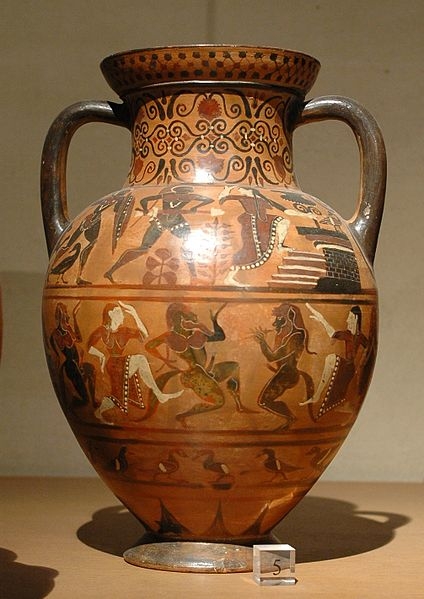
Etruscan amphora, Vulci, Italy, 540-530 BC
- source Louvre Museum via Wikipedia
By 525 BC the native designs on pottery were largely displaced by Attic-style decoration, although pottery with painted portraits of women is an example of unique Etruscan decoration into the 4th and 3rd centuries BC.
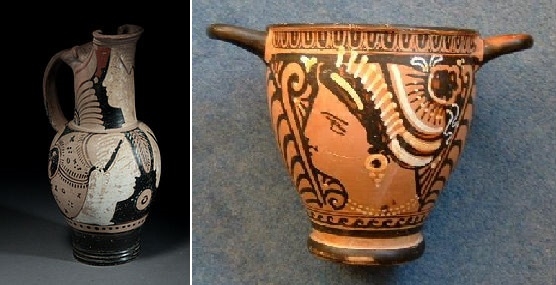
Etruscan red figure pottery, oenochoe 400
BC, and skyphos with woman’s head,
3rd century BC - source
Collector-Antiquities
The Romans later adopted this portrait style. They still imported some vessels, but most were local copies that they also exported.
| Page: 277 of 418 Go To Page: | |
◁◁ First | ◁ Previous | Next ▷ | Last ▷▷ |
Author: Dr. Stan Jones © Copyright 2010 -