

10. European Pottery to the Fall of the Romans
| 1040 Page: 278 of 418 Go To Page: |  |
◁◁ First | ◁ Previous | Next ▷ | Last ▷▷ |
Such large quantities of Greek pottery, both imports and locally made copies, have been found in Italy that archaeologists were at odds to explain it for decades. At the end of the 6th century BC the Etruscans were exporting goods including pottery to North Africa, Greece, Anatolia, The Balkans, France and Spain. Also in the late Archaic period around 500 BC, the Etruscans made life-sized pottery sculptures such as the figure of Apollo in the temple at Veii. Figures and busts were produced into the Hellenistic period.
Copies of the Attic black-figure vases were so good it was difficult to separate them from the originals. Later the decoration diverged from Attic styles and the vases were easier to separate from the originals, as the decoration was more elaborate. The Etruscan potters were one of the few groups outside Greece who also successfully copied red-figure vases. They started around 490 BC, but these first copies were quite different as they had an overall black slip that was overpainted red and white, requiring the figure details to be incised rather than painted. True red figure vases appeared around 410 BC, and of all the production centres outside Greece, it is only from South Italy and Sicily that red figure vases of the same quality as Attica were made. More than half the known red figure vases were made in Apulia, in the “heel” of Italy from about 430 to 300 BC. Early decoration illustrated athletic, mythological and life scenes, and uniquely, theatre scenes. Apulian vase painting also influenced the traditions of the other South Italian production centres.

Etruscan red figure vessels, lekanis 5th
century BC, and three Kraters - courtesy
Collector-Antiques
Both types of Etruscan “red” wares were produced not only for local use but also to export to markets such as Malta, Carthage and Rome. Taras became famous in the 4th century BC for its large, Greek style, elaborate funerary vessels called Basilican ware. They were red-figure with added white, pink, yellow and maroon. Although around 350 BC figure decoration declined in Greece and was replaced by ornamentation and floral motifs, the red-figure style continued to be produced in South Italy into the 3rd century BC.
The overall black glossy vases, which seems to have been produced from as early as 800 BC, reappeared and became popular around 300 BC. The Etruscans also produced very attractive black glossy vases (Gnathia) with white, yellow and red painted decoration, related to the red figure pottery, and polychrome (Canosa) vases that had a white applied slip with yellow, pink, red and blue paint, all applied after firing, therefore not hardwearing.
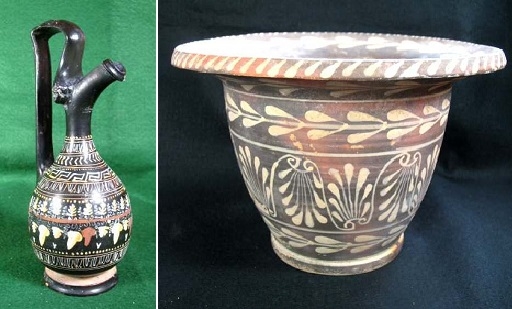
South Italian, gnathian prochus, 4th
century BC courtesy Collector-Antiquities,
and a Greek style bucket, 3rd-4th
centuries BC
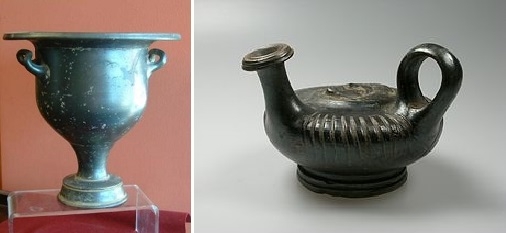
South Italian, black bell Krater 330 BC,
courtesy Collector-Antiquities and Apulian
Greek guttus, 200 BC
From the start the afterlife was important to the Etruscans. Aristocrat’s tombs were cut into the soft volcanic rock and appear as spacious houses complete with domestic objects including stone furniture, as well as very informative frescos including their view of the afterlife. The vases that were produced with covers in the form of a human head for funerary use continued until around 550 BC. From around this time until the 3rd century BC they built magnificent tombs that were full of “Greek” style painted pottery vessels, initially the ones probably made by the immigrant Greeks, but then Etruscan adaptations made locally became common. Similarly, the Etruscan terracotta sarcophagi showed significant Greek influence during the Archaic Period (660-480 BC) but then became localised.
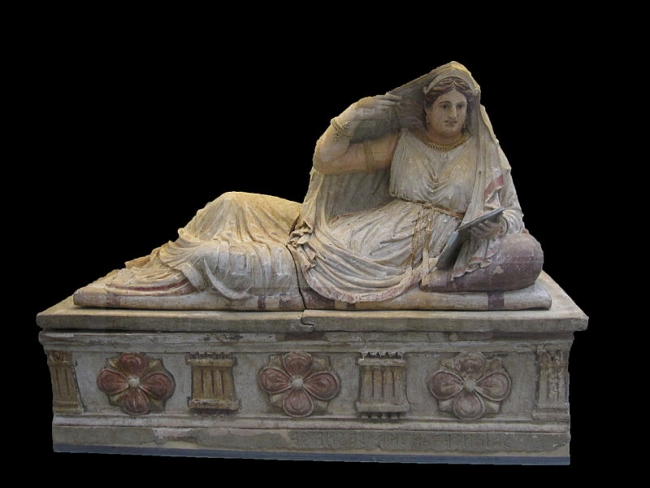
Etruscan sarcophagus 150-30 BC - source
British Museum via Wikipedia Ophelia
Summers
| Page: 278 of 418 Go To Page: | |
◁◁ First | ◁ Previous | Next ▷ | Last ▷▷ |
Author: Dr. Stan Jones © Copyright 2010 -