

10. European Pottery to the Fall of the Romans
| 1044 Page: 282 of 418 Go To Page: |  |
◁◁ First | ◁ Previous | Next ▷ | Last ▷▷ |
In the west, Spain was split into two provinces in 197 BC, imaginatively called “Nearer” and “Further” Spain. The Romans exploited its mineral wealth, as had the Phoenicians, Greeks and Carthaginians, especially its silver and copper from the Rio Tinto mines.
The third and final war against Carthage was provoked by Rome’s ally in North Africa, Numidia, by encroaching on Carthaginian territory. Carthage raised an army to resist but that was against the treaty, so Rome gave an ultimatum for the Carthaginians to abandon their city and move to a new one inland. This was rejected, so Rome crushed Carthage in 146 BC gaining a great deal of booty, enslaving 50,000 people, and made Carthage a Roman Province. All these provinces were ultimately ruled directly from Rome. By the end of the Carthaginian campaign in 146 BC, it is thought that 20% of the adult male population of Italy had been killed, with the Romans regularly raising armies 100,000 strong. This required large numbers of slaves to replace farm workers, and at the end of the Republic (31 BC), it is estimated there were one million slaves in Italy. The Romans learnt many things from the Carthaginians, including hydraulic technology, which was one of their specialities.
Rome’s income had been predominantly booty from victories and taxes from provinces, with relatively little exporting. However around 200 BC large landowners in Italy were exporting significant numbers of amphorae containing olive oil and wine to Gaul and North Africa.
Also around 200 BC Romans discovered crushed stone, lime and sand made of volcanic pazzolana would form a very strong building material when cured – they had invented concrete. This new technology made new structures such as large domes and aqueducts possible, as well as reducing building costs. The first paved road allowing vehicles to pass in both directions was the Via Apia connecting Rome to Capua started in 312 BC. In the Middle Republic the Romans started to build a network of roads throughout Italy. During this period there was a significant migration of people into Rome and from Rome into its Italian colonies. This increased social and cultural homogeneity.
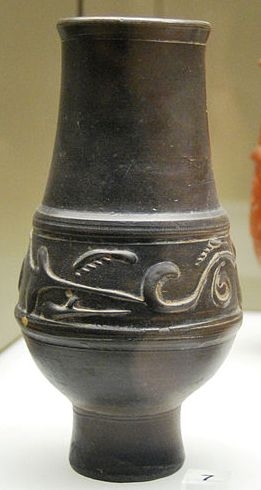
Roman terra nigra vase,
Cologne - source
Wikipedia (Hannibal21)
In the area around Naples in the late 3rd century BC they produced a rough, purplish-red ceramic ware with a hard metallic glossy finish, some were painted with white bands. Great quantities were produced between 200 and 30 BC and exported mainly to Western Mediterranean countries. Much finer wares were produced in former northern Etruscan areas and heralded later Arretine ware. In the mid 2nd century BC a buff bodied ware was produced with a black glossy finish, decorated with delicate rouletted bands and small stamps. Early stamps were made with signet rings. These black wares were known as Campana or Etruscan ware, although they were not the same as any earlier ware made by the Etruscans. Early in the 1st century BC reduction-fired grey-bodied wares appeared, with a simple firing process, often producing rather soft plates, many of which were found in Sicily. The Ephesus Region of Anatolia became a major producer of this grey ware. Polished black slipware was still produced in Anatolia, as were the Megarian moulded bowls. Pergamum produced a buff body with plum sheen and drinking vessels with applied decoration impressed from moulds with ivy or erotic motifs. They were black on the outside, and red on the inside and base, implying stacking in the kiln. In Gaul from 1st century BC to 1st century AD a black or silver grey tableware was made called Terra Nigra.
| Page: 282 of 418 Go To Page: | |
◁◁ First | ◁ Previous | Next ▷ | Last ▷▷ |
Author: Dr. Stan Jones © Copyright 2010 -