

10. European Pottery to the Fall of the Romans
| 1045 Page: 283 of 418 Go To Page: |  |
◁◁ First | ◁ Previous | Next ▷ | Last ▷▷ |
The amphora, the two-handled jar adopted by the Greeks, was used in huge quantities for transporting produce by the Romans from 250 BC, particularly the large versions (typically 3-4ft high). Many were of elongated form tapering to a solid toe designed for stowing on ships. Amphorae usually had a yellowish or light brown coloured body. Our knowledge comes from these often-complete amphorae found in large quantities in shipwrecks, and some in burials in peripheral provinces such as Britain, Gaul and Nubia.
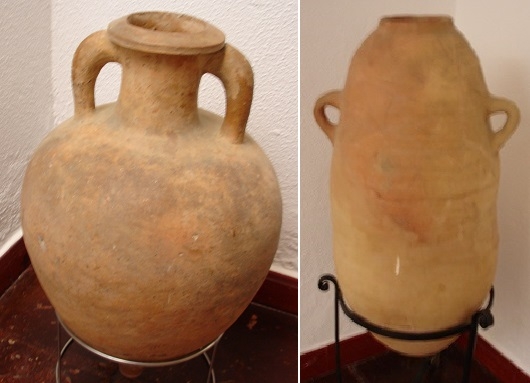
Amphorae in Spain 4th-2nd centuries BC
- source Museo Arqueologico, Seville
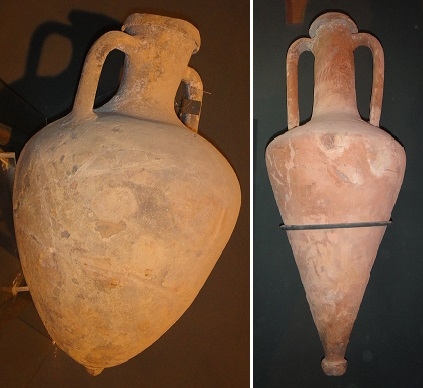
Shipwreck amphorae in Cyprus 290 BC
- source Kyrenia Castle Shipwreck Museum
Amphorae came in different shapes such as the heavy globular version from Southern Spain used for olive oil and the tall version used around the 1st century BC for wine in Etruria and Central Italy. Although shapes changed over the centuries, they were recognisable against their contents, which also included fish sauce and dates. Seals for the amphorae were made of plaster, wood or cork. Producers stamped the handles and inscribed or scratched the body identifying themselves, the contents or the shipper.
From the 1st century BC onwards, lead glaze was used on Roman earthenware, but intermittently, and more particularly in Anatolia, Egypt and Mesopotamia where they had the technology previously, before 200 BC. The vessel would be fired to biscuit, then glazed and fired again at around 900 degrees C. In general it was used on closed containers using copper and iron to give green, yellow and brown colours, but the glaze was thick and it ran in the kiln and cracked.
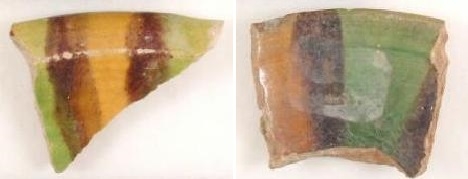
Glazed sherds from Hawara, Egypt, UC4594
and UC4595 - Copyright of the Petrie
Museum of Egyptian Archaeology, UCL
From the outset the potters in Pergamum and Ephesus achieved better quality glaze, no doubt because of their earlier experience. The only period that lead glaze could be considered common was in North Italy and the Danube region in late Roman times and Constantinople in the 7th and 8th centuries AD.
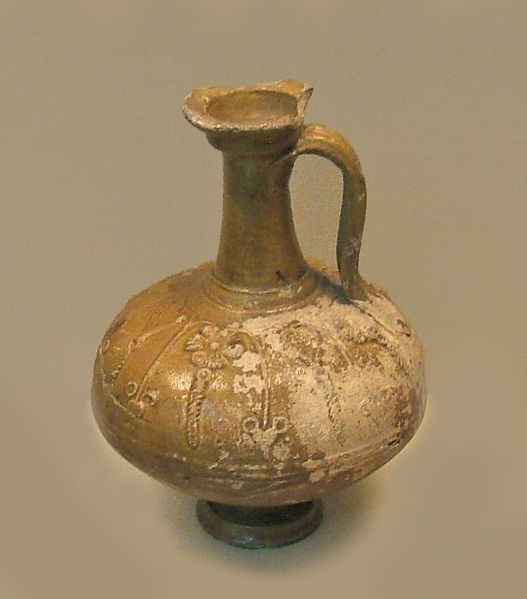
Glazed flagon from Gaul, 1st century BC
- source British Museum via AdTigress
The Romans also added lead oxide to their faience glaze mix in the 1st and 2nd centuries AD to enhance its gloss. The lead glazing technology spread throughout the Empire, reaching Italy and Gaul during the 1st century AD. Some green glazed vessels made in South Italy and dated to the 1st century AD have been found in Cyprus. However, the technology was lost to the West after the fall of the Romans, but was retained in Constantinople from where it became re-established in 11th century AD.
In the Late Republic (133-31 BC) war was pretty well continuous. “Barbarians” were targeted in Spain, Sardinia, Illyria and Macedonia. The Romans absorbed Asia Minor as a province in 129 BC, shortly after the death of the last king of Pergamum (having willed his kingdom to his allies the Romans).
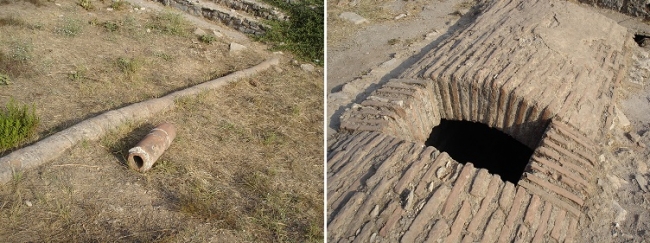
Roman watercourse and pipes, Ephesus, Turkey
The remains of Roman Ephesus show they had sophisticated water supply technology with aqueducts, brick watercourses with inspection manholes and earthenware pipes. Also found there were later terracotta toys, some with wheels and decorative plaques, probably grave goods, together with figures and many oil lamps. It was primarily a Greek city but became the Roman Regional Capital. Parchment was plentiful and there continued to be great libraries with Greek and Latin texts in Pergamum and Ephesus.
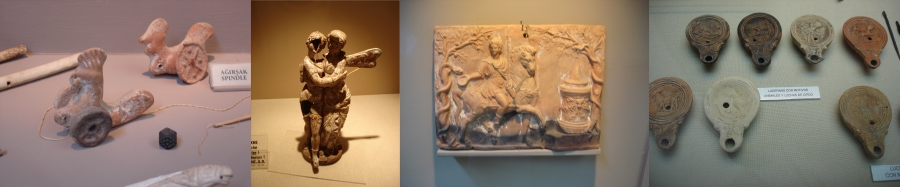
1st century AD, wheeled toys, figures and plaque
with horse, probably grave goods -
source Ephesus Museum, and Roman oil lamps
- source Museo Arqueologico, Seville
Ephesus was originally an important port, but excessive ploughing of the surrounding countryside caused serious silting of the rivers, and many of the major cities such as Ephesus became land-locked and miles from the sea. This increased the cost of transport for trade and the cities declined.
| Page: 283 of 418 Go To Page: | |
◁◁ First | ◁ Previous | Next ▷ | Last ▷▷ |
Author: Dr. Stan Jones © Copyright 2010 -