

10. European Pottery to the Fall of the Romans
| 1047 Page: 285 of 418 Go To Page: |  |
◁◁ First | ◁ Previous | Next ▷ | Last ▷▷ |
Generally the Romans did not bury pottery with their dead so this often-rich source is not as available to us. However, provincial burials, shipwrecks and shards provide plenty of examples. Roman interest in producing fine painted pottery was not as great as the Greeks, mainly because vessels in metal and glass were considered more important. Pottery hardly featured at all in texts, sculpture or mosaics. Although they appreciated and collected painted Greek pottery, much of their own production was good quality, standard wares so that distinguishing between fine and utilitarian was not always easy. Although Roman pottery was a pleasing combination of form and simple decoration, its standardisation meant there was little personal artistic input by the potters, unlike Greek pottery. Productivity was the key, especially using moulds to produce the relief decoration mechanically. Most Roman pots were thrown on a wheel and cut off with a wire, the vessel was then inverted, partially dried and the bottom tidied – horizontal scratch marks can often be seen. Necks and feet were added later. Large vessels would be made in several wheel-made sections, and the seams are often visible. Some vessels were wheel made and then had individually mould-made motifs attached to their surface. Large platters, some over 60cm wide, would have been supported with pads in the kiln to prevent sagging. As in Hellenistic times, many vessels, including fine ones, have been slipped only in the visible areas by dipping, no doubt to reduce cost. Apart from the relief decoration from the mould, most other decoration was by ribbing and rouletting.
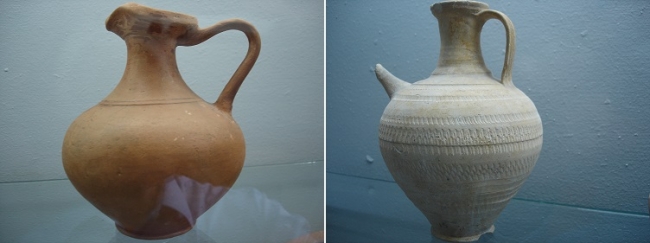
Roman pitchers - source Museo
Arqueologico, Seville
Ribbing and wheel ridging seems to have started in the Levant around 150 BC, and became most common in the 2nd and 3rd centuries AD. Some wares, particularly figures and lamps, were made by pressing clay into several moulds and then assembling the components.
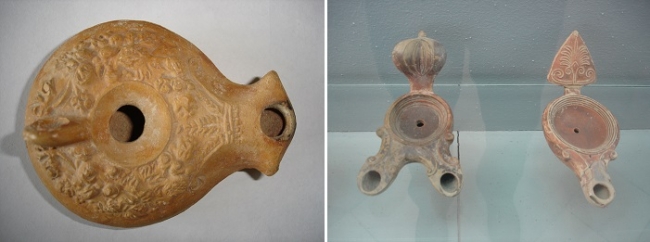
Roman lamp with garland of flowers, 2nd century AD.
Roman fancy lamps - source Museo
Arqueologico, Seville
This permitted closed shapes such as bottles and vases in the form of figures to be produced.
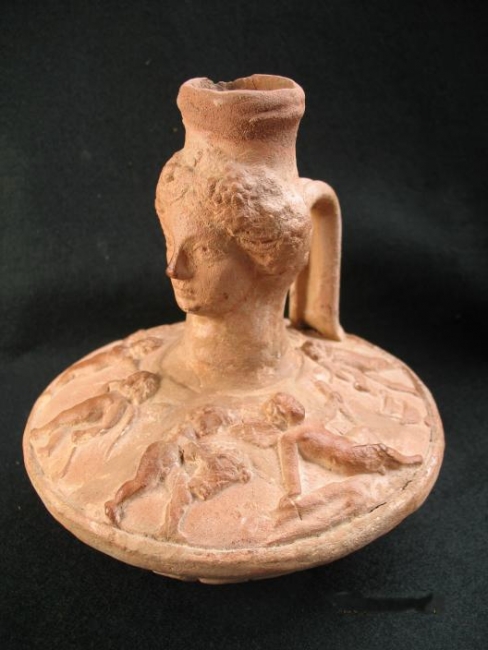
Late Hellenistic/early Roman lagynos -
courtesy Collector-Antiquities
Glass was very popular and had taken over several applications from pottery.
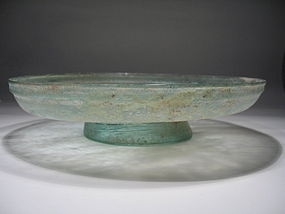
Roman green glass plate, 300 AD
However the use of pottery diversified to include beehives, lanterns, medicinal hot water compresses, souvenirs for spectator sports, small containers moulded as heads to contain perfume or medication, and specially shaped vessels to meet Roman and Jewish culinary practices such as flat baking pans (patinae).

Roman clay tablets (to hold wet clay) and
scribes - source Museo Arqueologico,
Seville
A great deal of utilitarian pottery was made locally throughout the Empire. Simple kitchenware was wheel thrown and fired in a simple updraft oxidising kiln at between 900 and 1,000 degrees C, using a variety of local clays. They were thick bodied with strong handles. Better quality tableware would be dipped in slip giving a glossy red finish as the iron is oxidised. The outside surface would be smooth, but the internal body might be quite rough. Decoration would be by simple relief or impression, including faces.
| Page: 285 of 418 Go To Page: | |
◁◁ First | ◁ Previous | Next ▷ | Last ▷▷ |
Author: Dr. Stan Jones © Copyright 2010 -