

10. European Pottery to the Fall of the Romans
| 1048 Page: 286 of 418 Go To Page: |  |
◁◁ First | ◁ Previous | Next ▷ | Last ▷▷ |
Around 50 BC in the old Etruscan city of Arretium (Arezzo) in Tuscany, they started to produce a fine quality, hard-fired, coral coloured earthenware with a highly-polished glossy orange/red-slipped surface in place of the earlier black glossy ware. It is known as “Terra Sigillata” (clay impressed with designs), Arretine ware or Samian ware, although the latter name is a mystery, as it has nothing to do with the Greek island of Samos.
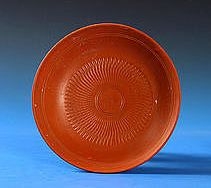
Roman plate 50-350 AD
The slip used was made from very fine particles after levigation, sometimes with added wood ash to reduce the melting temperature. The potters had to control the kilns carefully as it required very uniform firing to achieve the quality they did. The Romans were able to achieve 1150 degrees C for 8 to 10 days in well-designed kilns so were also able to produce stoneware. Arretine ware became the symbol of fine Roman pottery, and it was produced in the city along factory lines from 30 BC to 30 AD. It was usually produced in impressed pottery moulds having the design “in reverse” on the smooth inside surface of the moulds– reflecting the Hellenistic style. Such moulds have been found in the Arretine workshops. The moulds look like thick bowls made of high-fired, smooth, reddish ware. Punches were used to impress the motifs on the inside of the smooth surface while the clay was still wet.
The pot was thrown inside the finished mould that was mounted on the potter’s wheel, producing decoration having raised designs, resembling the repousse method used by metalworkers, which it attempted to copy. The rims, feet and handles were formed separately. Most vessels have the potter’s name stamped on the base or sometimes in the decoration, and sometimes the mould maker or workshop. Fine wares such as Arretine are also sometimes dated, as are the pottery oil lamps, the latter also often having the name of the producer. Vessel shapes were standardised, mainly footed plates, platters and bowl-like cups. The decoration included fine detailed reliefs of floral motifs, and individual figures of standard form such as gods, heroes and mythological beasts (Hercules and dancing satyrs). However, scenes of daily life were missing except for some Arretine and lead glazed vessels in the Augustine period (25 BC – 50 AD) when there was more delicate relief ornamentation.
Octavian became sole Emperor in 31 BC and ruled until 14 AD. In 27 BC the Senate named him Augustus and in 8 BC, August, the eighth month of the year was named after him. The Empire was supported by riches from Egypt and he was able to restore morale and unify the country. An unusual state of peace broke out. Industries for Arretine ware and wine flourished, and glass blowing became an important craft. There was significant territorial expansion and annexation, although satellite kingdoms were permitted autonomy if they paid tribute, so saving a costly military presence. Well-made, paved roads were built throughout the Empire, for the military and communications, especially the postal service, with rest stages and lodges for overnight stops. Pirates were suppressed and trade increased in textiles, pottery, tiles and papyrus. The Levantines became the main traders in the Mediterranean, but some goods went as far as India. By the time of Christ’s birth around 4 BC, the Roman Empire included Spain, parts of France, Eastern Mediterranean lands and up to the Black Sea.
| Page: 286 of 418 Go To Page: | |
◁◁ First | ◁ Previous | Next ▷ | Last ▷▷ |
Author: Dr. Stan Jones © Copyright 2010 -