

10. European Pottery to the Fall of the Romans
| 1049 Page: 287 of 418 Go To Page: |  |
◁◁ First | ◁ Previous | Next ▷ | Last ▷▷ |
Claudius was the Emperor from 41 to 54 AD, and in 43 AD he decided to annexe Britain. The second Roman invasion was much less resisted than the first possibly because the Continental influence had pre-Romanised the British people.
Under Nero’s rule from 54 to 68 AD, the Romans became unpopular in the provinces with rebellions in Britain (Boudicca) and in Judea. He particularly persecuted Christians as he blamed them for the fire in Rome in 64 AD. Nero finally committed suicide, and the Senate were so horrified by his past actions that they expunged his reign from the records. Rome’s focus was lost and there was civil war that was won by the eastern army in 69 AD.
From 69 to 192 AD there were a considerable number of buildings erected in Rome including the Colosseum, Trajan’s Forum, the Pantheon, Hadrian’s Mausoleum and many aqueducts keeping the city and its many fountains supplied with water. During the first century AD the Roman Empire reached its greatest extent, ruling 60 million people, spreading a complex Greco-Roman Culture. Rome’s spread can be judged by the number of languages derived from Latin, namely, French, Italian, Spanish, Portuguese and Romanian. As Latin spread widely in the west it split the Empire, as half spoke Latin (west) and half Greek (east). Contrary to intuition some infrastructure was better in the eastern than the western parts of the Empire, for example the roads.
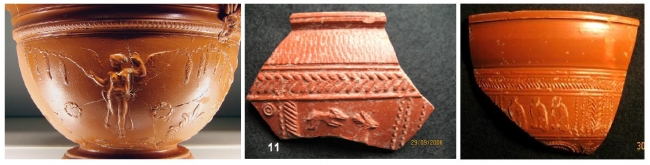
Arretine (sigillata) ware, Gaul vessel
from necropolis, Lugone - source Brescia
Archaeological Museum. “Sigillata
sherds from Spain and Portugal” -
latter courtesy Collector-Antiquities
Arretine wares were highly desired and widely exported, with discoveries in Pergamum, Syria, Ephesus, Cyprus and the Black Sea region, and the wares were copied with great success, particularly in Gaul, the Rhineland and Anatolia from 1st century AD. Arretine ware usually was fairly thinly potted, and some very thin, light, drinking vessels had walls only 1mm thick, often having elaborate handles, to compete with metal vessels. They were made in a mould or on a wheel, but the latter method was quite difficult. Surfaces ornamented by roulette or stamp helped to maintain a grip on vessels. Some tableware was decorated with very heavy relief or in the barbotine style.
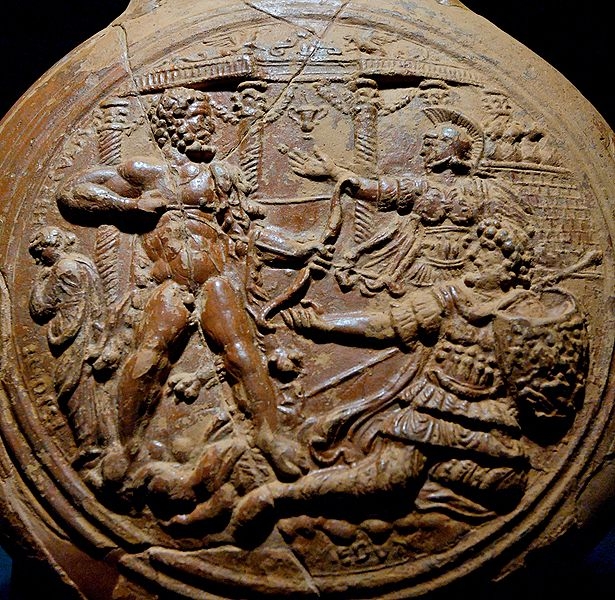
Roman sigillata flask from Gaul, Hercules
and Laomedon, 1st century AD
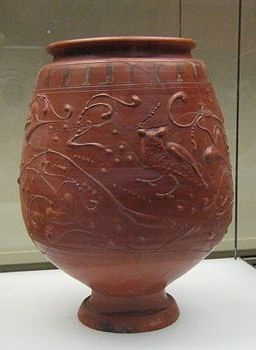
Roman barbotine terra sigillata vase
Roman earthenware pipes, tiles and bricks were also made throughout the Empire, the latter were standardised and quite recognisable. Their roof tiles were in two parts, a flat tile with two opposite raised edges and a semi-circular “half-pipe” to cover the join. Some Roman tiles found in London were clearly walked on by animals when laid out to dry as they have animal paw prints on them.
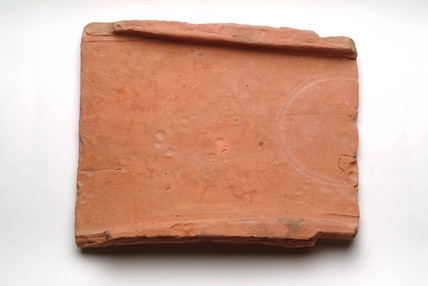
Tile with paw prints - courtesy
© Museum of London
Roman bricks were manufactured near to the location they were needed in a kiln made as a structure of dried clay bricks. A hollow was left underneath for the fire, together with a series of vents and flues, and the fire was kept burning for 4 to 6 weeks. When the kiln was dismantled, the fired bricks were removed from the centre as the outer bricks acted as insulation and would not be fully fired. Stoneware was sometimes used for Roman water supply pipes.
| Page: 287 of 418 Go To Page: | |
◁◁ First | ◁ Previous | Next ▷ | Last ▷▷ |
Author: Dr. Stan Jones © Copyright 2010 -