

10. European Pottery to the Fall of the Romans
| 1050 Page: 288 of 418 Go To Page: |  |
◁◁ First | ◁ Previous | Next ▷ | Last ▷▷ |
Unusually, in Egypt, jugs had bodies made in two sections that had been rotated in different directions on the wheel! In Egypt they also produced two-colour (black and red) painted wares on thin-walled, barbotine-decorated pale earthenware. The motifs were plants, vines and people. Black painted wares were mainly decorated with palm trees and geometrics around the 2nd century AD. Some very hard, pink unslipped Aswan ware was inscribed with Coptic inscriptions from the 4th century AD. Also some mould-made lamps were inscribed “product of Sagalossos” (in Anatolia), but were actually made in Egypt, so great care has to be taken with inscriptions that can turn out to be an ancient marketing scam.
The Romans remained in Britain for some 400 years, using stone and brick to build forts and villas, expanding towns, linking them with roads and introducing new industries, arts and crafts. The Romans introduced the first high-quality pottery to Britain. They brought much new technology including improved kilns (especially controlled cooling), lead glaze, spouts, applied decoration, rouletting and relief modelling (appliqué).
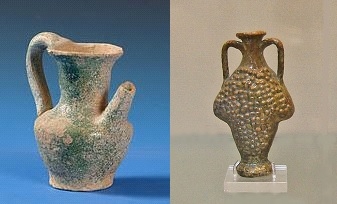
Roman glazed jar 200 AD and Syrian flask
1st century AD - source Wikipedia AdTigress
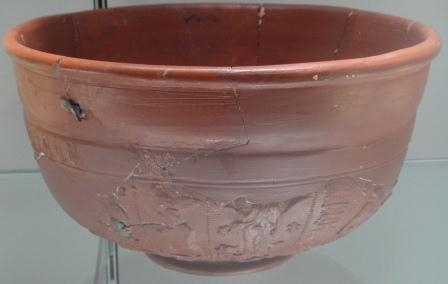
Samian ware bowl from French Gaul 2nd century AD
found in Shropshire - Image courtesy of the
Potteries Museum and art Gallery, Stoke-on-Trent
Roman soldiers brought the first lead glazed vessels to Britain, but by 70 AD its use had spread to the civilians; typically they were yellow/green cups, flagons and jars. South Gaulish Arretine ware from Lyons dominated the British market in the late 1st century AD, probably using slave workers. From 160 AD Arretine or Samian ware was manufactured in Colchester, England, by 20 immigrant potters from Gaul.
Initially the Provinces copied the Italian style, but by the 4th and 5th centuries AD, from Britain to Egypt, they produced local variations of Arretine ware with some common features. Painted pottery became popular, burnished overall or as a pattern, and stamps were used to identify makers. Roman vessels found in Britain had faces moulded in their sides, usually for religious purposes, but it is not certain what they represent. Other vessels refer to Roman gods. Soon British potters were producing Roman style pottery in quantity, particularly the red glossy Arretine ware.
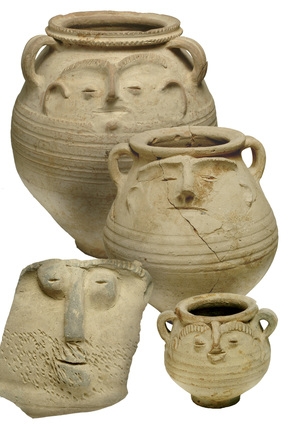
Roman face pots 43-200 AD
- courtesy © Museum of London
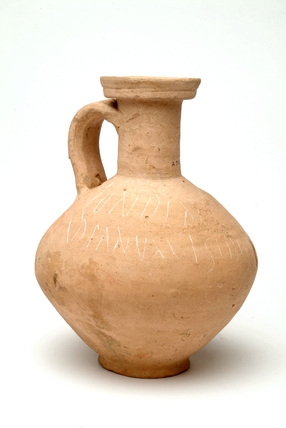
Roman single-handed white ware
flagon found in London, marks
indicate Isis cult, 95-100 AD
- courtesy © Museum of
London
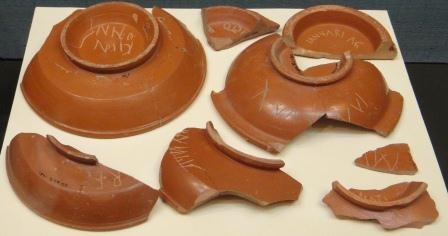
Roman Samian wares with scratched names of
owners - Image courtesy of the Potteries
Museum and Art Gallery, Stoke-on-Trent
Roman style beakers discovered at Peterborough, England, had a hard pale body and black/brown finish, some decorated in the trailed Barbotine style with plants and animals. It is called “Castor ware” after the village near Peterborough where it was made. It was distributed throughout Britain and elsewhere in the Empire from 2nd to 4th centuries AD. The most notable decoration was on the “hunt cups” that had barbotine relief designs of hounds hunting deer
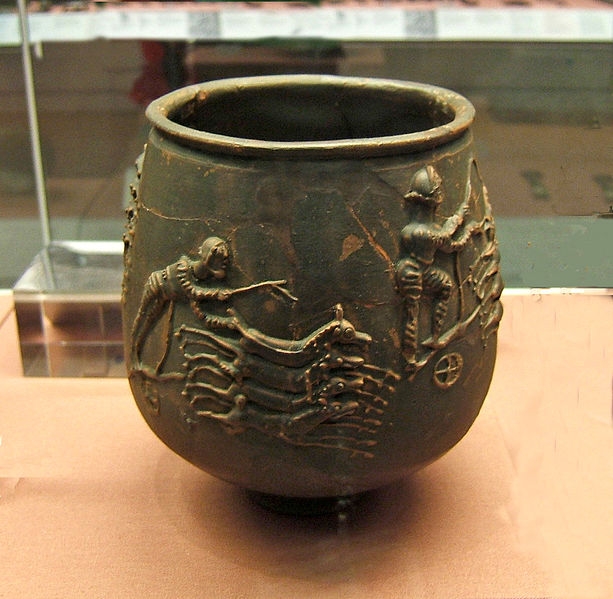
Romano-British barbotine pot, Colchester
2nd century AD - source Wikipedia AdTigress
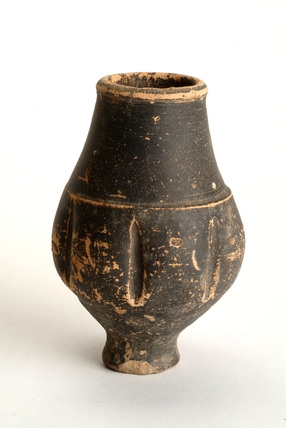
Roman “folded” beaker, Nene
Valley style, colour coated ware,
burial goods, 301-400 AD, found in
London - courtesy © Museum
of London
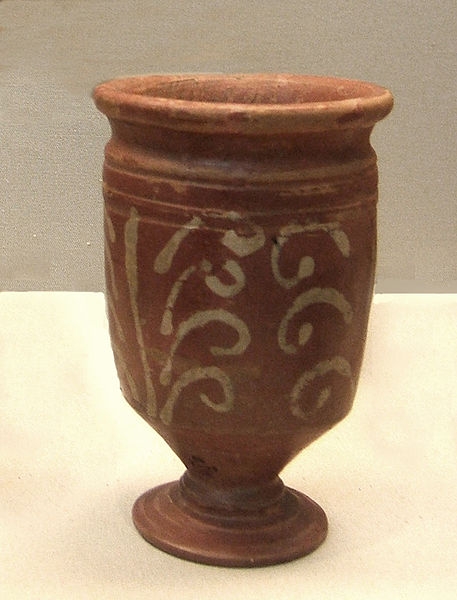
Roman beaker 4th century AD Oxfordshire
- source Wikipedia AdTigress
| Page: 288 of 418 Go To Page: | |
◁◁ First | ◁ Previous | Next ▷ | Last ▷▷ |
Author: Dr. Stan Jones © Copyright 2010 -