

10. European Pottery to the Fall of the Romans
| 1051 Page: 289 of 418 Go To Page: |  |
◁◁ First | ◁ Previous | Next ▷ | Last ▷▷ |
In the 1st century AD North African polished red slip ware began to be produced in Carthage. It was less sophisticated than Arretine ware, but still had smooth red slipped surfaces, the clay was easier to fire and pots were much cheaper to produce. Large quantities were traded throughout the Mediterranean in the 1st century AD. Very early examples of this pottery were even shipped to India. Manufacture spread to Byzacena (Tunisia) and Numidia (Algeria), where not only most of the cooking wares for the Empire were produced, particularly tableware for Europe in the 2nd and 3rd centuries AD, but also much fine pottery for the Empire came from this source.
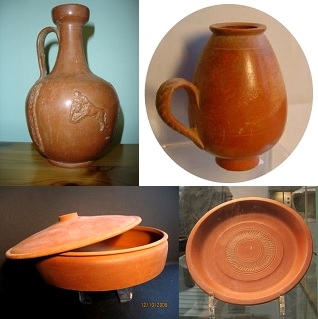
North African red slip ware, a bestiaries
wrestling a bull, 3rd century AD; handled
vase 4th century AD; Tunisian dish 350-400
AD and lidded dish 4th century AD”
b) and d) - courtesy
Collector-Antiquities, c) Wikipedia
Production ceased when the workshops were destroyed by the Arab invasion around 680 AD. Copies were made in Egypt and Cyprus and examples from the 5th and 6th centuries AD have been found in Constantinople and Cornwall. During this period Christian motifs were also used in the decoration. In the 7th century AD plates with serving compartments copying African red slip ware were made in Aswan.
Rome’s success was in good measure down to its inclusivity of conquered peoples who could eventually be granted Roman citizenship. All roles, including Emperor, could be held by people from outside Italy, and two Emperors, Trajan (98-117 AD) and Hadrian (117-138 AD) were Spanish.

Map of Roman Empire at the time of Trajan
117 AD - source Wikipedia Tataryn77
Hadrian was keen to delineate the Empire’s borders and have client states adjoining, hence much wall building in Germany and Britain. However, in 166 AD Eastern troops returning to Rome brought the plague to the West. Also barbarians continued to cross the Danube, especially in 175 AD.
Christianity developed only slowly in the 1st and 2nd centuries AD partly because of persecution, and in 202 AD Emperor Severus passed a law prohibiting it. Polytheist Rome often added provincial gods to their pantheon or adapted them to existing gods, which allowed other religions to be compatible and tolerated. They also considered the Emperor to be the go-between between humans and gods. But this was incompatible with Christianity so there was a fundamental clash of principles.
Exports from Italy had been a significant source of funds, however towards the end of the 2nd century AD exports of wine, oil, fine pottery and marble declined, as markets in Gaul and Germany replaced them with local products. Italy and Spain started to import Gallic bowls and plates, as seen at Pompeii. In Rome, Gallic, Spanish and North African food imports were greater than Italian. In the 3rd century AD there was an even greater shift in prosperity as Roman occupation gave a great impetus to wealth in some countries such as Numidia in North Africa and Britain.
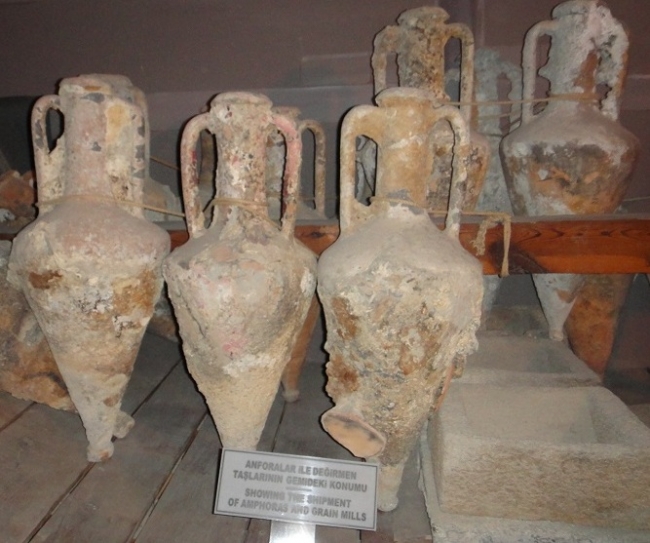
Example of earlier amphorae in Shipwreck
Museum, Kyrenia Castle, Cyprus, 292 BC
At this time there were few real technological developments apart from improving crops and animals, although skill levels improved considerably. Pottery, mainly utility, was produced in prodigious quantities, especially amphorae. The huge mound in Rome called Monte Testaccio is made up almost entirely of their shards. Some amphorae have potters marks that can be dated, while the dates of others can be determined by their shape. A great deal of information on trade can be revealed by analysis of amphorae at major market locations using X-Ray fluorescence or neutron activation techniques that can also reveal the contents. With shipwrecks, the number of amphorae allows the size of the vessel to be estimated. This information confirmed Gaul became an exporter of agricultural products to Italy in the mid-1st and North Africa in the 3rd century AD. Because of the huge demand for liquids (olive oil and wine), large-scale production of amphorae took place in North Africa by 4th century AD, and they became much more standardised.
| Page: 289 of 418 Go To Page: | |
◁◁ First | ◁ Previous | Next ▷ | Last ▷▷ |
Author: Dr. Stan Jones © Copyright 2010 -