

10. European Pottery to the Fall of the Romans
| 1052 Page: 290 of 418 Go To Page: |  |
◁◁ First | ◁ Previous | Next ▷ | Last ▷▷ |
Moulded terracotta plaques with Greek style relief decoration including mythological subjects were often used to decorate buildings. The Romans used fired bricks and roof tiles often decorated with coloured glazes when constructing their massive buildings. Many other pottery objects were produced.
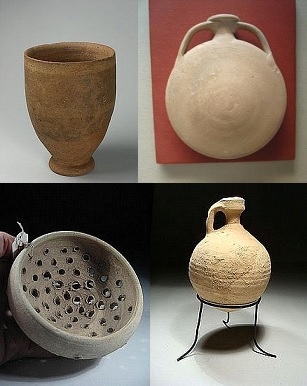
Roman, goblet; moonflask source Museo
Arqueologico, Seville; wine strainer bowl
100 AD; and perfume jar 37 BC - 70 AD
The small, often glazed, oil lamps were particularly numerous, commonly made of buff or dark grey clay, and decorated with a vast range of subjects often informative as well as decorative.
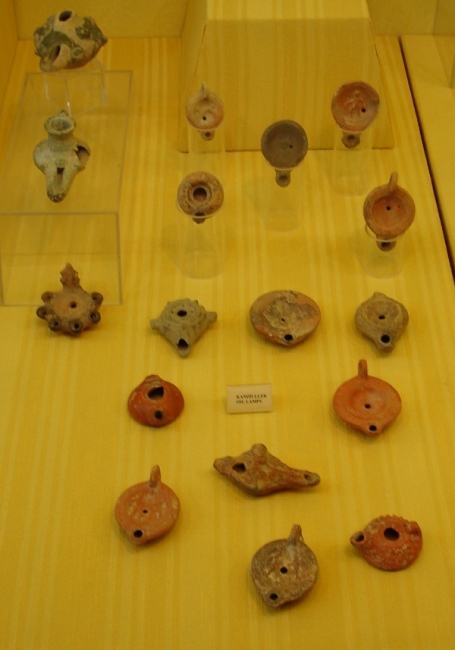
Roman oil lamps - source Hieropolis
Museum, Turkey
Christian motifs were used on these lamps following the conversion of the Empire in 4th century AD. The main fuel for the lamps was olive oil from Spain. The Romans also further developed and widely used ceramic drain pipes, bathtubs etc.
Such a vast Empire was difficult to control and very expensive to run. Although the Empire had grown apace, the army did not because of the cost, and in the middle of the 2nd century AD there were only 28 legions containing 400,000 men, mostly locals, spread relatively thinly, in three main armies. They were based, out of necessity, in Britain, the Danube and Roman Syria. Rome’s focus had moved from distinctly military to highly commercial. They suffered revolts and attacks at various places along the frontiers. The Goths (a Germanic tribe) from Sweden moved into the Crimea and attacked the Greek cities along the Black Sea in 238 AD, and the Sassanians attacked Anatolia and Syria in 256 AD. Around 250 AD there was another severe outbreak of plague, the economy collapsed because of raging inflation and the Romans started to abandon territory. In the west, Germanic tribes and Gauls burst through Gaul and on to Spain, joined by the Franks; and Germanic tribes sacked Athens in 267 AD. Some relatively independent countries such as Egypt and Britain were less affected. From 270 to 337 AD a series of Emperors from Illyria were appointed, which brought some stability. In 284 AD Diocletian was proclaimed Emperor, and in 286 AD he decided to reorganise the Empire by separating it East and West, having two rulers in each part – one ‘old” Augustus and one “young” Caesar (the Tetrach). The territory was split into four, and he moved to the east himself and set up the premier Capital in Nicomedia. The other Capitals were Trier, Germany; Milan, Italy and Antioch, Syria.
By 300 AD Christianity had spread widely and probably numbered about five of the Empire’s sixty million population. However, Diocletian considered the regular meetings of bishops a threat to Imperial control and from 303 to 311 AD he persecuted them severely. They did not help themselves by building a church opposite his palace in Nicomedia! As usual there was rivalry between the four “Emperors” and by 313 AD the last remaining original tetrarch Licinius shared power with Constantine, son of another original tetrarch, Constantius. Constantine’s conversion to Christianity around 313 AD is a bit of a mystery. Although he was reported to have had two visions of crosses, he was also surrounded by bishops for much of the time that might also have had a major impact. The persecution of Christians was halted when he issued the “Edict of Milan”. Christianity spread even faster and large church buildings were started in Rome and Constantinople. Constantine and Licinius fell out in 314 AD, and after several bloody battles Constantine was victorious, but forgave Licinius. However, in 322 AD Licinius started plotting against Constantine again and, after losing further disastrous battles, was sentenced to death by the Senate in 325 AD and “Constantine the Great” won sole power.
| Page: 290 of 418 Go To Page: | |
◁◁ First | ◁ Previous | Next ▷ | Last ▷▷ |
Author: Dr. Stan Jones © Copyright 2010 -