

10. European Pottery to the Fall of the Romans
| 1053 Page: 291 of 418 Go To Page: |  |
◁◁ First | ◁ Previous | Next ▷ | Last ▷▷ |
Christianity was made a religion of the Empire, but pagans, who were more prevalent in the West, were not persecuted. (Christianity was made the official Roman religion in 380 AD). Constantine decided to move the Administrative Capital of the Empire to Byzantium in 330 AD, renaming it Constantinople.
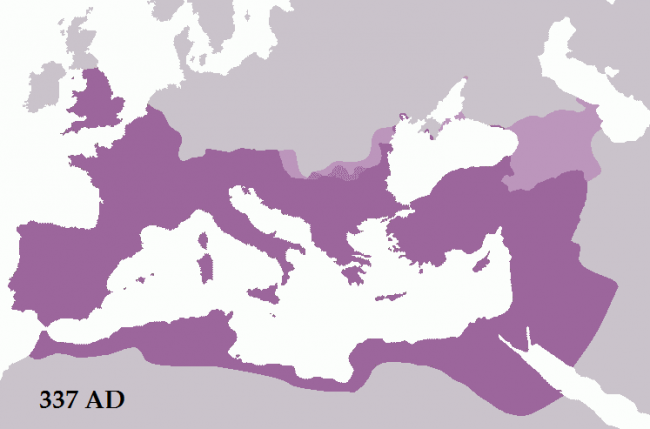
Map of Roman Empire at the time of
Constantine 337 AD - source Wikipedia via
tataryn77
It was chosen as it was adjacent to both the Danube and Euphrates frontiers and ideal for trade, although Troy was also considered. Byzantium was of course the Greek speaking ancient city-state set up by Greek colonists on the European side of the Bosporus – now Istanbul. Around 336 AD some 40,000 Goths were recruited to defend Constantinople and the palace guard was mainly Germans. There were many further battles, often within the Empire, and in 351 AD the two strongest Roman armies, from the Danube and Gaul Regions, led by a Gaul, Magnentius, faced the Eastern Roman army led by Constantius II in Croatia. The Western Army was defeated and there was huge loss of life on both sides that seriously weakened the Empire’s military capability.
In 375 AD, pressure from the Huns from the Steppes of Central Russia forced the Ostragoths and others into Thrace, and Goths into Macedonia. Although the Empire tried to bribe them to restrict themselves into certain territories, the Empire was being rapidly eroded. Under significant influence from “barbarian” leaders who had temporary treaties with the Empire, in 395 AD it was split for good into eastern and western parts. As Rome appeared to weaken, many peripheral tribes saw it as an opportunity to advance themselves and they were particularly attracted by the gold the Romans had amassed. The so-called barbarians were far from uncivilised, but they were described as such by Roman propaganda that history, particularly Catholic Christian, propagated. In fact they had cooperated with the Romans on-and-off for decades. In 410 AD the Visigoths descended on Rome and pillaged it for three days, then returned north to confront the Gauls. The Hun’s further terrifying advance pushed many other tribes across the Rhine into Gaul, including the Vandals, Suebi and Burgundians, to the chagrin of the resident Franks and there was much slaughter, including the Vandal’s king.
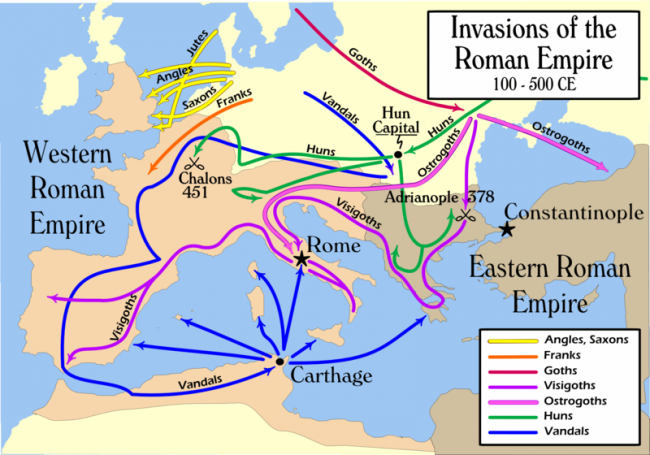
Map showing invasions of the Roman Empire
- source Wikipedia via mapmaster
Such mass migrations occurred several times in history, including those driven by the Mongols, Arabs, Turks and the Chinese, the latter driving people into Malaysia and Polynesia. Between 409 and 415 AD large numbers of Visigoths, Suebi and Vandals passed through France and arrived in Spain – Andalusia is derived from the name “Vandal”. The Romans asked the Visigoths to join them in fighting the Arian Christian Vandals and as a result in 428 AD some 80,000 Vandals crossed into North Africa in a flotilla of small boats, led by their king Gaiseric. He expanded his territory rapidly, as the North Africans considered him a better bet than the Romans. Carthage had been rebuilt and was very important, being the second city in the Western Empire after Rome, with a population of 100,000 people. It had become a major supplier of wheat and oil to Rome. Some 1,600 years of its records were discovered written on old amphorae. Carthage itself fell in 439 AD when the Vandals more or less walked in unopposed during a festival. They then defeated a joint east and west Roman army. The Romans were preoccupied with defending Constantinople from the Huns so they signed a treaty with the Vandals in 442 AD, recognising Gaiseric as the Ruler of North Africa and giving the Vandals much rich territory including Numidia. This was because the Vandals were in a position to starve Rome, threaten Sicily and control the Western Mediterranean with their naval fleet.
| Page: 291 of 418 Go To Page: | |
◁◁ First | ◁ Previous | Next ▷ | Last ▷▷ |
Author: Dr. Stan Jones © Copyright 2010 -