

5. West Asia - The Fertile Crescent
| 814 Page: 30 of 418 Go To Page: |  |
◁◁ First | ◁ Previous | Next ▷ | Last ▷▷ |
From about 24,000 to 16,000 years ago, which covered the coldest part of the last glacial period, most of this region was cold and dry with coastal winter precipitation and some habitable oases in semi-arid areas. From 20,000 to 15,000 years ago, hunter/gatherers known as the Kebarans eked out an existence between the coast and hills, with bases occupied in winter and early spring. About 18,000 to 16,500 years ago in the area of the present Jordan and Syria, there were, perhaps surprisingly, some large lakes, such as Lisan which was 150m higher than the present, and Nia, in the Ghab valley of North West Syria (which is now dry). The reason for this is that until about 13,000 years ago the monsoon from the Indian Ocean penetrated to parts of West Asia, such as the Arabian Peninsula and North-East Africa, so there was much more rain each year, but the monsoon pattern in this region tended to change quite abruptly.
It is difficult to move our minds away from our knowledge of the climate and vegetation of these areas today. However, there have been huge changes over a relatively short time. For example, Libya, which we think of as pretty arid generally, was lush savannah with giraffe, elephant and cattle only 10,000 years ago. Other parts of Africa had large agriculture-based civilisations, but many have now disappeared.
Pollen analysis has shown that some of the first wild wheat and barley grew by the sides of these lakes in the Levant some 18,000 years ago. The Levant is the area of the present Syria, Jordan, Israel, Palestine and Lebanon. After 16,500 years ago there was an increase in deciduous oak trees there as the climate ameliorated somewhat, and by about 14,500 years ago the climate became significantly warmer and wetter, and the forests expanded rapidly. Between 15,000 and 11,000 years ago CO2 levels are thought to have increased from 200 to about 270ppm, which would have favoured wild wheat and rice, as well as trees and shrubs. Larger prey decreased and fruit, nuts (almonds and pistachios), berries and roots became available along with small mammals such as antelope, deer and boar. The Natufians, who were the people living in this area (South Levant) from about 15,000 to 11,600 years ago, moved their villages into the forest to live around 14,500 years ago, and their diet became rather more vegetarian. This included the harvesting of wild wheat (grindstones for flour have been found in this area dated to 12,000 years ago). The much more benevolent environment and better quality food supply led to increased reproduction and the population grew rapidly. As in China, man became more sedentary as the forest supplied sufficient food without the need for a full-time nomadic lifestyle.
Unfortunately for the Natufians, about 12,700 years ago the temperature cooled relatively rapidly by about 5-7 degrees C and it became much drier – a period known as the Younger Dryas, that ended about 11,500 years ago.
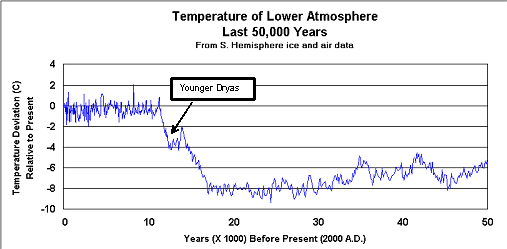
Temperatures Over Past 50,000 Years -
source geocraft.com
These climate changes were often dramatic in this region and significant variations could occur in only a couple of generations, causing more disruption than in China and Japan where it is thought that this effect was much less severe in this period. The character of the forest changed so much that fruit and nuts declined, forcing the inhabitants to seek alternative food supplies. While in the forest, the Natufians would have acquired rudimentary techniques of plant utilisation that would form a basis to subsequently domesticate plants. No doubt they carried out some selection to improve the food yield, if no more than recognising “good” plants and trees and encouraging their growth at the expense of others. Eventually though, of necessity, the Late Natufians (living between 12,500 and 11,600 years ago) moved out of the forest to the margins of the swampy lowlands surrounding the lakes. This made available water and the grains from wheat and barley, on which they became even more reliant to supplement their diet, which also included birds and fish. The lakes in the Levantine corridor (the expansion route our ancestors had taken out of Africa) fell by 150m during the Younger Dryas.
| Page: 30 of 418 Go To Page: | |
◁◁ First | ◁ Previous | Next ▷ | Last ▷▷ |
Author: Dr. Stan Jones © Copyright 2010 -