

12. European Pottery - Fall of Romans to the Present
| 1422 Page: 320 of 418 Go To Page: |  |
◁◁ First | ◁ Previous | Next ▷ | Last ▷▷ |
The Grand Dauphin, Louis de France, set up two apartments containing fine blue-and-white Chinese porcelain. Such rooms were then designed into the homes of the aristocracy by architects, often shelved from floor to ceiling with many mirrors – the emphasis appearing to be on quantity. Everything was made of porcelain – mirror and picture frames, panels in doors and furniture, chandeliers, mantelpieces and floors. The probate entry of the king’s nephew, Philippe d’Orleans, Regent of France (1674 to 1721 AD), lists countless pieces of Chinese porcelain vases, cups and plates painted with the “arms of Orleans” made to order. Clearly there was considerable incentive for local French potteries to produce porcelain, particularly as Louis XIV had to have silver vessels melted down to pay for these exotic imports. Principal among the French factories that carried out early development work on porcelain were Saint-Cloud (1664 to 1766 AD), Chantilly (1725 to 1789 AD) and Vincennes. The Saint-Cloud factory was probably founded by Parisian importers of Dutch Delftware, the brothers C & F Reverend, to produce faience, although they were granted the first “privilege” to produce porcelain in 1664 AD. However the Poterat family of Rouen probably developed the first French frit porcelain in 1673 AD and was granted a patent for it by Louis XIV. Very few pieces survive and production stopped when Louis Poterat died in 1696 AD. In 1674 AD Saint-Cloud was taken over by P. Chicaneau, who is credited with the (re)discovery of the soft-paste process, combining white clays with ground glass. He died in 1678 AD and his wife and son took over, improving the body, and enabling Saint-Cloud to become the first commercial soft-paste porcelain factory in Europe around 1695 AD. This ware was fired somewhat lower than hard-paste porcelain, was softer and could be scratched with a file. Early wares had moulded decoration copying Chinese prunus blossom, sometimes using underglaze blue paint.
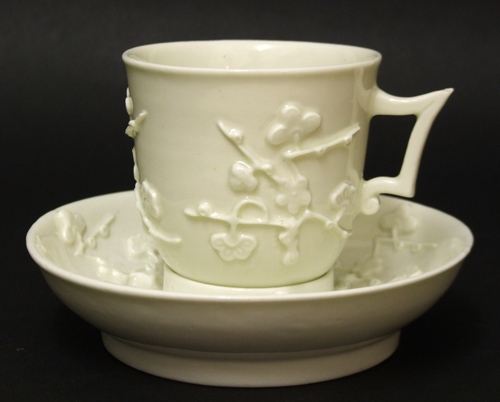
St Cloud soft-paste cup and saucer in
Chinese blanc-de-chine style, 1730-50 AD
- courtesy R&G McPherson Antiques
From 1730 AD polychrome decoration in the Kakiemon style appeared. The wares were high quality luxury goods often with silver mounts and were correspondingly expensive. The factory closed in 1766 AD.
The receipt of Pere d’Entrecolles letters from China in 1712 and 1722 AD, the first published in the “Journal des Savants” in 1716 AD, describing porcelain production triggered further experimentation. In particular Reaumur, who invented the temperature scale used mainly in winemaking, was almost as well known for his work on ceramics. However, his published article in 1739 AD really described a glass processed by devitrification to a white translucent form. He packed glass in sand and gypsum and heated to a red heat for several days producing devitrified crystalline calcium silicate that looked like porcelain, in fact he had invented the first “glass ceramic”. Reaumur’s ideas were not taken up, but 250 years later glass ceramics are used for many scientific applications including radomes in missiles. Another researcher, Count Louis Leon produced hard paste porcelain around 1763-68 AD, but it is not known whether this used French or Chinese kaolin – several pieces still exist.
The Chantilly pottery produced soft-paste porcelain in the Kakiemon style. Unusually, this was covered in tin glaze that was replaced by a transparent one in 1751 AD. In 1740 AD they started to copy Meissen wares, especially the German flowers.
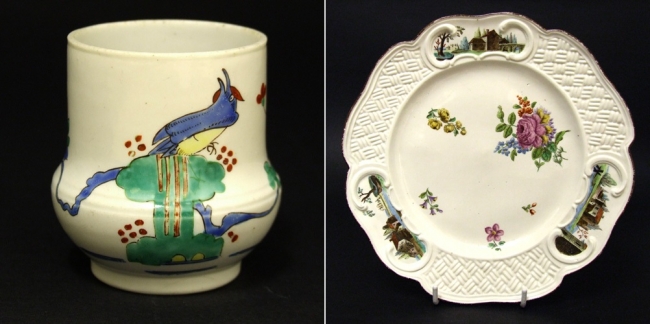
Chantilly soft-paste porcelain, Japanese
Kakiemon mug 1735 AD, and Meissen style plate
1760 AD - courtesy R&G McPherson Antiques
The Duc de Villeroy was the patron of the smaller Mennecy soft-paste porcelain factory that started around 1735 AD just south of Paris. It produced excellent flower painting, figure modelling and small zoomorphic boxes.
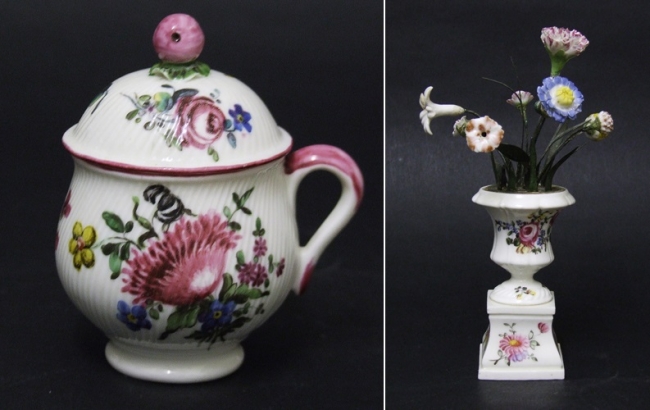
Mennecy soft-paste porcelain, 1750-60 AD,
pot-au-jus, and jardinière with porcelain flowers
- courtesy R&G McPherson Antiques
| Page: 320 of 418 Go To Page: | |
◁◁ First | ◁ Previous | Next ▷ | Last ▷▷ |
Author: Dr. Stan Jones © Copyright 2010 -