

12. European Pottery - Fall of Romans to the Present
| 1423 Page: 321 of 418 Go To Page: |  |
◁◁ First | ◁ Previous | Next ▷ | Last ▷▷ |
The Vincennes factory was established in 1738 AD by a group of craftsmen from Chantilly, and was under the patronage of the king Louis XV who also became a large shareholder in 1752 AD, In 1753 AD there was a very restrictive royal edict to support the development of the new Vincennes pottery that prohibited the use of polychrome and gold in decoration except for the royal factory. This forced Chantilly and others to produce porcelain in the white with a few flower sprigs in underglaze blue. Vincennes was also patronised by Madame de Pompadour for whom it produced beautiful naturalistic porcelain flowers mounted on branches of bronze.
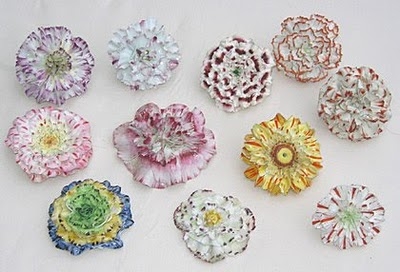
Vincennes porcelain flowers - source John Whitehead
The Vincennes craftsmen produced exceptionally fine wares with superb detail in their painting and gilding.
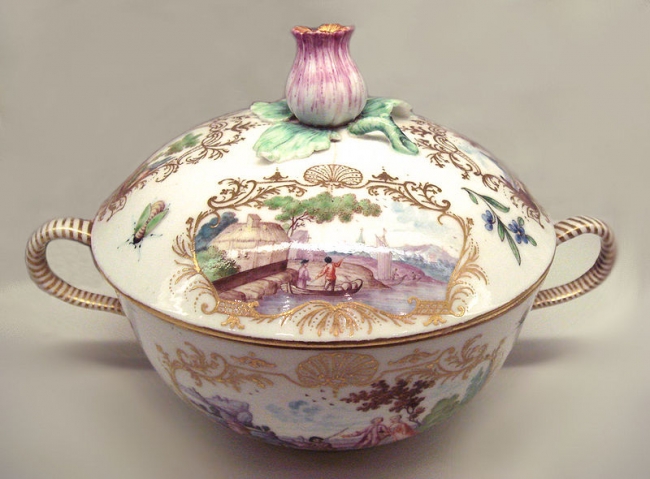
Vincennes soft-porcelain bowl and lid 1749-50 AD
- source Wikipedia via World Imaging
They also developed new glaze colours such as “bleu celeste”, “Turkish blue”, “bleu lapis” and “rose Pompadour”, and started the practice of applying date marks and painter’s marks. The Vincennes factory had a relatively short production run before it was removed to its successor factory in Sevres in 1756 AD, and had to be rescued from bankruptcy by the king in 1759 AD. Sevres purchased the secret of hard paste porcelain from P A Hannong of the Strasbourg pottery in 1761 AD. Then kaolin was discovered in Limoges, France in 1768 AD and the Sevres factory started to produce hard-paste porcelain around 1772 AD, although it was initially only used for biscuit figures. Their monopoly on polychrome decoration was removed in 1780 AD.
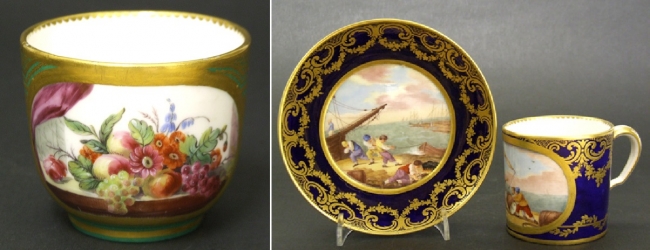
Sevres gilded porcelain, cup 1770 AD,
and coffee can and saucer 1780 AD
- courtesy R&G McPherson Antiques
The high quality of Sevres was particularly apparent in the colours of its palette and technical brilliance of its painters. Unlike Meissen where individual artists were identifiable, Sevres had more of a “house style” and few individuals were highlighted apart from sculptor Etienne Falconet and painter Francois Boucher. The soft-paste porcelain was of very high standard and the coloured enamels sank into the main glaze producing a unique effect. It was also noted for it’s gilding, using a recipe from a monk that was based on one used for illuminating manuscripts. Gold powder was mixed with a foul-smelling solution of vinegar, garlic and gum Arabic. They also used a more pleasant formula based on honey that was the method also used at Chelsea. At Sevres the gold was applied in thicker layers than was used by other factories. After firing the gilding was tooled to create patterns, then some was polished and some left matt. Cuts in the thickness of the gold created facets reflecting light and sparkling in candlelight. In the 1780’s Sevres replaced Meissen as pre-eminent porcelain manufacturer in Europe, and probably the best soft-paste porcelain figures of all the potteries were made at Sevres. The supreme achievement of the Sevres factory was the 744-piece service made for Catherine II of Russia, although George IV of Britain was also an avid collector of Sevres porcelain.
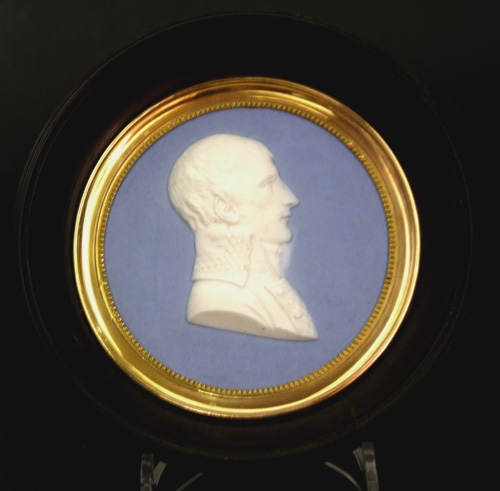
Sevres portrait medallion of Napoleon
Bonaparte in Wedgwood jasper style
- courtesy R&G McPherson Antiques
However, the French Revolution in the latter decades of the 18th century caused Sevres great financial problems, when it was taken into state ownership in 1793 AD. Then the new director, Brongniant, revitalised it, and led it for nearly 50 years. They only continued to make soft-paste porcelain until 1804 AD, when hard-paste porcelain took over. This was the year Napoleon was declared Emperor and shortly thereafter the factory came into his private ownership. It is now back in state ownership.
| Page: 321 of 418 Go To Page: | |
◁◁ First | ◁ Previous | Next ▷ | Last ▷▷ |
Author: Dr. Stan Jones © Copyright 2010 -