

12. European Pottery - Fall of Romans to the Present
| 1441 Page: 330 of 418 Go To Page: |  |
◁◁ First | ◁ Previous | Next ▷ | Last ▷▷ |
In the Anglo-Saxon Pagan Period (400-650 AD) most pots discovered have been cremation urns, either for the ashes or accessories, mainly made by the Angles. In the 5th century stamps were introduced for decoration, made from bone or antler. Typical motifs were the swastika, the symbol for Thunnor the god of thunder, chevrons and panels of vertical lines. Vessels were thick-walled, coarse, grit tempered, mainly black, bag shaped with few lids, probably fired on a bonfire.
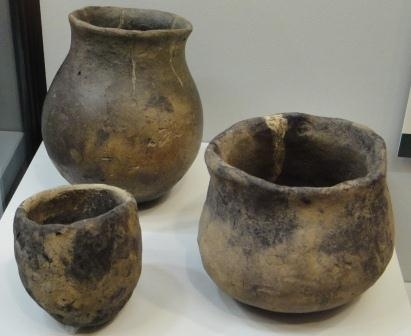
Anglo Saxon cemetery bowls for cremated
bones, 550-650 AD - Image courtesy of the
Potteries Museum and Art Gallery,
Stoke-on-Trent
In the 6th century AD they made bi-conical urns or ones with a pedestal. Decoration included bosses (round protrusions), together with incised arcs, zigzags and triangles, and bands of dots or stamped motifs including swags. There were clearly links with the Continent that had similar wares. In the 7th century AD they produced tall vessels with high necks, most undecorated, all recovered from graves. A serpent-like decoration was used, probably the “Wyrm Dragon” who protected burials. Some wheel made pots were imported from the Franks, although neither the early Anglo-Saxons nor Celts used the potter’s wheel.
There were seven major kingdoms in Britain in the Middle Anglo-Saxon period (650-800 AD), including Mercia, Wessex and Northumbria. Trading centres came into existence and coins were in use to ease trading. Pottery was increasingly related to settlements rather than cemeteries. Many pots were still hand made by coiling, but the slow, hand-turned potter’s wheel reappeared. (The fast wheel reappeared in Northumbria in the middle of the 9th century AD, but its use was not universal until the late 12th century). Vessels were still thick-walled, but updraught kilns had been introduced, improving firing. There were still imports from France, mainly via Northumbria.
In the late Anglo-Saxon period (800-1066) their kingdoms coalesced into England, bringing in urbanisation, literacy and culture on a par with the Continent. Alfred the Great negotiated with the Danish Vikings and traded an area of Eastern England (the Danelaw) for peace. The fast wheel was introduced and spread during this early medieval time. Common wares were cooking pots, often having sagging bases, with rouletted decoration as lines of diamonds, squares and rectangles. “Shelly” ware was produced from Roman to late Anglo-Saxon times. It was so-called as the temper was predominantly crushed oyster shells.
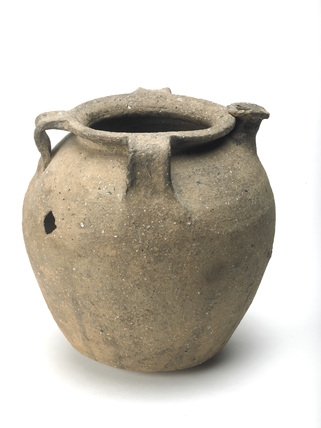
Late Saxon, 900-1160, shelly ware
pitcher probably from Oxford
- courtesy © Museum of London
Extensive kilns were found in Stamford, one of the five fortified Danish Viking Danelaw towns, where crucibles, lamps, large storage vessels with multiple handles, pilgrim flasks and strainers were also made. They produced one of the earliest home-developed glazed wares in Britain from the 9th to the 13th centuries. Called “Stamford” ware, it was a lead-glazed earthenware that had a hard whitish body with a translucent greenish/yellow glaze. Notable forms were spouted jugs, pitchers and small bowls. Stamford ware is probably the most widespread of pottery of this period, and has been found in Canterbury, the Welsh Marches, Durham and in the 13th century Aberdeen and Perth. It was probably spread by coastal and river boats, and (carefully) in the bags of travellers. The Medieval spread of wares often follows coastal and river routes as exemplified by “Scarborough” ware distribution, but as the volume was quite low it does not indicate organised trading. Winchester pitchers also had a clear lead glaze applied, together with rouletted decoration. Particularly large glazed ones appeared in the 11th century, and its early development was probably helped by its royal connection. During the late Anglo-Saxon period, items such as large amphorae were imported from the Rhineland and France, and increasingly after 1066 from Normandy.
| Page: 330 of 418 Go To Page: | |
◁◁ First | ◁ Previous | Next ▷ | Last ▷▷ |
Author: Dr. Stan Jones © Copyright 2010 -