

12. European Pottery - Fall of Romans to the Present
| 1442 Page: 331 of 418 Go To Page: |  |
◁◁ First | ◁ Previous | Next ▷ | Last ▷▷ |
Before the Norman invasion in 1066, Britain was peaceful and prosperous. After it there were many social, political and economic changes. There were considerable advances in building technology, seen in castles and cathedrals. However, although there had been an increase in the use of pots in cooking from the 9th century, possibly due to more stewing and boiling of food, pottery technology was static. They carried on making Anglo-Saxon-style wares into the 12th century, and it wasn’t until after 1150 that Stamford potters used a new shiny green lead glaze coloured with copper. Jugs became more popular as drinking habits changed, partly due to the increased popularity of wine. Jugs and pitchers were also used for water and milk in the kitchen.
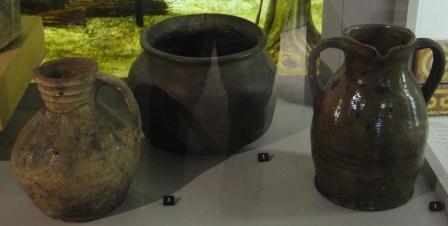
Medieval pots from Cambridgeshire and
Oxfordshire - Image courtesy of the
Potteries Museum and Art Gallery,
Stoke-on-Trent
Mugs imported from the Continent were widely imitated, especially French ones, using white bodies and rich green glazes, and white painted decoration was fashionable. In the late 13th century the potters used higher-temperature, better-controlled kilns, and the ratio of temper reduced as better materials were used. The use of reducing, multi-flue kilns resulted in high-fired earthenware, near stoneware, bodies. Very ornamental baluster-shaped jugs as well as tripod pitchers were fashionable having barley sugar twisted cables of clay pressed onto their surface. Other decoration was foliage patterns, horseshoes and brooches together with human bearded facemasks and even relief figures of knights on horseback that were luted onto the bodies, mainly on the shoulders of vessels. Vessels were also incised and rouletted.
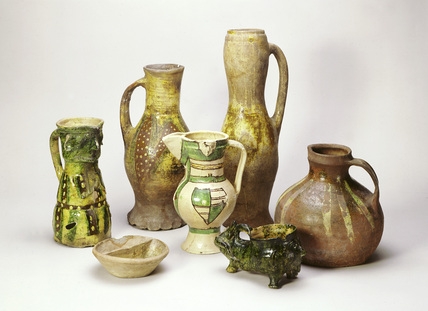
Medieval table and kitchen pots, white
central jug is French, 1260-1350, others
(incl. facemask) made in London area
13-14th centuries - © Museum of London
Cooking ware came in a wide range of form and size, some having capacities between 7 and 11 litres. Storage vessels were larger, one of 60 litres was found in Kent and some Thetford ware vessels were much larger. These vessels would probably be formed by coiling and finished on a wheel. Analysis of residues left in the pores of the vessels indicates that meat stew, cereal gruel with vegetable oil and milk products were prepared in them. The use of trivets to hold the pot over the fire and ceramic pots inside large metal ones for steaming has been illustrated in contemporary drawings from the 14th century. One medieval recipe had a tall jug filled with sausage mixture, its mouth sealed with canvas, placed in a cauldron to simmer. When cooked the jug was broken open, the sausage basted with batter and roasted on a spit until a golden colour.
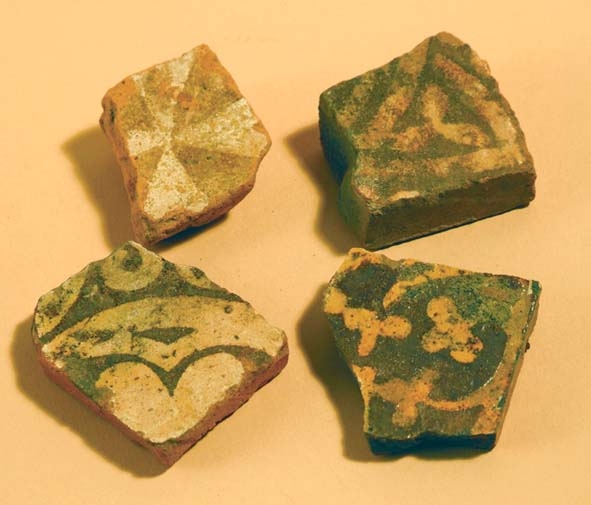
14th century Penn tile
fragments - courtesy Wycombe Museum
Up to the 14th century only three forms of pottery vessels had been at all common, cooking pots, bowls and jugs. Then some imported wares became popular such as stoneware drinking jugs and tankards that started to arrive from the Continent.
Ceramic floor tiles were used in great quantities in the medieval period. Encaustic (burning pigment) tiles were popular as they were decorative and hard wearing. They were made by carving the required pattern in a wooden block that was pressed into the wet tile to form indentations. These were then filled with a contrasting coloured clay, often white pipe clay, glazed and fired. In 1351 an order for 5,000 tiles at 8 shillings per thousand was received by the potters at Penn, Buckinghamshire, for Windsor Castle.
| Page: 331 of 418 Go To Page: | |
◁◁ First | ◁ Previous | Next ▷ | Last ▷▷ |
Author: Dr. Stan Jones © Copyright 2010 -