

12. European Pottery - Fall of Romans to the Present
| 1443 Page: 332 of 418 Go To Page: |  |
◁◁ First | ◁ Previous | Next ▷ | Last ▷▷ |
Towards the end of the medieval period (14/15th centuries) two wares of note were “Midlands Purple” and northern “Reduced Greenware”, both reflecting the final glaze colour. The glaze on the Reduced Greenware was yellow when applied and green when fired. Elsewhere, apart from clear, other colours used were honey and dark brown. Generally in the medieval period the colours available for glaze were derived from iron and copper oxides in clays providing yellows, reds, browns and greens together with white, but not blue. Glaze was sometimes dripped or splashed on, often on just the upper part of the vessel. In some regions shell was still used for temper. Coloured slips were used, sometimes inscribed to give a two-colour effect. Applied pads, sometimes stamped, and added strips were used to produce more complex designs. Sometimes strips were applied around the circumference of vessels to help lifting. A characteristic design at this time was for cooking pots to have multiple strap handles, and some of these handles have stab holes that were made to aid drying prior to firing.
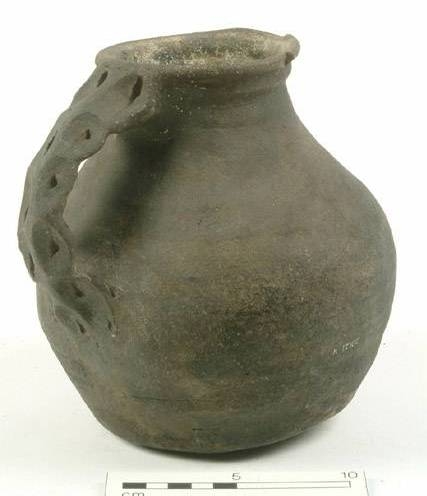
Medieval jug with stab and thumb decorated
handle, late 12-mid 14th centuries
- © Museum of London
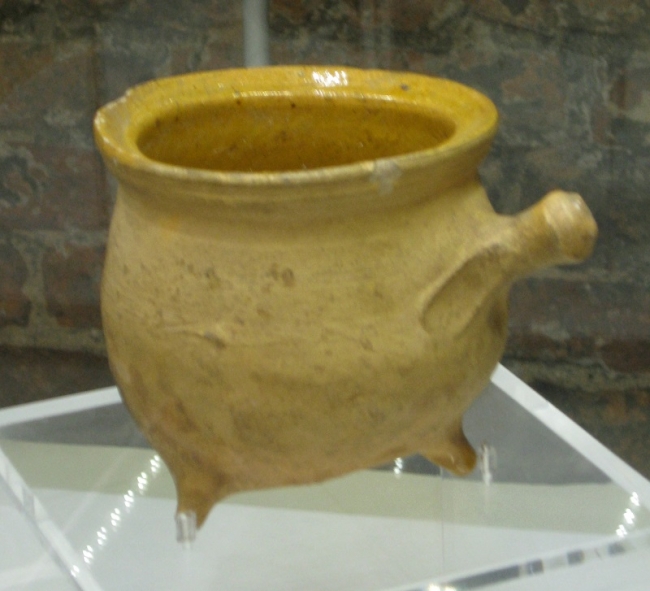
Sussex white ware pipkin, 16th
century - source Hampton Court
Less usual shapes were chamber pots, moneyboxes, skillets (frying pans) and pipkins. Pipkins were cooking pots with a handle and spout, often with short tripod legs, and rather like a saucepan. Small versions were probably ladles. Spouts were pinched, sparrow-beak or tubular with a septum or bridge support. Early shapes were copies of imported wares or designed by immigrant potters. Some cooking pots were glazed on the inside rather than the outside to reduce seepage and others had rims frilled like piecrusts. Mortars were used to grind meat and spices, and although many were stone or metal some were ceramic. Several examples exist of cheap pottery copies being made of metal items used by the rich. Unusually, some wares were inscribed on the base with the name of the maker or buyer. There was a good two-way flow of wares between Britain and the Continent. Imports were red painted wares, fine red-bodied wares with a white slip and shiny glaze, as well as two types from Gascony related to the wine industry. One was a thin-walled white jug with green mottled glaze and the other had unglazed polychrome decoration with shields or birds.
A significant change in the 14th and 15th centuries was that although many potters had worked in the monasteries receiving appropriate support, with their closure they had to find an alternative way of life, setting up in villages and towns.
After the 14th century new shapes of metal vessels took over from some pottery, mainly for cooking, usually using cast iron. This is evidenced by the lack of soot on the base of some later earthenware pots. Cooking habits changed, with the kitchen removed to the end of a building rather than the middle, having metal pots suspended from the chimneypiece. Some pottery copies of these cooking pots were made subsequently. Pottery cisterns with bungholes became popular – probably used to brew beer or ale that became common in the 15th century as brewing increased. Some inroads were made in pottery drinking cups, replacing earlier wooden or even leather ones. Puzzle jugs and cups were also introduced. In Cornwall they produced some flat bottomed cooking wares with high parrot beak shaped projections to protect the string used to suspend them over the fire, pointing to the use of immigrant potters from the Low Countries.
| Page: 332 of 418 Go To Page: | |
◁◁ First | ◁ Previous | Next ▷ | Last ▷▷ |
Author: Dr. Stan Jones © Copyright 2010 -