

12. European Pottery - Fall of Romans to the Present
| 1444 Page: 333 of 418 Go To Page: |  |
◁◁ First | ◁ Previous | Next ▷ | Last ▷▷ |
The 16th and 17th centuries roughly covered the reigns of the Tudors and Stuarts. Prior to Henry VIII (1509-1547) few ceramic pots had migrated from the kitchen onto the dining table, but there would have been jugs in the buttery/serving area. During his reign, reasonable quality moulded and incised plates of whitish clay covered in green glaze were introduced replacing wooden platters and trenchers (carving and serving boards). Also ash wood cups were replaced by pottery ones at the Inns of Court in his reign. “Clay” pipes were made in huge quantities as tobacco was imported from America. Chafing dishes became popular to hold food dishes above glowing charcoal, equivalent to modern “hostess trolleys”. “Tudor Greenware” was used to produce many shapes including inkpots, moneyboxes, stove tiles, watering cans, candleholders and vessels to distil brandy.
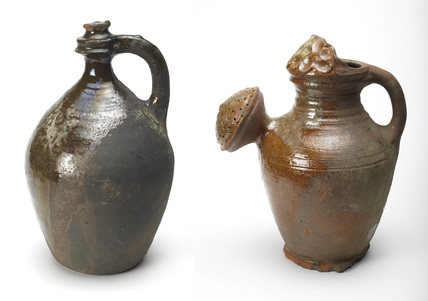
Tudor watering cans, left one having perforated
base operated by thumb on top
- © Museum of London
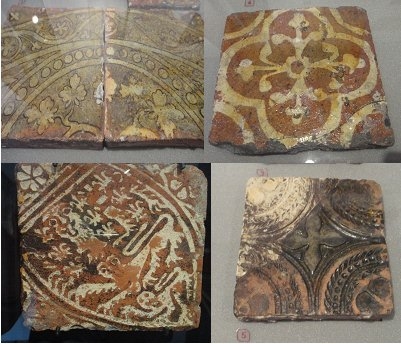
14-15th century English tiles, Lancaster Abbey,
Derbyshire white clay inlaid with copper/lead
glaze, wooden stamp and white clay inlaid, and
relief pattern using stamps and tools - Image
courtesy of the Potteries Museum and Art
Gallery, Stoke-on-Trent
The stove tiles were typically 13” x 10”, hollow and green glazed. Floor tiles were used extensively in buildings, based on red and white firing clays. Fuming pots were commonly used to overcome medieval smells. They contained herbs and spices heated by charcoal. Another interesting ceramic item of the Tudor Period was used to cover a fire overnight to prevent sparks flying out. This was called a “Couvre-feu”, which led to the English “curfew”. “Cistercian” ware had a shiny dark brown or black glaze over a reddish body and was used for jugs and tall cups, some with multiple handles called “tygs”, probably after the Anglo-Saxon word for “object made of clay”, some were decorated with white slip or incised with horizontal lines, rosettes or stag or goat heads. The addition of iron to the glaze produced shinier “Midlands Blackware”, which spread throughout Britain and was still used to make bread bowls to the end of the 19th century.
Although tin-glazed wares had been imported into Britain previously, tin-glazed earthenware (Delftware) started to be made in Britain around 1550 AD, causing lead-glazed wares to decline. It appeared in Norwich in 1567 and London in1570, assisted by migrant Dutch potters driven out of their own country by religious persecution. Records show potters from Antwerp worked in Aldgate, London in 1571. It was the first “white” pottery to be made in Britain and featured drug jars and tiles. A notable area of production, particularly when Delftware became popular in the 17th century, was south of the Thames in London, producing mainly blue and white, but some polychrome, Delftware.
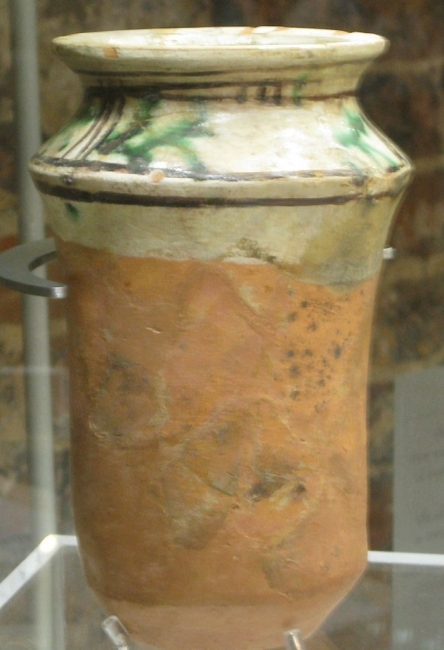
Tin glazed pot
- source Hampton Court
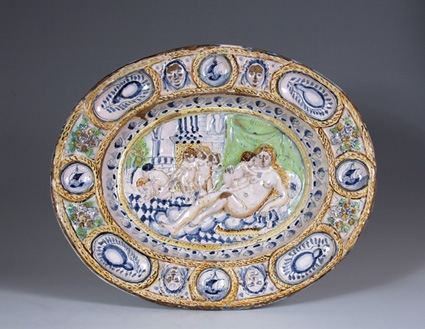
English Delftware 1660
- courtesy E&H Manners
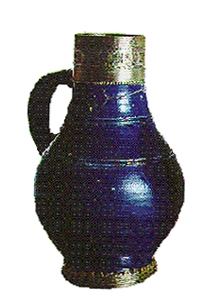
Mallingware jug
- source web via “nautarch”
Some early Delftware jugs were called “Mallingware”, after a church in Kent where one was found. Some were coloured turquoise and others probably mimicked tigerware having a blue ground flecked with orange. Many have pewter or silver mounts.
| Page: 333 of 418 Go To Page: | |
◁◁ First | ◁ Previous | Next ▷ | Last ▷▷ |
Author: Dr. Stan Jones © Copyright 2010 -