

12. European Pottery - Fall of Romans to the Present
| 1445 Page: 334 of 418 Go To Page: |  |
◁◁ First | ◁ Previous | Next ▷ | Last ▷▷ |
Wine bottles were also produced with the name e.g. Sack, and the date painted in blue. One pottery was in Southwark, where a Dutch immigrant potter C. Wilhelm set up the “Pickleherring” factory in 1618. It was influenced by Chinese Wanli blue and white ware with birds amid flowers. Other active locations were Lambeth and Fulham.
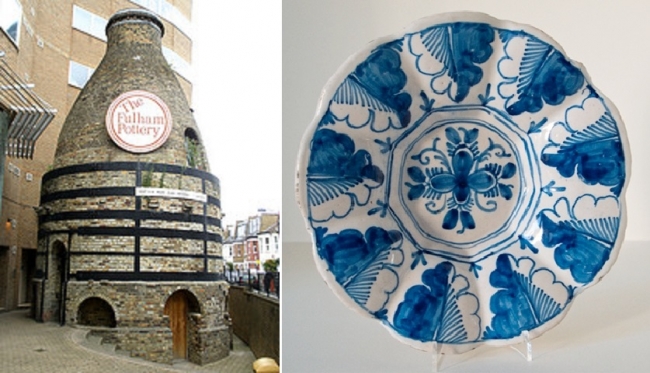
Fulham pottery and 1860 lobed plate from
Lambeth - source amandabhslater, and
courtesy Juno Antiques
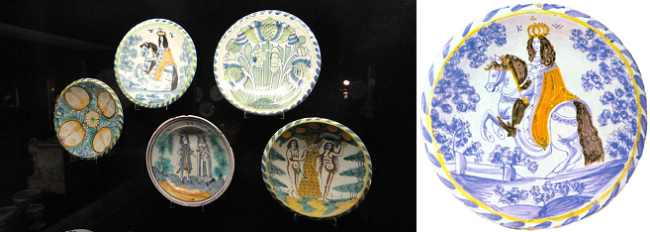
Blue dash chargers – group of five,
Image courtesy of the Potteries Museum and
Art Gallery, Stoke-on-Trent and William of
Orange 1690 source web via nautarch
There were also potteries producing Delft in Bristol (1645) and Liverpool (1710) as well as in Staffordshire. One impetus for its popularity was because Charles I (1625-1645) like Louis XIV (1643-1715) had to send their silverware to the mint for coinage to pay their armies, so they needed a supply of good quality, inexpensive Delftware to replace it, prior to porcelain being available locally. A second impetus was because at that time Britain was not producing much other art of particular merit. Some large polychrome dishes/plates (chargers) were made from 1600 featuring borders of blue dashes – the “blue dash chargers”.
In the second half of the 17th century these British Delftware chargers became popular and featured, amongst other designs, a portrait of Charles II (1660-1685) or Adam and Eve. Although rarely marked, some Delftware was dated making it particularly collectable. Towards the end of the 17th century Delft tableware was produced and polychrome painting increased in popularity. Delft production peaked around 1750, but production continued in Lambeth until 1846. In the mid 18th century overglaze painting was introduced on tin-glazed wares, but Creamware started to supplant it towards the end of the 18th century.
One of the major developments in the 16th and 17th centuries was slipware. This was based on a red-bodied earthenware with decoration of dotted and trailed slip, initially directly on the body of the pot but later on a slip ground. Some Wrotham, Kent wares, notably tygs, bear dates and potter’s initials; and London ones, mainly dishes, bear religious scenes and sometimes puritanical inscriptions. A famous area for the production of decorative and functional pottery in Europe is around Stoke-on-Trent in Staffordshire, England, hence the term “The Potteries”. This is mainly because it had a good supply of suitable clay (except white) and coal for the kilns. Initially farmers and smallholders made pots as a sideline, digging and firing the clay themselves. Pottery making in Staffordshire took off in the 16th century producing domestic pots for local yeomen and agricultural workers, also usually decorated with dotted and trailed slip. In the 17th century it became a major centre for slipwares and from around 1660 very elaborate vessels were made mainly having a creamy yellow ground, with a brown pattern including combed zigzags and swirls. Large dishes were decorated with dots of light coloured slip outlining the main design, called “jewelling”. Wares also included beautiful, now rare, slipware by Ralph Toft and a relative Thomas Toft, who were active in Burslem around 1675. Slipware was produced in Staffordshire until the end of the 18th century.
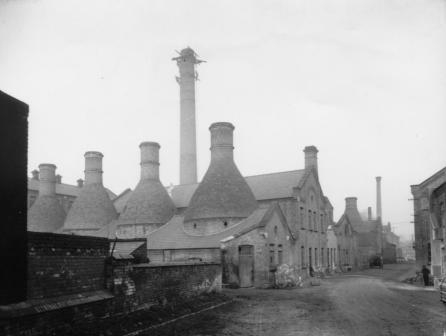
Example of large pottery, Worcester from
the back gate 1895 - courtesy Worcester
Porcelain Museum
Multi-flue bottle kilns sprang up like forests in areas having major pottery industries, such as Stoke-on-Trent. Moulding was preferred to manually intensive wheel throwing, using biscuit or plaster-of-Paris moulds. When used, wheels were turned mechanically. They allowed more consistent body forms with thinner walls. At the end of the 17th century Galena (lead sulphide) was replaced by Litharge (lead oxide), which produced a shinier glaze. Slipware decoration became quite complex, for example, illustrating King Charles II hiding in a tree or St George on horseback. Most utilitarian pottery in the 18th and 19th centuries was red bodied with yellowish lead glaze. However some black glazed wares continued, some with white decoration. An interesting item was a pottery insect trap having an unglazed “road” leading to a glazed “well” to be filled with an aromatic liquid to drown the intrepid visitor.
| Page: 334 of 418 Go To Page: | |
◁◁ First | ◁ Previous | Next ▷ | Last ▷▷ |
Author: Dr. Stan Jones © Copyright 2010 -