

12. European Pottery - Fall of Romans to the Present
| 1447 Page: 336 of 418 Go To Page: |  |
◁◁ First | ◁ Previous | Next ▷ | Last ▷▷ |
In the 17th century development work to manufacture stoneware began in Britain. Francis Place (1647-1728) was a painter and engraver in York who experimented with ceramic bodies in his workshop. There is a black and brown marbled coffee cup with a grey stoneware body made by him in the Victoria and Albert Museum. Around 1670 John Dwight gave up his job as an ecclesiastical lawyer to become a potter in Fulham. He learned the salt-glazing process, and he produced good copies of Bellarmines and bottles in brown salt-glazed stoneware having a marbled finish and stamped and applied ornamentation. His formulae are thought to be based on German Cologne ware. He also produced the earliest British pottery figures. Charles II had granted him a patent in 1671 to make “transparent earthenware” meaning porcelain, which was his main intention, and this is the first recorded evidence of an attempt to make porcelain in Britain. However, what he developed seems to have been not so much “transparent” stoneware but frit porcelain two years before Poterat in France. Other stoneware production centres at this time were Bristol and Nottingham. Nottingham wares had thin walls, did not have a mottled finish, but they often had inscriptions and incised patterns. They also produced a bear-shaped mug on which the fur was produced by sprinkling clay crumbs onto the surface. Staffordshire stoneware was often glazed solely on the top part of the vessel.
The British East India Company had been formed in 1600 but focussed mainly on India. In 1669 their first shipment of tea to Britain from China also contained some of the Chinese red Yi-hsing stoneware teapots (considered to be porcelain at the time) that became much sought after for tea making in Britain.
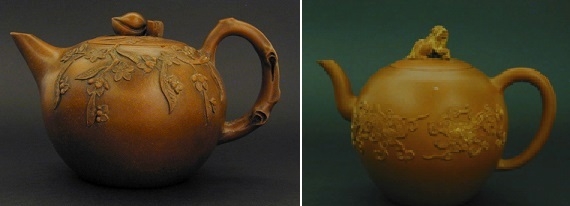
Yi-hsing or Yixing teapots - courtesy
R&G McPherson Antiques
Interestingly there was confusion over the origins of imported wares as the respective “East Indian Companies” shipped them, so the popular “Indian Boy” pattern actually depicted a Chinese boy!
John Dwight took out a further patent in 1684 on the technology for his replacement of Yi-hsing ware. At this point the Dutch Elers brothers, John-Philip and David, previously silversmiths, also brought the red stoneware technology to Britain from Delft. They found an excellent seam of red firing clay in Staffordshire and started to make red stoneware, decorated with stamped reliefs often of prunus blossom. Dwight sued them, Morley of Nottingham and Aaron, Richard and Thomas Wedgwood for breach of patent, but came to a compromise agreement with them. However, it appears from records that Dwight did not exploit his red stoneware patent commercially from his own factory, although stoneware manufacture continued at Fulham after his death, and was copied elsewhere. The inefficient hand-made manufacturing methods used by the Elers caused their pottery to fail financially in 1698, even though towards the end of the 17thcentury they introduced more efficient slip casting and lathes to finish their red stoneware.
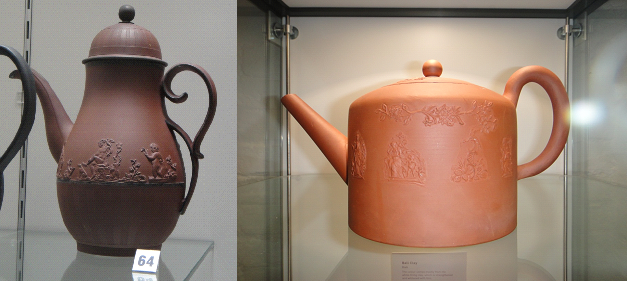
Staffordshire red ware coffee pot with
sprigged decoration, 1800 and teapot, 1760
- Image courtesy of the Potteries Museum
and Art Gallery, Stoke-on-Trent
As mentioned previously, lathes were also mentioned in Aaron Shaw’s inventory in 1714, and Isaac Marsh had a turning house in his works in 1732. The technology of red stoneware seems to disappear, and from 1720 Staffordshire potters made lead-glazed red earthenware copies instead, which by the 1740’s had become very good quality. They were press-moulded or wheel-made and decorated with “sprigged” ornamentation and with pseudo-Chinese seal marks. By 1750 red stoneware reappeared that was high-fired, very hard and thin, and used for a range of tableware having relief plant sprig decoration, but the red ware petered out around 1800.
| Page: 336 of 418 Go To Page: | |
◁◁ First | ◁ Previous | Next ▷ | Last ▷▷ |
Author: Dr. Stan Jones © Copyright 2010 -