

12. European Pottery - Fall of Romans to the Present
| 1449 Page: 337 of 418 Go To Page: |  |
◁◁ First | ◁ Previous | Next ▷ | Last ▷▷ |
White salt-glazed stoneware was made in Staffordshire, Leeds and Derby around 1690 as a substitute for porcelain, initially using a grey ware dipped in white slip, then after 1720 made of imported white clay with calcined flint as temper that produced a hard and light body. This ware dominated the market until indigenous porcelain and Creamware became widespread in the 1770’s. White stoneware was wheel thrown and finished on a lathe. From about 1730 to 1775 wares called “scratched blue” were incised with floral motifs and highlighted in blue. Press moulding was used from the 1730’s, using metal, wood or fired clay moulds together with slip casting. Later moulds using plaster of Paris improved the quality of decoration, and piercing appeared. While some stonewares were left white, others were decorated to imitate Chinese imports using enamelling and gilding. Thomas and John Wedgwood subsequently became the major manufacturer, after Aaron, their father, died in 1743.
From the end of the 17th century there was a neo-classical revival, partly influenced by the discovery of Pompeii. Vessels brought back included some made from semi-precious stones provoking the imitation of stones such as agate. Thomas Whieldon was probably the first exponent of agate and marbled ware, which was made between 1725 and 1750. This was achieved by using clays or slips of differing colours. Slabs of different coloured clay were laid on top of each other and beaten to form a striated mass of clay, or a lathe was used with slips to produce the marbling effects. Early versions were salt glazed and later ones had a clear lead glaze. Visually attractive fine pottery had become a status item in Britain.
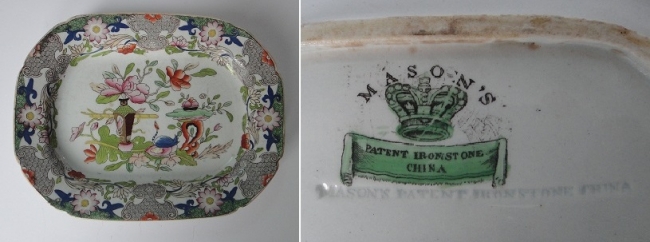
Mason’s ironware shallow dish and
manufacturers marks on base
William Turner was the first successful manufacturer of “Ironstone China” in 1800 at the Lane End Pottery. It is a dense heavy form of vitreous earthenware, near to fine stoneware containing white clay, feldspar and glass frit, fired around 1100-1200 degrees C. His patent was transferred to Spode in 1805, but Charles James Mason, who obtained a separate patent in 1813 and coined the name Mason’s “Ironstone” China, made the ware popular. Mason’s formula used Cornish white clay, ironstone slag (from blast furnaces), flint and a little cobalt oxide making it bluish-white. His decoration used underglaze transfer printing with colourful overglaze enamels.
Around 1850 slip casting was used to produce white or brown salt-glazed, relief-decorated stoneware jugs and teapots. Doulton was a major stoneware manufacturer that was started by John Doulton in Lambeth in 1815, producing solely utility wares. His son Henry joined the company in 1835, was very ambitious and grew the company, still in utility pottery. Based on this success he moved into decorative wares and won international acclaim. After 1860 Doulton copied 18th century brown stoneware, made figures and incised vases with decoration such as those illustrating animals, particularly horses, by artists such as Hannah Barlow.
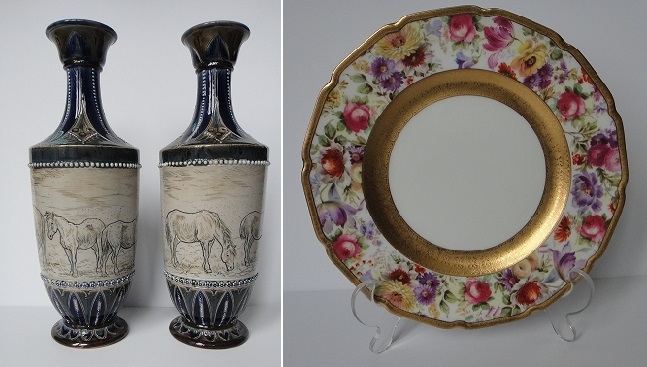
Doulton vases by Hannah Barlow, 1898, and
floral edged plate signed E Percy
In 1877 Henry moved to Burslem in Staffordshire and Doulton became one of the finest pottery producers in the world. In the 20th century Doulton figurines became particularly popular collector’s items.
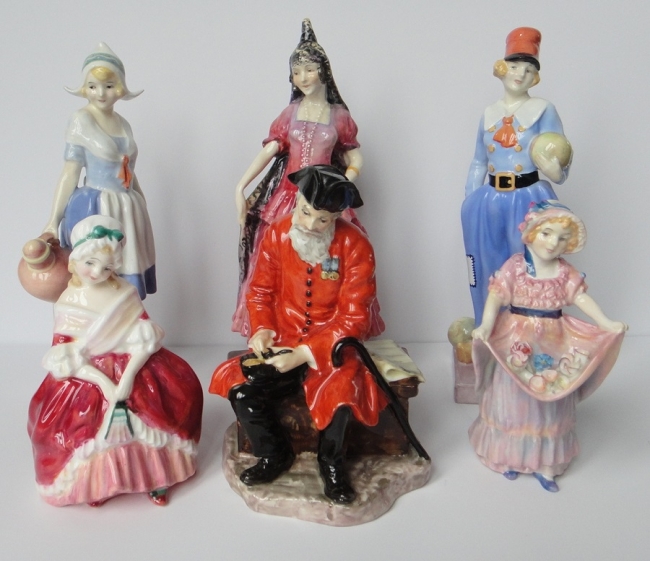
A collection of Doulton figures
Another Lambeth pottery owned by the Martin Brothers produced very amusing, grotesque stoneware vases that are very collectable today. Amusing wares can also be obtained today at local craft fairs.
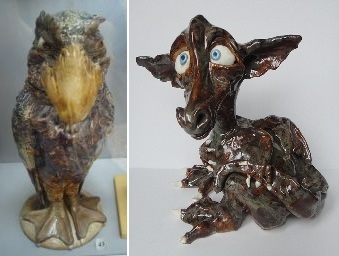
Martin Brothers amusing bird, reproduced
by permission of Plymouth City Council
Museums and Archives, and a typical craft
fair dragon figure
More recently there have been a number of craft potters producing uniquely designed and decorated earthenware and stoneware, some well known such as Charlotte Rhead (1885-1947 AD) and Bernard Leach. The latter trained a large number of potters before his death in 1979.
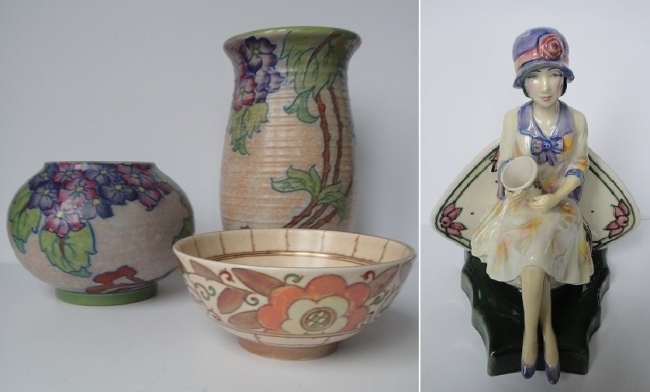
Charlotte Rhead pottery and Staffordshire
pottery figure of Charlotte Rhead
| Page: 337 of 418 Go To Page: | |
◁◁ First | ◁ Previous | Next ▷ | Last ▷▷ |
Author: Dr. Stan Jones © Copyright 2010 -