

12. European Pottery - Fall of Romans to the Present
| 1451 Page: 339 of 418 Go To Page: |  |
◁◁ First | ◁ Previous | Next ▷ | Last ▷▷ |
A number of figures, notably of a girl-on-a-swing in the V&A Museum, London, was unascribed until research at Sevres showed that Charles Gouyn, left Chelsea and set up the St James pottery that operated from 1748 to 1759. It mainly produced small items such as perfume bottles and patch boxes in polychrome or left white.
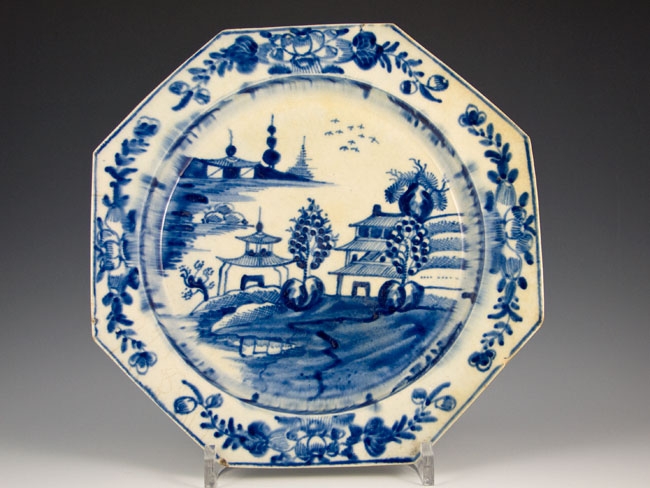
Isleworth plate 1765 - courtesy Juno Antiques
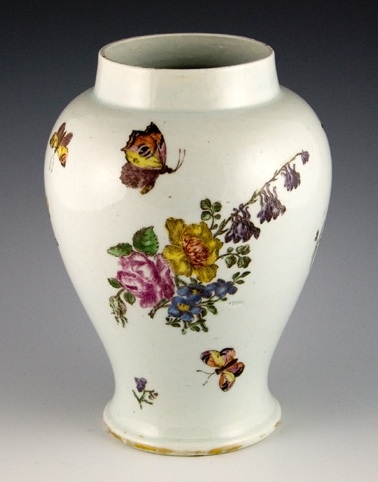
Vauxhall vase 1756-58
- courtesy Juno Antiques
There were several other factories in Britain that produced soft-paste porcelain, sometimes after producing Delft, such as Vauxhall (1751-64) founded by N Crisp and J Sanders who used a steatite body, decorated in underglaze blue and polychrome, including early printing. The discoveries at its site in the 1980’s led to the reattribution of Vauxhall’s wares that were previously thought to be made by W Bell of Liverpool. Similarly, the site of the Limehouse pottery (1745-1748) that was rediscovered in 1990, led to another reattribution of wares, this time from W Reid of Liverpool. Isleworth was another of London’s early potteries, starting in 1757 and operating for some 40 years.
Bow was possibly the successor to the “unknown” factory producing A–mark wares around 1744-1745. Bow was certainly founded by Thomas Frye around this date, as he took out patents on the use of calcined bone in porcelain in 1744 and 1748. Production started in about 1747, and around 1750 Bow started to add calcined bones to its soft-porcelain body. In the same year the company was taken over and the factory renamed “New Canton”, although Frye continued to work at Bow until 1759. They produced many figures, its most noted modeller being called Tebo, possibly a Frenchman named Thibaud, later at Plymouth.
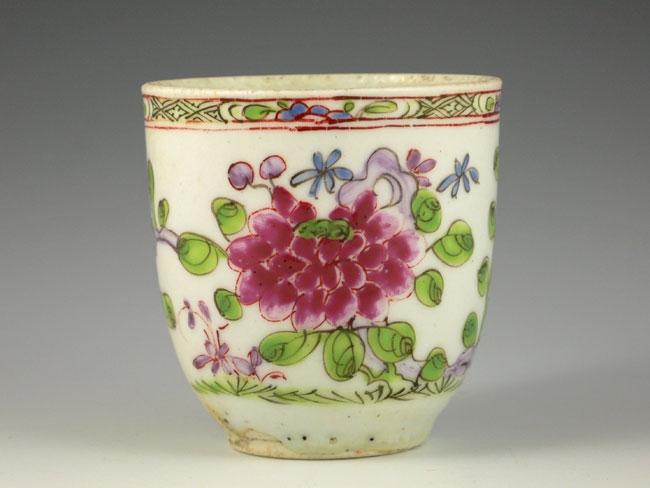
Bow famille rose cup 1752 - courtesy Juno Antiques
Bow used some clay brought from Virginia by the American Andre Duche, who probably produced hard-paste porcelain around 1741 in his pottery in Savannah, Georgia, that he started in 1730. This made it the earliest hard-paste porcelain in an English speaking country. He was unable to raise the finance to exploit his development in USA, so travelled to the UK to sell his ideas, although Bow did not take up his offer. Duche also visited William Cookworthy in Plymouth on his way back to USA. The tableware and figures made by Bow were less sophisticated than Chelsea’s and aimed at a middle-class market including much underglaze blue decoration, although polychrome wares and figures were also made. The Bow factory started to decline and was sold to William Duesbury in 1776 and all the moulds and implements moved to Derby.
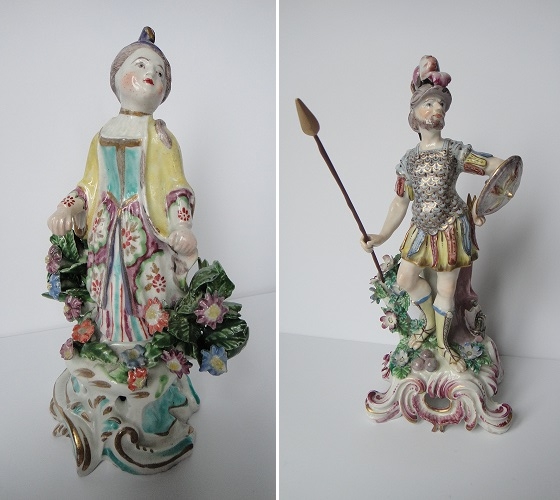
18th century Bow figures,
flower seller with gold anchor and dagger and Mars
Lowestoft was set up in 1757 by 5 partners, one, Robert Browne previously had worked at Bow. The body used a very fine soft-paste porcelain using calcined bone. They produced a range of middle priced wares, decorated in underglaze blue to 1768, and then printed in underglaze blue and polychrome. They also made some figures, mainly copying Bow styles. Lowestoft closed in1802.
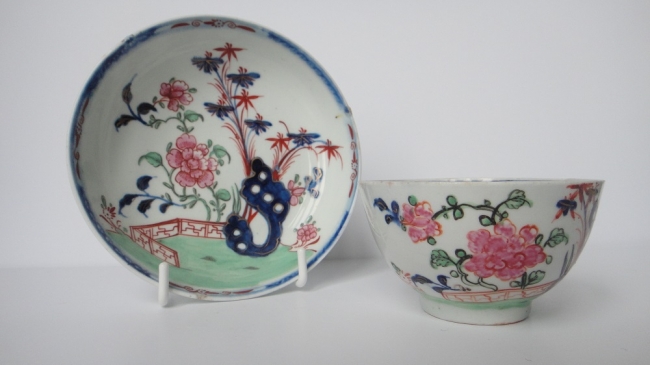
Lowestoft cup and saucer, 1785
| Page: 339 of 418 Go To Page: | |
◁◁ First | ◁ Previous | Next ▷ | Last ▷▷ |
Author: Dr. Stan Jones © Copyright 2010 -