

12. European Pottery - Fall of Romans to the Present
| 1452 Page: 340 of 418 Go To Page: |  |
◁◁ First | ◁ Previous | Next ▷ | Last ▷▷ |
Longton Hall (1749-1760) in Staffordshire made salt-glazed stoneware and soft-paste porcelain figures as well as tableware moulded as leaves. Longton Hall was noted for their figures although some were excessively glazed so appeared “fuzzy” and are sometimes referred to as “snowmen”. Painting was often in “Littler’s blue” pigment, based on cobalt and devised by William Littler who was a partner from 1751. William Duesbury worked as a decorator at Longton Hall around 1753-55. The factory was closed in 1760 with a sale of 90,000 ceramic items.
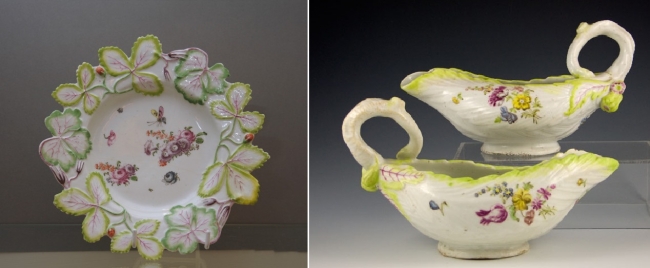
Longton Hall, plate 1755, source
online-galleries, and sauce boats,
courtesy Juno Antiques
Prior to its closure, around 1755, Littler moved to the West Pans pottery that was started by Cistercian monks around 1154. He launched Scotland’s porcelain industry and started producing costly wares relying on the support of the well off. This declined and Littler closed the pottery around 1777. R Bagnall reopened it in 1784 making Creamware. It finally closed in 1818.
A pottery was started in around 1750 in Derby by another Huguenot silversmith, Andre Planche, producing “dry-edged” figures, so-called because the glaze did not reach the base. Some were decorated by William Duesbury in his workshop. This operation did not last long, and in 1756 Duesbury and banker John Heath bought the pottery in Derby and Duesbury ran it until his death in 1785, and it continues today. They used a soft-paste body initially, and although it was suitable for fine figures, it was not resistant to thermal shock and so unsuitable for tableware.
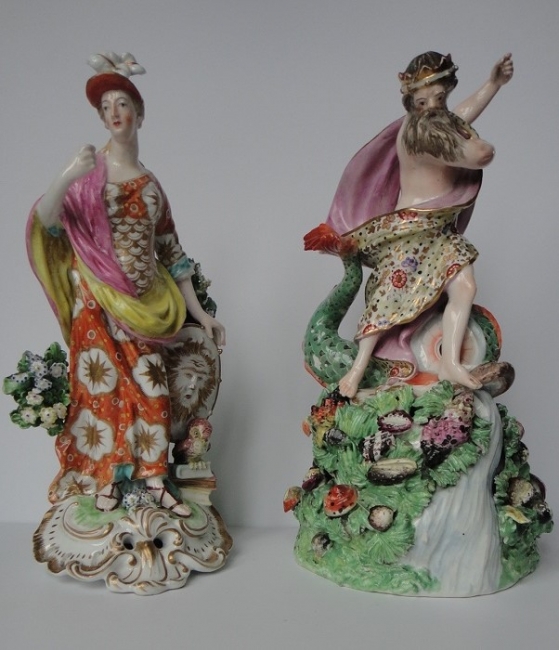
18th century Derby figures of
Minerva and Neptune
Duesbury developed a new body containing steatite and calcined bone, which led to Derby’s fine tableware. They started using continental decorative designs, such as birds, flowers, landscapes and figures, but on British body shapes (some from metal ware). They recruited some great painters including Billingsley and “Quaker” Pegg.
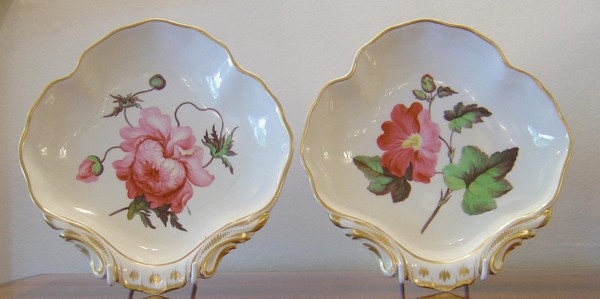
Small dishes painted with Derby flowers by
Quaker Pegg - source online-galleries
Their output of fine figures probably equals the entire output of the other British manufacturers. Derby acquired Longton Hall in 1760, Chelsea in 1769 and Bow in1776, and this concentration of resources made it a major force in 18th century Europe. The fine painting at Derby, particularly landscapes and flowers, continued into the 19th century and later. One of the most popular later designs for Derby tea wares is the Imari pattern.
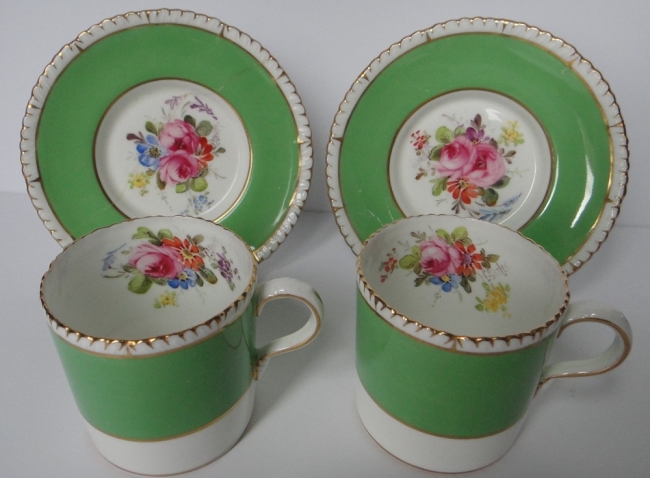
Part of Derby floral teaset from 1937
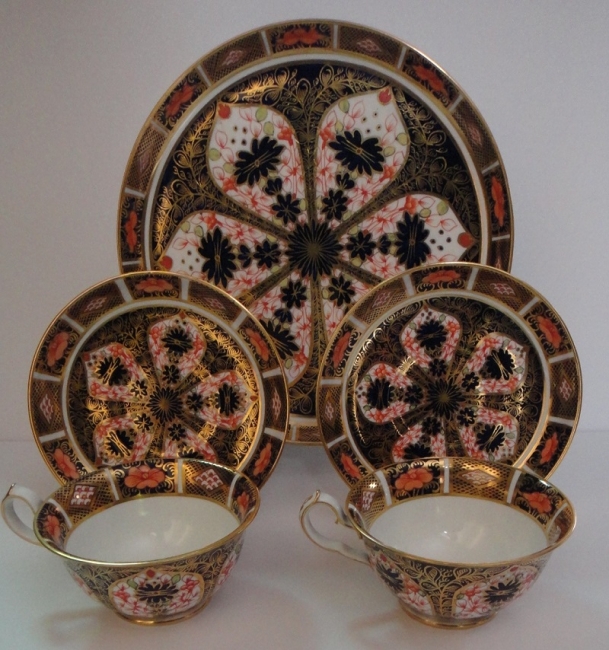
Derby Imari tea service, 1913/14
| Page: 340 of 418 Go To Page: | |
◁◁ First | ◁ Previous | Next ▷ | Last ▷▷ |
Author: Dr. Stan Jones © Copyright 2010 -