

12. European Pottery - Fall of Romans to the Present
| 1453 Page: 341 of 418 Go To Page: |  |
◁◁ First | ◁ Previous | Next ▷ | Last ▷▷ |
Benjamin Lund set up probably the first viable soft-paste porcelain pottery outside London in 1748 in Bristol. It produced wares mainly in underglaze blue with Chinoiserie decoration. However, it was short lived and, together with its secret soapstone (steatite) formula, it was transferred in 1752 to the Worcester pottery set up by Dr John Wall in 1751. This was a time of much experimentation in pottery bodies, and Worcester was making several simultaneously including frit porcelain, bone china and a body with 40% steatite. Worcester was particularly noted for its ornamental wares and elaborate dinner services, whereas Bow, Derby and Chelsea rather more for their figures. One challenge put to early British porcelain producers was to copy Chinese items from services that had become broken, and various examples exist including a Chinese Imari decorated cup and saucer by Worcester, as well as a service made for Raby Castle to replace pieces of an earlier Chinese service.
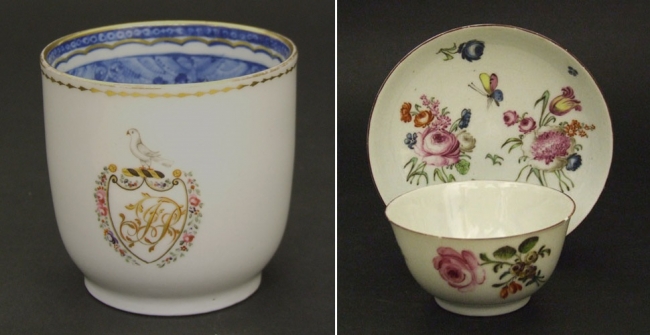
English hard paste replacement of a Qianlong cup,
made 1790-1815, and a Qianlong tea bowl (1750)
decorated in London 1755/6 with matching Longton
Hall saucer, 1758 - courtesy R&G McPherson Antiques
Transfer printing was an important technology in the development of decoration in the 18th century. It was probably first invented by an Irishman called Brooks in London in 1746 and further developed by Simon Francis Ravenet, a French printing expert, at the York House, Battersea, factory that operated successfully from 1753 to 1756. Here copper plaques and small items such as boxes were decorated with colourful enamels using transfer printing. Ravenet worked with Robert Hancock to develop its use on pottery, and it was first used at Bow around 1756. Two of the partners at Worcester, Josiah and Richard Holdship, introduced printing using engraved copper plates to their factory, and in 1756 Robert Hancock began employment at Worcester and remained there until 1774.
The Caughley pottery (1750-1799) was set up in Shropshire by Browne and taken over by Ambrose Gallimore in 1754. Caughley followed Worcester as the second user of transfer printing technology, and from 1760 underglaze printing was used there using blue or black paint on a white ground that became very fashionable. Caughley started to produce soft-paste, steatite-based porcelain in 1775 using Worcester technology and styles when Robert Hancock joined the company. They produced good quality utilitarian blue and white wares, while their polychrome and gilded wares were sent to be decorated by Chamberlains. Privately Thomas Turner (a partner of Worcester) became a partner in the company with Gallimore in 1772. In 1799, partly because of Turners ill health, the business was sold to J Rose of Coalport who used it to produce white ware for painting at Coalport until about 1814.
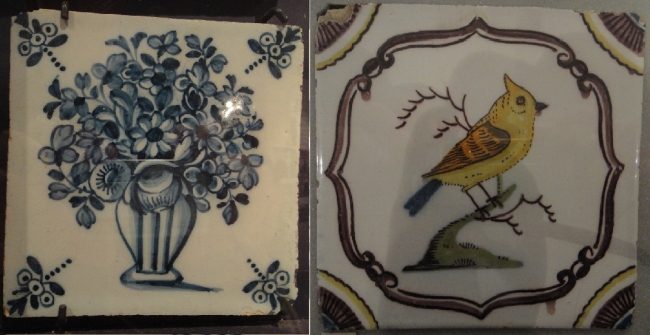
Liverpool tiles, 1760 - Image courtesy of
the Potteries Museum and Art Gallery,
Stoke-on-Trent
Sadler and Green in Liverpool were also reported to be early experimenters in transfer printing probably before 1756, including polychrome in the 1760’s. It was to a large extent Worcester and Wedgwood who further developed the art of transfer printing that contributed to mass-production technology. Initially the only pigment that could be used under the glaze was imported cobalt, so most other colours for decoration were used over the glaze.
| Page: 341 of 418 Go To Page: | |
◁◁ First | ◁ Previous | Next ▷ | Last ▷▷ |
Author: Dr. Stan Jones © Copyright 2010 -