

12. European Pottery - Fall of Romans to the Present
| 1456 Page: 344 of 418 Go To Page: |  |
◁◁ First | ◁ Previous | Next ▷ | Last ▷▷ |
The Cookworthy/Champion patent for hard paste porcelain, excluding the monopoly on West Country clays, was subsequently sold to a group of six Staffordshire potters including John Turner, Samuel Hollins and Anthony Keeling in 1780. Richard Champion moved to Staffordshire to help them set up the company that become Newhall in 1782. Newhall produced a variety of wares in hard-paste porcelain until 1810 when bone china was introduced. The factory closed in 1835.
Much of the problems of competition were due to the difficulties of transport of raw materials and fuel. Those factories with access to canals had a great advantage.
Hard porcelain never really took off in Britain compared with the Continent, as other acceptable wares had by now become established.
Two major factories, Wedgwood and Worcester, are described below as examples of companies involved in the forefront of the development of ceramics in Britain from the 17th to the 20th centuries.
12.3 Wedgwood
The history of Wedgwood is of a pottery Dynasty based in Staffordshire. As it is a rare name, although not always spelt the same way, the family can be traced back to Henry of Wedgwood, living round 1300, and Stephen de Wegewood who lived from 1358 to 1393. Their family tree is rather complicated because of the large sizes of some of the families and the repeated use of the same few Christian names. A series of Richard Wedgwoods in the 16th century culminated in a Richard Wedgwoode (1544-1626), his youngest son Gilbert Wedgwood (1588-1678) from Biddulph was the first Master Potter of the line. Another important family in the story that can be traced back to the 14th century was the Burslem family of Burslem, one of the six towns making up Stoke on Trent in the Potteries. Thomas Burslem (1565-1628) was the owner of both Dale Hall, where he lived until 1616 and Overhouse to where he moved. He had two daughters, Margaret and Katherine. Katherine married a potter William Colclough (1590-1662) and Margaret married Gilbert Wedgwood in 1612, and later Gilbert bought Dale Hall in Burslem from his father-in-law. On Thomas Burslem’s death the bulk of his estate passed to Katherine and William Colclough. Records show that Gilbert was the appraiser of goods at Thomas Adams, a potter, in 1629, and he signed himself as “potter” at his fifth son, Gilbert II’s wedding ceremony. Later he operated from the Overhouse site.
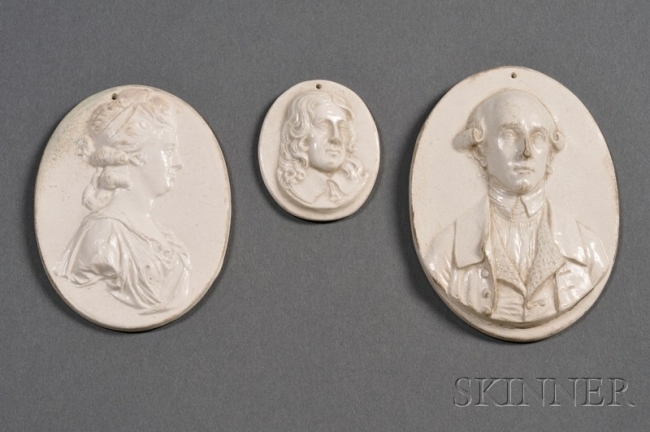
White salt glazed stoneware 1800
- courtesy Skinner Inc
Gilbert had a total of eight sons and three daughters. The eldest son was Burslem (1614-1652), then Thomas I (1617-1679); Gilbert’s third son was Moses, the fourth William, the fifth Gilbert and the sixth Aaron I. Following the marriage of Gilbert’s second son Thomas I to Margaret Shaw, he was given 50% of John Shaw’s Churchyard Works in 1657, although he was probably already a potter. The Thomas Wedgwood family occupied Churchyard House alongside the Churchyard Works from that date until 1773. On the death of Katherine in 1669, following that of her husband, William Colclough, the bulk of their estate went to Katherine’s great nephew also named Burslem (1649-1696), while Thomas I inherited pottery equipment from William’s half brother John. The family now had a number of branches, many having an involvement in potteries, and several sites including Dale Hall, Overhouse and Churchyard. One very important family branch was based at the Red Lion pottery site. Aaron Wedgwood II (1667-1743), the son of Aaron I, built a thriving business after partnering with the Elers brothers between 1690 and 1693. This experience prompted the Wedgwoods to make stoneware and salt glaze, and white salt-glazed stoneware was included in Wedgwood’s early productions at the end of the 17th century. By 1733 white stoneware made of flint and native clays, slipped with white Devonshire clay and salt glazed was very popular and widely exported. Aaron II’s business was taken up by his two sons, Thomas (1703-1776) and John (1705-1780). Their pottery became the largest in the potteries, specialising in salt glazed stoneware, and by 1737 they were using lathes in the production process.
| Page: 344 of 418 Go To Page: | |
◁◁ First | ◁ Previous | Next ▷ | Last ▷▷ |
Author: Dr. Stan Jones © Copyright 2010 -