

12. European Pottery - Fall of Romans to the Present
| 1457 Page: 345 of 418 Go To Page: |  |
◁◁ First | ◁ Previous | Next ▷ | Last ▷▷ |
The brothers made sufficient money to retire in luxury and their factory closed in 1763. Aaron’s brother, Richard, had a daughter called Sarah, who plays an important subsequent role in the Wedgwood dynasty. Also descended from Aaron I, Dr Thomas Wedgwood was recorded as a maker of brown stoneware between 1710 and 1750. From William’s family line, his son, Thomas (1643-1719), was followed by another potter, Aaron Wedgwood (1671-1746). Differentiating the various family lines is quite a problem!
At around this time another North Staffordshire potter named Astbury was also experimenting with pottery bodies. He had noticed the whiteness of ground flint used by vets and tried it in his feldspathic earthenware, which became noticeably whiter and harder. He was possibly the first to import pipe clay from Devon to decorate his ‘flatback” groups, around 1720. His son Thomas experimented with the body producing the precursor to Creamware.
Returning to Gilbert’s Wedgwood’s son Thomas I of Churchyard House, his second son Thomas II (1660-1716) was a Master Potter, as was, in turn, the latter’s first son Thomas III (1686-1739) and they each ran the pottery business at the Churchyard Works that was rebuilt by Thomas II. Thomas III married Mary Stringer in 1709, and they had twelve children, the first boy, Thomas IV (1716-1773) and the last Josiah (1730-1795).
Josiah Wedgwood was said to be the greatest potter of all time and “the father of English pottery”, although he was clearly supported by a formidable heritage. Josiah Wedgwood pioneered much ceramic technology and invented several new ceramic bodies during his illustrious career. He started work at the age of nine, on the death of his father, in the family’s Churchyard Works, which his elder brother Thomas had inherited. Thomas was the Master Potter, and Josiah became apprenticed to him for five years at the age of fourteen. However, Josiah’s right knee had been damaged and weakened by smallpox when he was twelve, and because of this he could not work as a thrower as he was unable to operate the pedal of a potter’s wheel effectively. This meant he had to focus on design and experimentation. His request for a partnership in his early twenties was declined, so he left to partner with Thomas Whieldon in his pottery in 1754. This was the time Josiah Spode and Aaron Wood worked with Wedgwood at the Whieldon factory. There Wedgwood started his lifetime of experimentation and by 1759 he had developed the fine green and yellow glazes used to decorate the pots moulded in the form of fruit and vegetables.
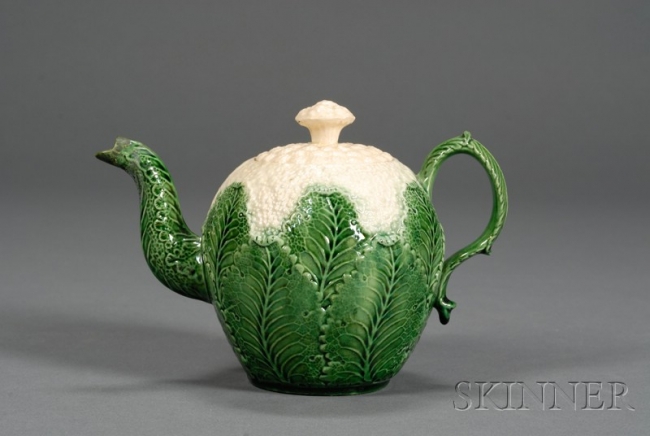
Wedgwood cauliflower teapot 1765 -
courtesy Skinner Inc
He decided to set up on his own and leased the Ivy Works in Burslem from his cousin on 1st May 1759 and worked there until 1764. His friend Thomas Whieldon allowed him to take the results of his experimentation with him, and he also took Whieldon’s original ideas on agate ware and the tortoiseshell effect, and carried out considerable further development work on them. One of his goals was to develop an earthenware with a brilliant glaze that would endure sudden changes of heat and cold. In 1763 he developed a much-improved cream coloured earthenware with a body of ground flint and pipe clay covered with a reintroduced brilliant lead glaze. This glaze matched the body well and did not craze easily compared with the softer tin opacified glazes on Delft. The biscuit firing was 1050 to 1150 degrees C and glazing 900 to 1050 degrees C.
In 1764 Josiah married his third cousin Sarah, the daughter of Richard of Red Lion, who was financially well endowed and could support his pottery aspirations and, in the same year, he leased the Brickhouse Works from the Adams family. However, his leg had become so troublesome that he had to have it amputated around this time, as it was thought to threaten his life.
| Page: 345 of 418 Go To Page: | |
◁◁ First | ◁ Previous | Next ▷ | Last ▷▷ |
Author: Dr. Stan Jones © Copyright 2010 -