

12. European Pottery - Fall of Romans to the Present
| 1458 Page: 346 of 418 Go To Page: |  |
◁◁ First | ◁ Previous | Next ▷ | Last ▷▷ |
Wedgwood’s new ceramic body was the famous “Creamware” that was of fine quality and cheap enough for everyday use. Its universal application spread from dairy vessels to armorial wares, and Josiah’s interest in seashells resulted in shell-shaped wares. The clay was much easier to handle for the new neoclassical styles that were popular outside Britain, so exports took off. As a result of the success of Creamware, Delftwares declined rapidly, and by the end of the 19th century Delft stopped being produced in Britain altogether, and only two factories remained in Holland where it began in Europe.
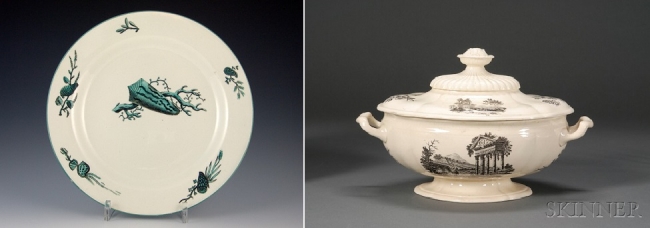
Wedgwood Creamware plate 1777 and tureen 1780
- courtesy Juno Antiques and Skinner Inc
In June 1765 Wedgwood received an order from Queen Charlotte (wife of George III) for a tea and coffee service in the new ware that she consented to be called “Queensware”. Some of these wares were sent to Liverpool to be transfer printed by Sadler and Green. Their engravers had been used previously by Wedgwood to produce black and red transfer printing. Queen Charlotte appointed Wedgwood to be Her Majesty’s Potter in 1765.
Josiah was not only an expert workman but organisationally he was well ahead of his time, and the Wedgwood Company started the systematic improvement of quality in Britain (ideas that spread well outside the pottery industry). Creamware was exported to Germany and France, causing the continental porcelain and faience factories to suffer severely from the competition, so they started to copy it. Wedgwood had assumed the dominant position Meissen and Sevres had earlier, but the difference was that Wedgwood was a wholly private company. A variation of Creamware called “Pearlware” was developed, if not actually invented, by Wedgwood in the 1760’s with a new glaze that made it closer to porcelain in appearance.
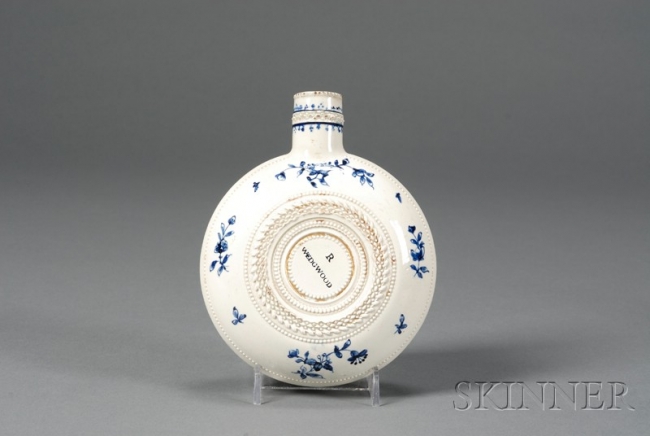
Wedgwood pearlware flask late 18th C
- courtesy Skinner Inc
This ware allowed the potters great flexibility permitting complex painted or printed scenes on a cheap earthenware body. A rival Leeds factory also produced this ware, and sometimes pearlware items were pierced. Both factories produced a wide range of painted wares. In 1779 Wedgwood introduced a new pearl white body for tableware. By the start of the 19th century pure white earthenware was finally achieved.
During the 18th century culinary moulds became popular for jellies, blancmanges and other gelatine-set sweet and savoury dishes. These appeared in a huge range of shapes, sizes and designs, some in saltglaze, but most were Creamware.
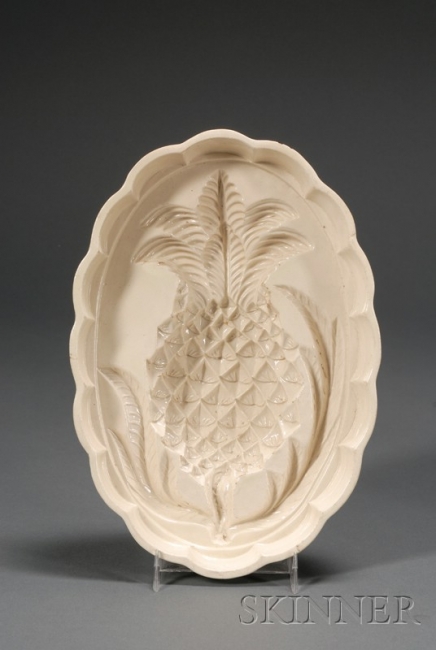
Queensware pineapple mould 1800
- courtesy Skinner Inc
Although many were for eating they were also just used for table decoration, some being two-part, an inner painted piece and outer shell that was removed when the jelly had set to leave the inner decoration visible through the jelly.
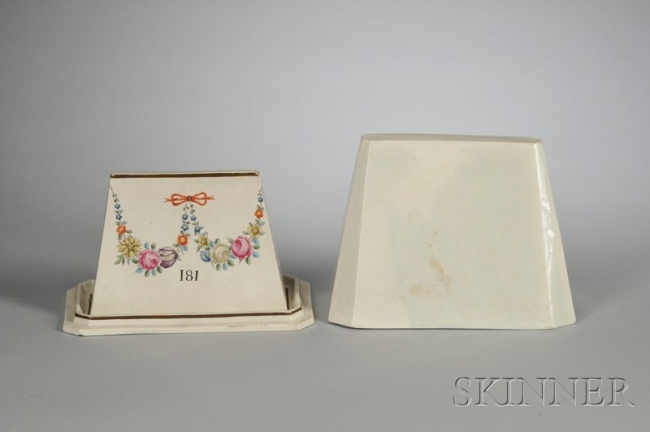
Wedgwood jelly mould and cover
- courtesy Skinner Inc
Because roads were so poor in the 18th century, the transport of pots by road was impractical, so canals were developed to transport them without breakages. They also permitted the cheap transport of bulk raw materials. Hence the owners of potteries such as Wedgwood became involved in the construction of canals, and Spode improved roads. In particular Wedgwood supported the Trent-Mersey canal connecting Liverpool and the Potteries. Josiah, his friend Erasmus Darwin and Thomas Bentley were heavily involved in lobbying parliament for this canal, which was to pass the Etruria site.
In July 1766 Wedgwood had bought the Ridgehouse Estate of 350 acres and that is where he founded the Etruria pottery in 1769. It was named after the Etruscan Master Potters who were the source of so much high quality Attic ware found in Italy. The factory was at the forefront of modern manufacturing technology at the start of the Industrial Revolution, so much so that it became a “Mecca” for visiting manufacturers, politicians and royalty.
| Page: 346 of 418 Go To Page: | |
◁◁ First | ◁ Previous | Next ▷ | Last ▷▷ |
Author: Dr. Stan Jones © Copyright 2010 -