

12. European Pottery - Fall of Romans to the Present
| 1460 Page: 347 of 418 Go To Page: |  |
◁◁ First | ◁ Previous | Next ▷ | Last ▷▷ |
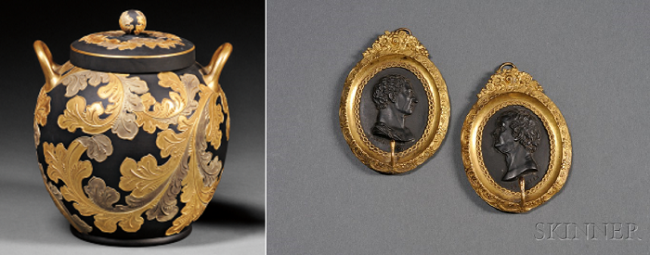
Wedgwood gilded black basalt potpourri, 1885
and medallions 1776 - courtesy Skinner Inc
Although Josiah Wedgwood was a pioneer in production technology and made many advances in mass production, using lathes effectively in the production process in 1763, he is probably best known today for his two other, mainly ornamental, unique wares, black Basalt and Jasper stonewares. In the late 18th century chemists such as Josiah Wedgwood introduced a great deal of science into pottery processes, which allowed him to produce novel formulae for bodies based on this technology. Interestingly he imported several tons of Cherokee clay in 1768 to use in the development of different bodies including the later Jasper ware body. As he admired, and wanted to produce imitation classic vases, he started by copying Attic ware, beginning with black Basalt. This is a fine textured unglazed stoneware, coloured black with manganese and cobalt oxides, which he introduced around 1768.
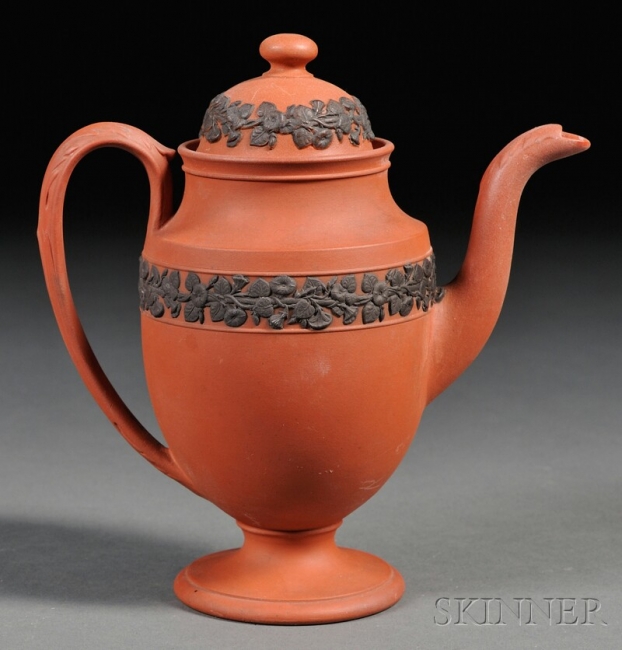
Wedgwood red coffee pot, 1820
- courtesy Skinner Inc
It is a very hard stoneware, polished on a lapidary wheel (hard enough to polish precious stones), impervious, so not requiring a glaze. It was sometimes painted to imitate the matt surface of classical Greek black and red figure vases such as Attic Hydria, using the so-called encaustic decoration. (Originally this method used an inlay of a different coloured clay to make the decoration, but Wedgwood used coloured slip). Otherwise decoration on vases, candlesticks, plaques, tea wares etc. was moulded and applied, or incised on the lathe. Basalt teapots were especially popular with women, as the black colour set off their white hands well. This body was also used to make busts, and Wedgwood also developed a red stoneware body, using it to produce the same classical designs. To mark the opening of the Etruria factory, Josiah threw six Basalt vases with his colleague Thomas Bentley turning the wheel.
Josiah partnered with the well-respected Thomas Bentley and in 1769 formed Wedgwood and Bentley, with Bentley mainly responsible for sales and the Chelsea, London Studio. During this partnership the company produced spectacular imitation agate and porphyry vases based on a cream-coloured earthenware body coloured with different metal oxides.
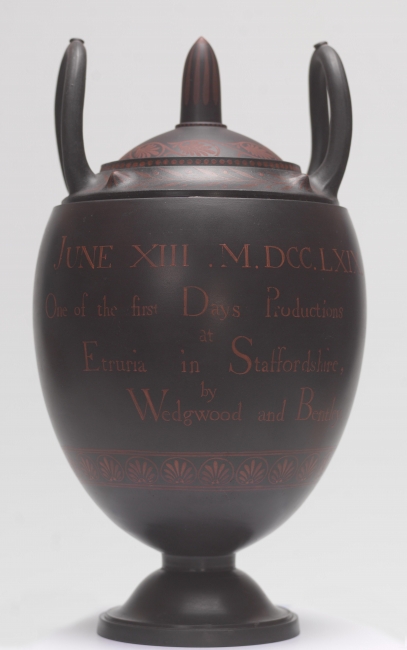
Wedgwood basalt commemorative
“First Day” vase - Image courtesy
of the Wedgwood Museum
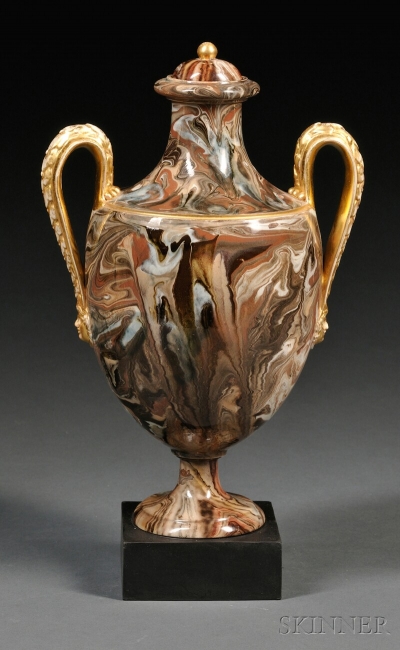
Wedgwood & Bentley agate
ware, 1775 - courtesy Skinner Inc
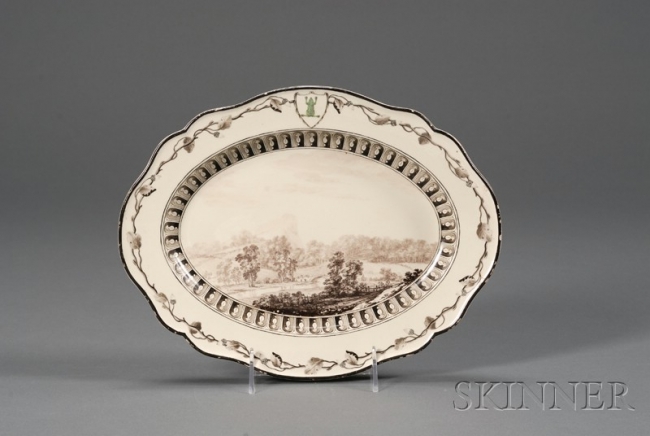
Wedgwood “frog” platter 1774 - courtesy Skinner Inc
In 1773 Wedgwood received a second order from Catherine the Great of Russia (the first was ordered in 1770) for a massive Creamware dinner and dessert service of 952 pieces, each piece hand-painted with a British topographical scene, and with a green frog crest (the Frog Service) as it was to be used at the Palace of La Grenouillere (The Froggery). Much of the painting was carried out in their Chelsea decorating studio. It was put on display in London before shipping, causing great interest, and a few extra demonstration pieces remain in circulation today.
Also in 1773 the Churchyard Works were closed, although they were bought by Thomas Green in 1785 and ultimately became the home of Crown Staffordshire. On the death of Thomas Bentley in 1780, Josiah promoted his nephew Thomas Byerley to take over the London office. Significantly for the family’s future, Josiah turned for the advice he had been receiving from Bentley to Erasmus Darwin.
| Page: 347 of 418 Go To Page: | |
◁◁ First | ◁ Previous | Next ▷ | Last ▷▷ |
Author: Dr. Stan Jones © Copyright 2010 -