

12. European Pottery - Fall of Romans to the Present
| 1461 Page: 348 of 418 Go To Page: |  |
◁◁ First | ◁ Previous | Next ▷ | Last ▷▷ |
In 1772 Wedgwood began experimenting with a new body, probably inspired by Sevres biscuit porcelain. He created Jasper stoneware around 1774 by adding barium sulphate to the clay and flint body that caused it to be vitrified to a slightly translucent white, creating a fine-grained, unglazed pure white stoneware, almost porcelain. The name was chosen to reflect its resemblance to the natural stone in hardness. The Jasper body could be coloured with metallic oxides giving blue, lilac, green, yellow, brown and black.
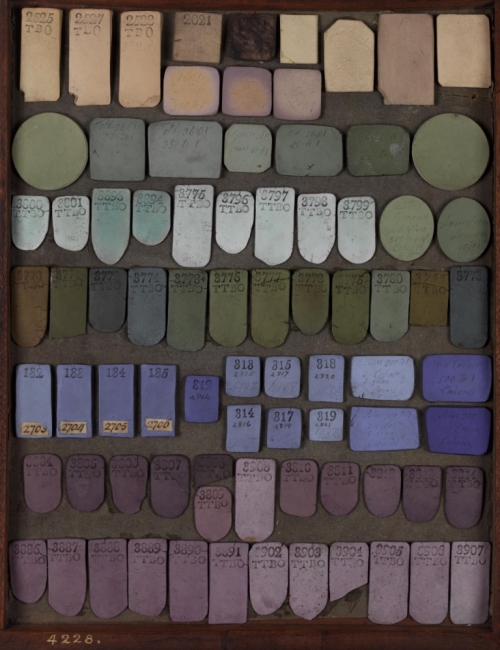
Jasper colour trials - Image courtesy of
the Wedgwood Museum
Jasper ware was used for figures and groups, such as a child in white on a brown plinth holding a green blanket. Josiah was interested in cameo and in 1774 he made the first bas-relief figures, the design of which was based on Roman cameo glass, which were applied to the Jasper bodies. These very detailed applied relief scenes and figures were made initially in white and applied to a blue body, often copying the classic Greek style made popular by the excavations at Pompeii and the work of the architects John and Robert Adam.
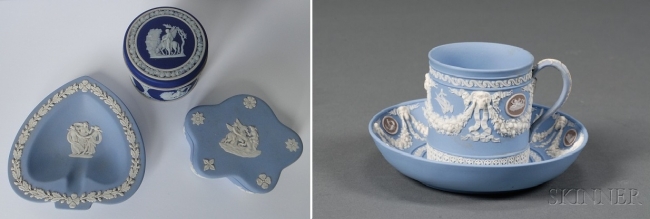
Collection of Wedgwood white on blue
jasper and three colour cup and saucer
1870 - courtesy Skinner Inc
The bas-reliefs were made in hard earthenware moulds. They started with a large model that shrank on firing. They then used this to produce the next mould that again shrank when fired, and so on until they achieved the right size, retaining the original detail. At first the entire body clay was coloured with the metallic oxides, but later just the surface was coloured. Many shapes were produced; commonly, ornamental vases, tea wares, plaques and interesting portrait medallions, but the less common items included snuffboxes, beads and opera glasses. Various eminent artists were employed to design the bas-reliefs including George Stubbs. Stubbs was a friend of the family and interested in painting with ceramic enamels, firstly on copper and then on biscuit earthenware.
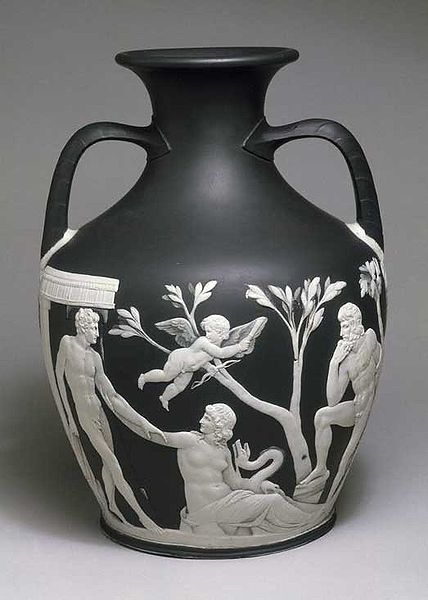
Wedgwood Portland vase
- source Wikipedia via Magnus
Manske – location V&A museum
Josiah strived to use this technology to copy the magnificent Portland or Barberini glass vase, thought to have been made by Alexandrian craftsmen in Rome in the first century BC. It had been found in the tomb of Emperor Severus containing his ashes. It is a fantastic cameo glass vase of dark blue glass decorated with white figures. Sir William Hamilton, ambassador to Naples, bought it in 1783 and sold it to the Dowager Duchess of Portland. On her death in 1785, it was put up for sale at auction and her son the third Duke of Portland contested with Josiah Wedgwood for ownership. By agreement Wedgwood dropped out when the Duke promised to lend it to him, which he did a few days after the auction. Wedgwood’s copy was based on a dark Jasper body with applied low or bas-relief, but even after four years of experimentation it proved difficult to achieve adequate quality and consistency. One major problem was that the extremities of the glass cameos could be feathered into the glass body, but this was extremely difficult to achieve in applied ceramic relief. He had to make a number of versions before he was satisfied with the result in 1789 when some 43 had been made as a first edition, but several of these still had faults. The original glass vase now resides in the British Museum. A vandal broke it in 1845 and Wedgwood’s version was used as a guide to piece together the original.
| Page: 348 of 418 Go To Page: | |
◁◁ First | ◁ Previous | Next ▷ | Last ▷▷ |
Author: Dr. Stan Jones © Copyright 2010 -