

12. European Pottery - Fall of Romans to the Present
| 1462 Page: 349 of 418 Go To Page: |  |
◁◁ First | ◁ Previous | Next ▷ | Last ▷▷ |
Three of Josiah’s children are particularly noteworthy, Susannah Wedgwood married Robert Darwin, son of Erasmus Darwin, in 1817 becoming the mother of Charles Darwin, Dr Thomas Wedgwood (1771-1805) is described as the father of photography for his pioneering research on “solar pictures” with Humphrey Davy, and John Wedgwood was a founder of the Royal Horticultural Society.
On the death of Josiah in 1795, his children had either developed a career outside pottery or were too involved with the social whirl to bother to run the factory, so Tom Byerley took over, and the company traded under the name Wedgwood and Byerley. However, there was a series of economic events that damaged the company, including the deteriorating relations with the United States (eventually leading to the war between USA and Britain in 1812), and the Napoleonic revolution. Josiah’s eldest son John returned in 1800 and his brother Josiah II joined him in 1805. The road to financial recovery was long and difficult.
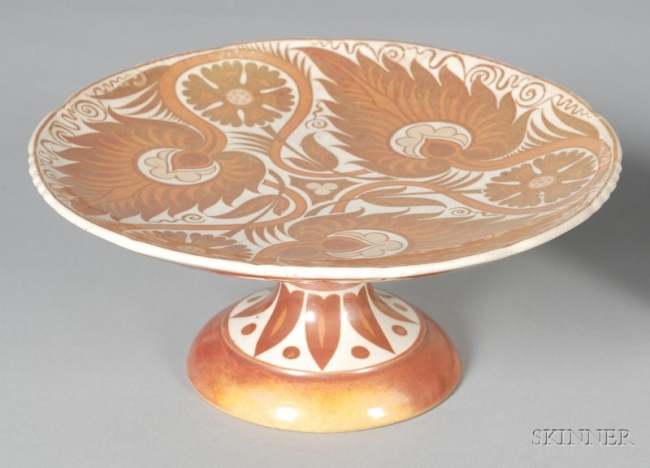
Wedgwood pink lustre for William de Morgan
1894 - courtesy Skinner Inc
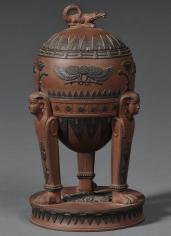
Wedgwood Egyptian style vase
- courtesy Skinner Inc
In the early 19th century the Wedgwood factory produced lustreware, and around 1805 it used platinum to produce a silver colour, which was used to imitate silver metal ware. John Hancock had invented the technique of platinum lustre at Spode at the end of the 18th century. Around the middle of the century they also developed a pink and white lustre, imitating mother of pearl. Sometimes lustre grounds were used with relief designs in reserve. Gold was used to produce pink lustre when applied over a white slip, or a copper colour if directly applied on a red ground. In the Regency period, Oriental and Egyptian motifs were popular.
Wedgwood developed and introduced bone china between 1812 and 1829, and in the 1820’s it was painted using coloured enamels in a range of colourful patterns and styles. Its manufacture resumed in 1878 and continues to the present day. Brown painting on a cream ground was introduced in 1835, used for decorations illustrating foreign towns and ships.
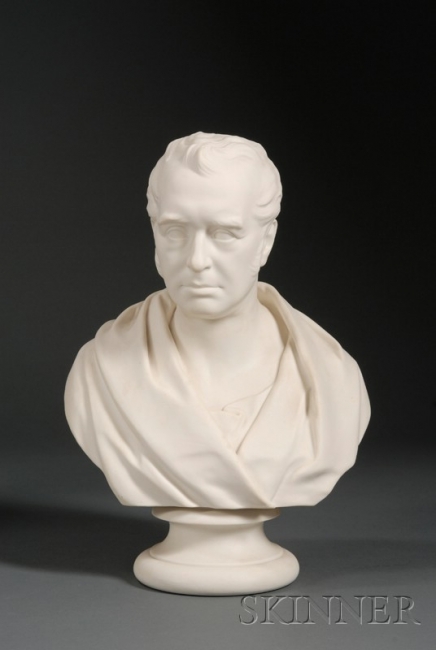
Wedgwood Parian bust of
George Stephenson - courtesy
Skinner Inc
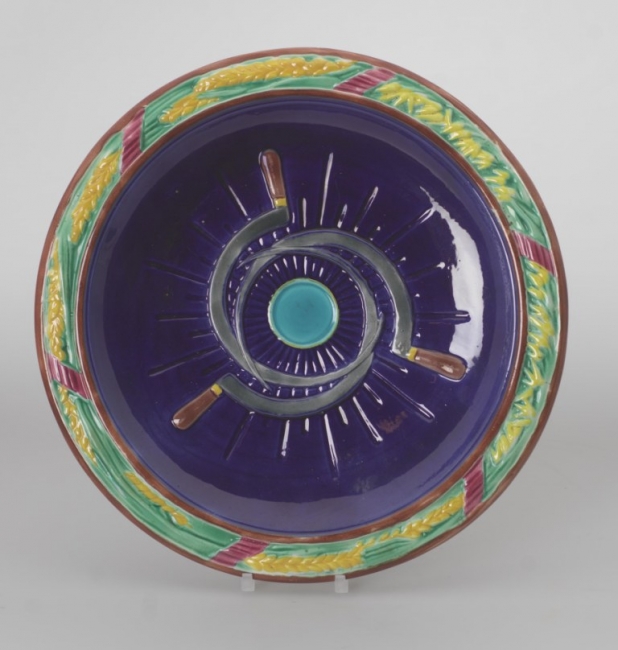
Wedgwood majolica bread plate with sickles
and wheat, 1880 - Image courtesy of the
Wedgwood Museum
Tastes in the Victorian era changed, and statuary marble became popular, so in 1848 the company produced Parian ware called “Carrara” after the white marble quarries in Tuscany. Majolica was also produced in 1860 to meet the growing demand created by Mintons, and production continued until 1910. This earthenware body was covered in brightly coloured glazes and used for products as diverse as tableware and garden seats. At this time several eminent artists worked at Wedgwood including Emile Lessore (from Sevres) and Walter Crane. Wedgwood attended London exhibitions in 1851, 62 and 71 to great acclaim, even showing sanitary wares. A new art director, Thomas Allen, was appointed in 1880. His lasting legacy is the superb figure painting depicting semi-draped nudes, so popular in Victorian times.
| Page: 349 of 418 Go To Page: | |
◁◁ First | ◁ Previous | Next ▷ | Last ▷▷ |
Author: Dr. Stan Jones © Copyright 2010 -