

12. European Pottery - Fall of Romans to the Present
| 1463 Page: 350 of 418 Go To Page: |  |
◁◁ First | ◁ Previous | Next ▷ | Last ▷▷ |
In the 20th century Wedgwood was mainly concerned with surface decoration rather than new bodies or shapes. At the start of the 20th century they extended their business in the USA and a service of around 1,300 pieces was sent to President Theodore Roosevelt (1901-1909) at the White House. In the 20’s Major Frank Wedgwood, who was a great, great grandson of Josiah I, led the Company in its expansion. After the First World War significant investment was made at Etruria such as oil-fired tunnel ovens and electric muffle ovens. On his death in 1930 Frank Wedgwood was succeeded by his nephew Josiah V who had been company secretary since 1927. Josiah V introduced new designs in the “arts and crafts” style, and in the 1930’s planned a new factory at Barlaston, a brave decision bearing in mind the world economy and the company’s financial status at the time. In fact the company’s survival in the mid 30’s was hugely dependant on an order from Cadburys for a large number of branded product containers (Bournvita mugs)!
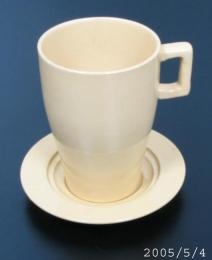
Bournvita mug 1933 - source
Powerhouse Museum
Josiah argued that although investing in a new factory was a great risk, the risk of standing still was even greater. The problems were exacerbated because the Etruria factory was suffering terrible pollution from adjacent factories causing serious quality problems, as well as major subsidence from coal mining, which limited the operation of larger plant such as rail-mounted kilns. So in 1936 it was decided to move from Etruria to a garden setting in Barlaston, where Josiah V had bought 300 acres, and to construct an ultra-modern manufacturing operation. Electric double-tunnel ovens were specially designed by Brown Boveri, and the factory was heralded as the latest word in factory technology. The foundation stone at Barlaston was laid on 10 September 1938, and production began there in 1940. The government considered that the construction of the factory was a matter of national importance, mainly based on the valuable exports to USA. Eighty percent of production was undecorated utility ware under the laws covering the war period, although decoration was permitted for these export wares. “Utility Ware” was especially designed by Victor Skellern to be as flexible as possible so that lids could double as bowls and cups as sugar basins. The Company also obtained large orders from the Government for the forces and ordnance factories. Transfer of all operations from Etruria was delayed until 1951 to comply with wartime imperatives, and to accommodate this delay, work was optimised so that, although bone china was made at Etruria, it was glazed in Barlaston to avoid the pollution.
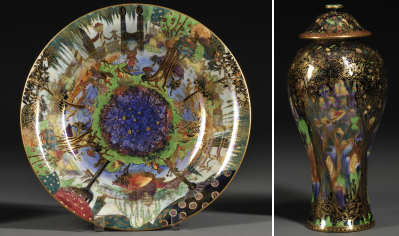
Wedgwood fairyland lustre - courtesy Skinner Inc
The Company has been associated with ten reigns of British monarchy since Queen Charlotte’s royal warrant. A noted artist Eric Ravilious designed a commemorative mug for Edward VIII’s Coronation. He was lost in action as a war artist in 1942, but his designs were used subsequently for royal occasions.
In 1945 multi-coloured lithography was introduced, causing the demand for free-hand painting to decline. However, artists started to produce unique “artwares”. Walter Nunn specialised in historical characters, while Dr Christopher Dresser and “Daisy” Makeig-Jones introduced the first range of lustres with dragon, butterfly and fish designs in 1914. Two years later Daisy brought out the “Fairyland” range that were popular up to the end of the 20’s, and today are both very popular and expensive.
| Page: 350 of 418 Go To Page: | |
◁◁ First | ◁ Previous | Next ▷ | Last ▷▷ |
Author: Dr. Stan Jones © Copyright 2010 -