

12. European Pottery - Fall of Romans to the Present
| 1470 Page: 353 of 418 Go To Page: |  |
◁◁ First | ◁ Previous | Next ▷ | Last ▷▷ |
Kerr was particularly responsible for rebuilding the facilities at the factory, greatly improving quality, particularly of fine bone china, and expanding the operation from a workforce of 75 to a highly skilled workforce of 400 (thanks partly to the Worcester School of Art). In 1862 Kerr decided to return to Ireland, so the pottery workers made him a magnificent blue ground porcelain vase decorated in Limoge-style enamels as a leaving gift in gratitude for his contribution to the company. During the Kerr and Binns period spectacular Parian models were also produced.
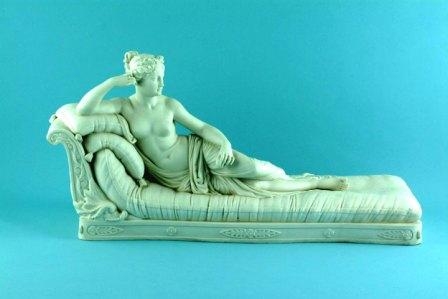
Parian figure by Pauline Bonepart -
courtesy Worcester Porcelain Museum
As the company was operating successfully, but required capital to grow, Binns was able to attract other investors by forming a joint stock company “The Worcester Royal Porcelain Company” on 24th June 1862. Binns was made Director of artistic production and he contributed greatly to both artistic merit and company management. Some important services were made in the early days of “Royal Worcester”, including one presented to the Prince of Wales on his marriage in 1863, for the Countess of Dudley in 1865 and another for the Prince of Wales in 1875 that was still in use in Sandringham in the 1970’s. Various special items were made for exhibitions such as the Hastings vase.
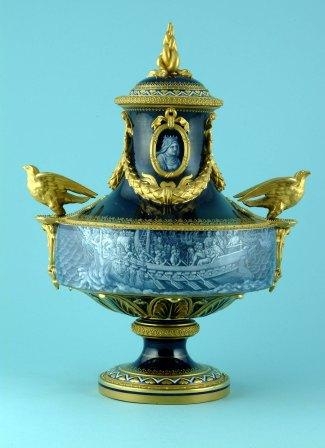
Hastings vase by Thomas Bott, 1868 -
courtesy Worcester Porcelain Museum
The Company also took part in European Art Fairs, including London in 1862, Paris in 1867 and Vienna in 1873. In Paris and Vienna, Binns designed their wares in a style influenced by Japanese tastes. Binns was an enthusiastic collector of early Worcester wares and saved a considerable amount of historic Worcester pieces by purchasing from a broker much of the old stock when Warmstry closed. He also set up the first Royal Worcester museum. Binns was responsible for setting up a chemical development laboratory in 1873, as the finer the wares became, the better the process had to be controlled. Development work was also carried out on the use of gas for fuelling the kilns. In Paris in 1878 there was a major exhibition of Worcester wares, still in the Japanese style, where they won the Legion of Honour jointly with Mintons. Attendance at these exhibitions gave the Company scope not only to exhibit their artistic qualities but also to bring back to Worcester ideas based on the products of other countries and companies. These activities and others, such as the visit of the Prince and Princess of Wales in 1884, put the Royal Worcester Company well into prominence. In 1891 Binns became ill and retired in 1897, although he was working on a book on Worcester porcelain when he died in 1900. In 1893 a major exhibition was held in Chicago where Royal Worcester had a large display including the largest porcelain vase they ever produced, the “Seasons” or “Chicago” Vase. The vase was a huge challenge. It was modelled by James Hadley, moulded by John Finney and painted by Edward Raby.
A popular tableware at the turn of the century was “blush”, which was made in a large range of shapes.
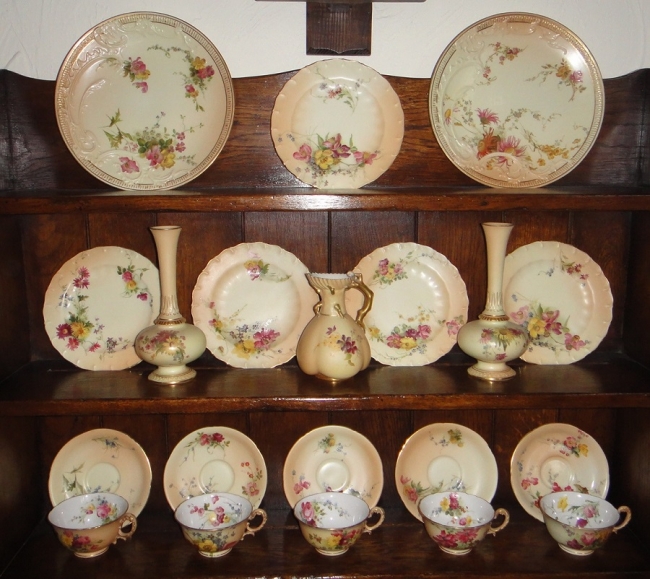
Collection of blush Worcester porcelain
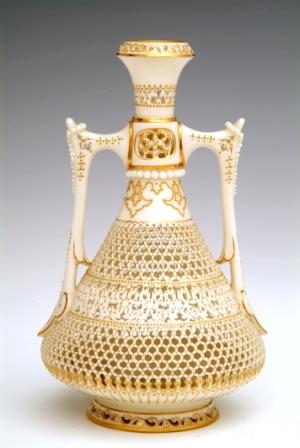
George Owen reticulated vase
- courtesy Worcester
Porcelain Museum
George Owen (1845-1917) is probably the best-known practitioner of reticulation and perfected the art, which left no room for error, at Royal Worcester. He was ambidextrous and could pierce equally effectively with both hands, using an oiled knife on the damp clay. His work is spectacular, and he was very secretive about his methods. He insisted that any visitor to his workshop knocked at the door and waited until he put away his work when he would unlock the door. Apparently he did not even pass his technology to his son.
| Page: 353 of 418 Go To Page: | |
◁◁ First | ◁ Previous | Next ▷ | Last ▷▷ |
Author: Dr. Stan Jones © Copyright 2010 -