

12. European Pottery - Fall of Romans to the Present
| 1467 Page: 354 of 418 Go To Page: |  |
◁◁ First | ◁ Previous | Next ▷ | Last ▷▷ |
Another important Worcester pottery established in 1801 was owned by Thomas Grainger, a grandson of Robert Chamberlain, who served his apprenticeship in the family pottery. Until around 1807 he only decorated bought-in white ware, but from that date he manufactured his own wares, producing well made useful and ornamental wares. His pottery made fine tea wares along with vases and mugs that were well decorated in the Imari style or with flowers and landscapes.
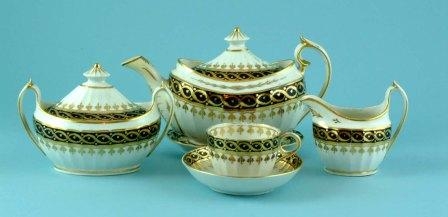
Grainger tea service, 1810 - courtesy
Worcester Porcelain Museum
When Thomas died in 1839, his wife and son George successfully took over, George introduced a Parian-like opaque semi-vitreous form of semi-porcelain in 1848, and used it for making elaborate ornamental wares in the Neo-Rococo style, having extravagant shapes, bright colours and scrolled gilding, that was very popular in the 1840’s and 50’s. The company had great success at the London International Exhibition in 1862, particularly for the reticulated Parian wares of Alfred Barry. George also made hard porcelain for laboratory use. In 1889 George died and the company was sold by his son Frank to the Worcester Royal Porcelain Co, although production continued at the St Martin’s Gate factory until 1902, by which time many Grainger workers, including Barry and the Stintons, had moved to Diglis.
There were two other pottery establishments in Worcester. One owned by James Hadley, a very skilled ceramic modeller, who started work in the W H Kerr factory around 1851/2, becoming chief designer and a top modeller responsible for magnificent figures and vases from the mid 1860’s. He set up on his own in 1875 as a modeller and designer, selling almost all his designs of fine vases to Royal Worcester. He also exhibited them in Paris in 1878 and Chicago in 1893. He started his own pottery, based in a factory near the main Diglis plant, which began manufacture of majolica type earthenware made from different coloured clays in 1896, known widely as “Hadley ware”, initially using the kilns at Locke’s factory. James died in 1903 and in 1905 his factory was bought by the Worcester Royal Porcelain Co. who continued to produce his popular wares for many years.
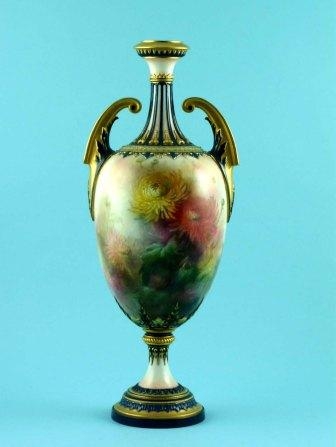
Hadley vase, 1900 - courtesy Worcester
Porcelain Museum
The other pottery, Locke and Co, started in 1895. It was owned by Edward Locke who had for some years previously worked for Graingers, and who took several workers, including two of the Stinton family, with him. It did not compete head on with Royal Worcester, but made smaller wares including crested wares. However, in 1902 Royal Worcester took exception to their branding that caused confusion in the marketplace. A legal battle ensued that was lost by Lockes. It continued operation until 1915 when it closed down.
Charles William Dyson Perrins (1864-1958) was the son of James Dyson Perrins, the owner of the Lea and Perrins Sauce factory, and the grandson of William Perrins, the co-founder of the secret recipe of Worcester sauce. Charles followed his father as a director of Royal Worcester in 1891, and became an enthusiastic collector of old Worcester wares. His financial support was key to the company’s survival, and he started by providing the company with a loan of £20,000 in 1898 when its finances were struggling. He also bought the Company’s historic ceramic collection above its market price in 1927 to assist its cash flow. Royal Worcester became bankrupt on 24th July 1930, and was restarted by the administrators on 8th August 1930. In 1934 Charles Perrins bought the company outright and kept it going with his own funds until it could be taken public in 1954. He also created the Perrins Trust in 1946 to protect his large collection of Worcester ceramics, which his widow used to form the Dyson Perrins Museum.
| Page: 354 of 418 Go To Page: | |
◁◁ First | ◁ Previous | Next ▷ | Last ▷▷ |
Author: Dr. Stan Jones © Copyright 2010 -