

6. Spread of Agriculture, Pottery and Civilisations
| 808 Page: 36 of 418 Go To Page: |  |
◁◁ First | ◁ Previous | Next ▷ | Last ▷▷ |
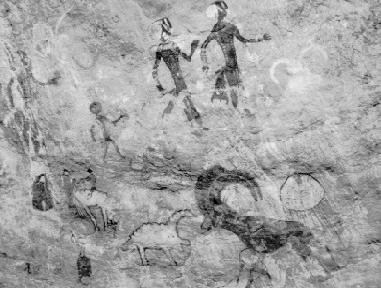
Rock Art, Algeria 8,000 to 4,000 BC
Around 7,000 BC they were herding possibly the world’s earliest cattle in several parts of this region, and their rock art changed to depict domesticated animals, particularly cattle that became revered as the most important part of their existence, so much so that half of the pictures were of cattle.
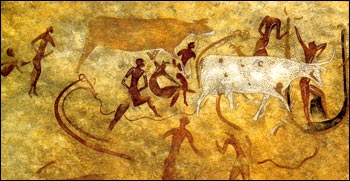
Cattle Rock Art - source Telespazio,
Luca Pietranera, sahara_paint
These fishermen made some of the earliest pottery some dated to 7,500 BC with a distinctive decoration of horizontal, wavy lines. These later developed into dotted, wavy lines created by a stick or a catfish spine, moved horizontally and up and down. There is evidence that the first appearance of the same dotted, wavy-line pottery in the Nile Region occurred some time later, alongside the earlier indigenous Egyptian pottery, giving credence to the idea that Saharan pottery was one of the cultures that was subsequently transferred to Egypt.
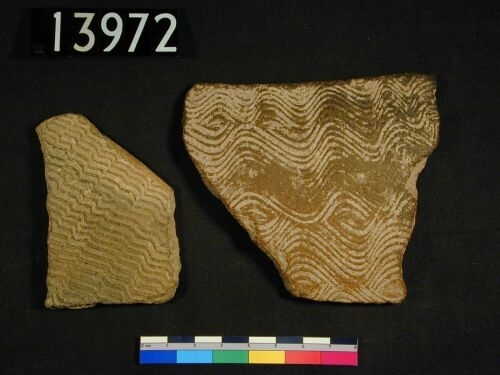
Wavy Line Pottery, Sudan, 8,000 to 3,000
BC-UC13972. Copyright of the Petrie Museum
of Egyptian Archaeology, UCL
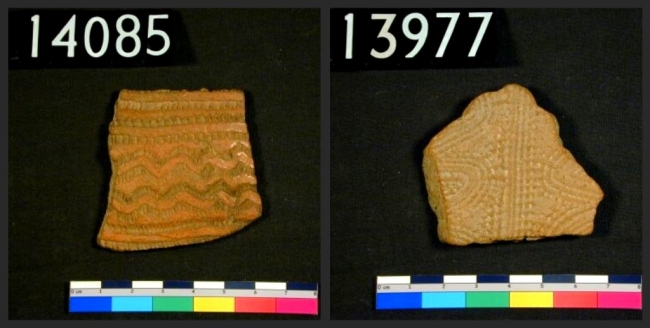
Dotted Wavy Line Pottery, Khartoum, 8,000 to
3,000 BC-UC14085 and 13977. Copyright of
the Petrie Museum of Egyptian Archaeology, UCL
There is evidence that the first appearance of the same dotted, wavy-line pottery in the Nile Region occurred some time later, alongside the earlier indigenous Egyptian pottery, giving credence to the idea that Saharan pottery was one of the cultures that was subsequently transferred to Egypt. Later, around 5,000 BC, pale-skinned people from Mesopotamia in West Asia arrived via Egypt, bringing barley and a further influx of cattle and goats. They met here and merged their cultures. At its height the area covered by these people spread from Algeria and Mali to Egypt and Sudan – larger than the whole of Europe. The pottery culture spread widely, but the body materials varied with the locality.
| Page: 36 of 418 Go To Page: | |
◁◁ First | ◁ Previous | Next ▷ | Last ▷▷ |
Author: Dr. Stan Jones © Copyright 2010 -