

16. Characteristics and Applications of Advanced Ceramic Materials
| 1867 Page: 387 of 418 Go To Page: |  |
◁◁ First | ◁ Previous | Next ▷ | Last ▷▷ |
Casting is also used, similar to pottery casting. After cast moulding the body is dried and sintered so that up to 98% of theoretical maximum density can be achieved. Tape casting can produce 0.1 mm thick tapes, formed by transferring a colloidal suspension of the ferrite onto a permeable carrier belt with blades to control the thickness. The tape is then dried and sintered. Tape casting is commonly used to prepare sheets of various ceramic compositions.
Account must be taken of shrinkage during sintering, which takes place over 2 to 24 hours using an atmosphere of different appropriate gases that help to reduce pores and increase density. Sintering takes place in a kiln at temperatures above the ceramic’s Curie temperature, typically 1000-1400 ºC, when it is highly resistive and has no magnetic alignment. Being ceramics, ferrites are hard and brittle, so are sintered in their final shape and their critical dimensions have to be achieved subsequently by wet grinding using diamond abrasive wheels.
Because of the high conductivity of metals used for permanent magnets, energy loss from parasitic electric “eddy” currents can be very high, and become increasingly so as frequencies increase. Ferrites on the other hand usually have high resistivities, so they are good insulators, which prevent these eddy currents flowing. This is a huge advantage when ferrites are used for the cores of transformers and inductors at higher frequencies, and they dominate applications at microwave frequencies. Other advantages of ferrites over metals are smaller size, lower cost and weight, ease of manufacture and high coercive force (ability to retain their magnetic field).
There are three classes of ferrites depending on what material is combined with the iron oxide (Fe2O3), and two are named after their crystal structure. The first are cubic ferrites or “spinels”. The first discovery of magnetic behaviour in iron oxide spinels was by J L Snoeck in 1947. Most spinels are “soft” so the direction of domain magnetisation can change readily and continuously. Applications include transformers used in touch-tone telephones, inductors, as well as in ultrasonic machining, welding and cleaning.
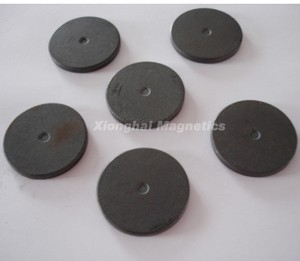
Ceramic magnets comprising strontium
carbonate and iron oxide
The second class is hexagonal ferrites or “magnetoplumbites”. These ceramic ferrites have a complex structure where the grain boundaries have a major role in their properties. Magnetoplumbites are “hard”, their domain magnetisation is difficult to change so they can maintain a permanent magnetic alignment that is frozen in manufacture by poling. They are used for permanent magnets such as the magnetic strips on credit and debit cards, loudspeakers, magnetos, separators for ore concentration and the removal of tramp iron. Flexible permanent magnets can be made by embedding hard ferrite particles in a plastic or rubber matrix, such as those for latches on fridge doors.
The third class is “Garnets” or rare earth ferrites discovered in 1956, where the iron oxide is combined with, for example, yttrium, forming yttrium iron garnet or YIG. They have high resistivity and the lowest loss of the ferrites and are therefore used in microwave applications, particularly the manganese/zinc and nickel/zinc ferrites. They can be produced as polycrystalline ceramics, single crystals or thin films. Garnets are highly tailorable, lower in cost than nickel/cobalt metal alternatives, lower in weight, easier to manufacture and have a high coercive force to resist demagnetisation in applications such as motors. Thin films of YIG have also been used for “bubble” memories for computers, and may be used for magneto-optical applications.
| Page: 387 of 418 Go To Page: | |
◁◁ First | ◁ Previous | Next ▷ | Last ▷▷ |
Author: Dr. Stan Jones © Copyright 2010 -