

6. Spread of Agriculture, Pottery and Civilisations
| 833 Page: 39 of 418 Go To Page: |  |
◁◁ First | ◁ Previous | Next ▷ | Last ▷▷ |
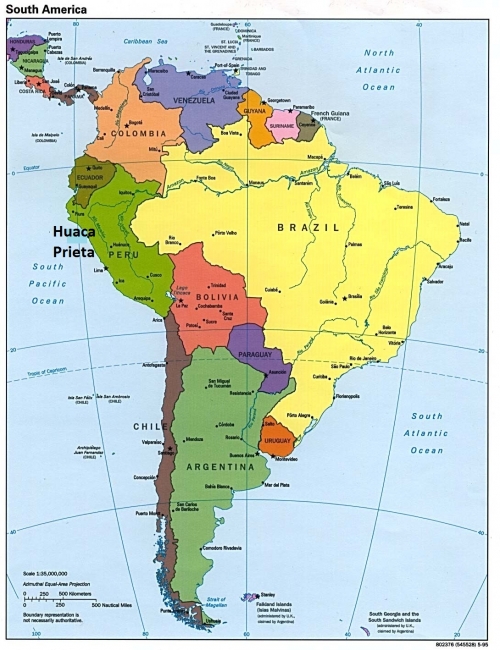
Map of South America - source CIA Maps
The earliest farmers in South America were on the North coast of Ecuador, where they were cultivating Indian corn (maize) by 6,000 BC. At this time maize had single seeds in separate sheaths, but continual selective propagation has resulted in the multi-seeded cob we see today. Further south east in the Amazon Basin around 3,000 BC, they cultivated manioc (cassava) to supplement forest hunting and gathering. However, the main areas of agricultural and subsequent societal development were to the west in the Peruvian Andes and to the north in Meso-America.
Around 8,500 BC people in the Andes were eating wild grass seeds, squash, beans, peppers and wild potatoes and other tubers and root vegetables. Grindstones for the wild cereals have been dated to 8,000 BC. Agriculture proper started about 4,500 BC. Cultivated potatoes appeared about 3,500 BC in the Peruvian Andes together with cotton production. By 2,500 BC they had large agricultural village settlements with an economy based on Lima beans, potatoes and, around 2,000 BC large-scale cultivation of maize. Around 1,800 BC there are clear indications of a more complex society and densely populated centres had developed, together with a monumental ceremonial centre. However, recent excavation has shown that the earliest recognised civilisation in America, the Norte Chico, was to be found on the coast of Peru from around 3,000 to 1,800 BC. There were some 30 settlements, which featured religion, monumental buildings and textiles, but no evidence of art or pottery. These early coastal communities (for example Huaca Prieta) depended heavily on marine fish and shellfish. Around 1,500 BC metalworking also appeared. Reunification of the region did not occur for several hundred years, until the creation of another major Andean civilisation, the Chavin Culture, which lasted from about 1,200 to 200 BC, and developed a widespread religious cult.
| Page: 39 of 418 Go To Page: | |
◁◁ First | ◁ Previous | Next ▷ | Last ▷▷ |
Author: Dr. Stan Jones © Copyright 2010 -