

6. Spread of Agriculture, Pottery and Civilisations
| 834 Page: 40 of 418 Go To Page: |  |
◁◁ First | ◁ Previous | Next ▷ | Last ▷▷ |
In Meso-America there were semi-permanent villages 6-7,000 BC where they were selecting and planting seeds, and they were supplementing their diet by eating cultivated chilli peppers, squash and possibly beans.
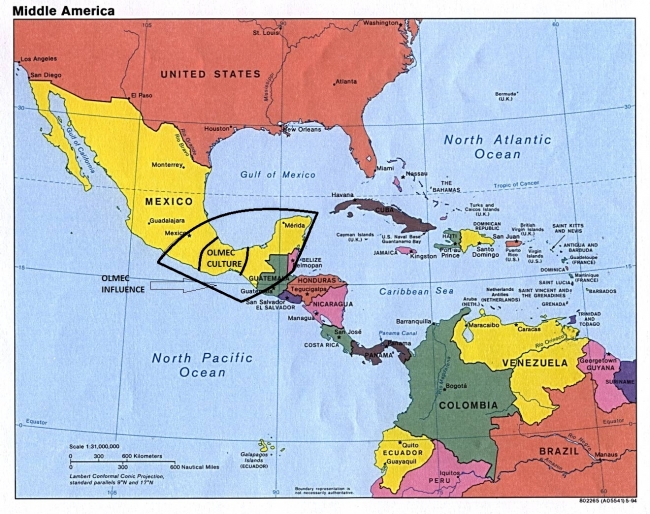
Map of Meso America - source CIA Maps
By 4,750 BC they were also selectively planting mutant forms of maize showing signs of the husks we recognise in domesticated maize today. From 3,500 to 1,500 BC Meso-America became dominated with settled horticultural villages, having pit houses, and with much improved maize as the main crop, but also growing cotton, weaving cloth and making fishing nets. The villages around 1,500 BC were autonomous, but two to three hundred years later large buildings appeared and there was significant social change with a class structure and political centralised society. This coincided with the start of the earliest civilisation in Meso-America, the Olmec Culture around 1,150 BC. They initiated religion and gods, gave rise to kings and classes, fought wars as well as trading over vast distances, heavily influencing adjacent cultures. They also built large towns and cities with significant temple complexes. Unification of the region was swift and also lasted until 500 BC. The earliest pictographic writing was from this area in the later, Zapotec civilisation, about 400 BC.
These two cultures, Chavin and Olmec, shared knowledge of the technology for food plant, ceramic and metallurgy, but they had quite unique cultural traditions. The Meso-Americas were noted for writing, calendars and religion and the Peruvians for government institutions and empire building.
| Page: 40 of 418 Go To Page: | |
◁◁ First | ◁ Previous | Next ▷ | Last ▷▷ |
Author: Dr. Stan Jones © Copyright 2010 -