

6. Spread of Agriculture, Pottery and Civilisations
| 837 Page: 43 of 418 Go To Page: |  |
◁◁ First | ◁ Previous | Next ▷ | Last ▷▷ |
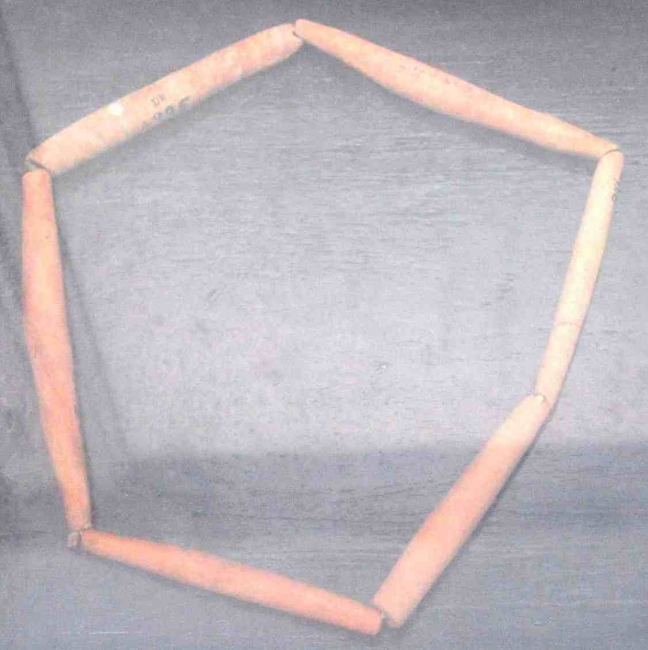
Pottery Beads Imitating Carnelian, Indus
Period 5,000 to 2,000 BC Courtesy
Government Museum, Chennai
The Mehrgarh people migrated to the Indus River Valley, probably because Baluchistan became drier. The subsequent Indus Valley civilisation grew from the technological base of these people. This settlement of the very fertile Indus Valley and its tributaries by a farming culture before 5,000 BC, led to the ability to divert resources for later communal projects such as constructing monumental ceremonial centres. By 4,000 BC, their agricultural technology included irrigation, the plough, and they were producing painted pottery using a slow wheel and living in mud brick homes in walled towns. They also produced decorative beads from semi-precious stones such as carnelian as well as pottery imitations.
There was also a remarkable development that reached the Indus Valley from Egypt around this time called “faience”. In the Indus Valley they were made from local materials, finely powdered quartz, with malachite, blue azurite and powdered talc. When fired these had the self-glazing property due to a glass being formed round each quartz grain that amalgamated to form a continuous glazed surface.
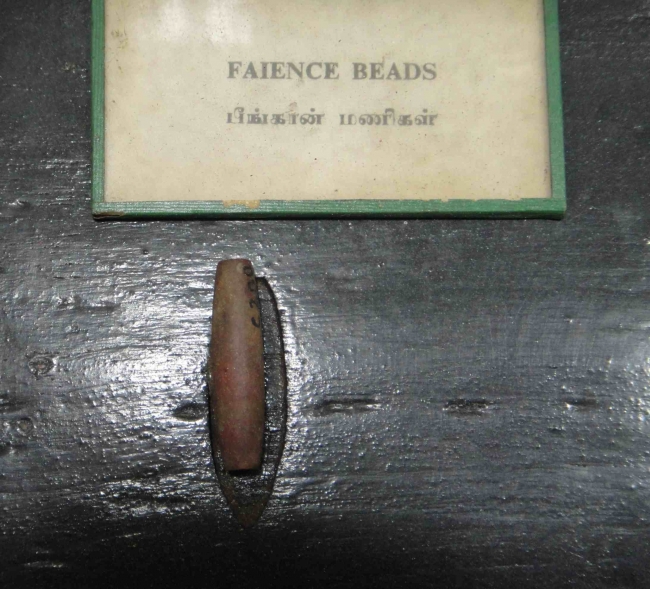
Faience Bead, Indus Period, 5,000 to
2,000BC - Courtesy Government
Museum, Chenna
This material was also used to coat beads of soapstone. This process was probably used, as in Egypt, as a cheaper substitute for more valuable materials such as turquoise. Faience was used for various applications including jewellery. Soapstone is steatite, largely talc, which feels soapy to the touch. It can be fired to form a harder ceramic, or it can be used as a component of the clay for pottery, producing a pot more resistant to heat.
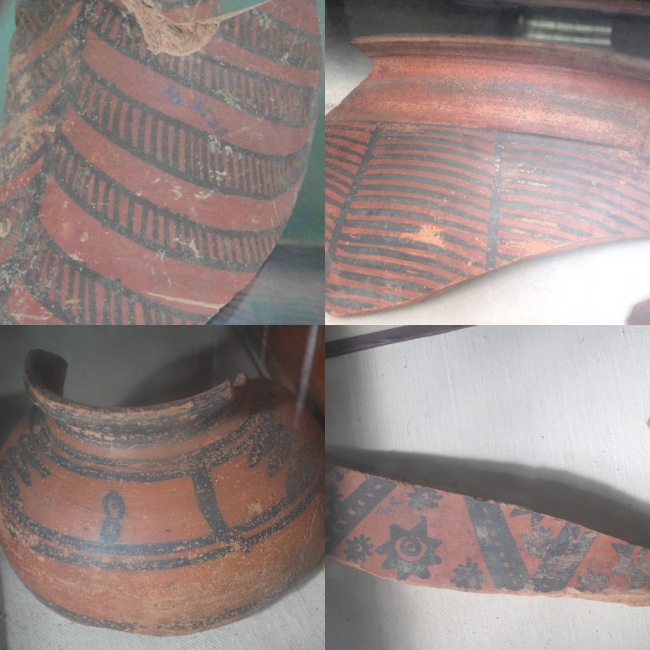
Sherds of Harappan Culture Pottery
Courtesy Government Museum, Chennai
The ceremonial centres provided the focus for the subsequent development of larger settlements around 3,500 BC and led to the first great Indus civilisation, the Harappan Culture, which emerged there about 3,300 BC. At this time the pottery was wheel-made Hakra ware, some of which was incised, had brown slip on buff, bichrome or painted black on red. It showed similarities to the wares of Northern Iran.
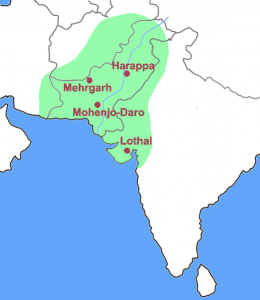
Map of Indus Valley - source Wikipedia
By 2,500 BC the Indus Valley had evolved into one of the three first urban areas in the world, only slightly later than Mesopotamia and Egypt. At its height, its geographical reach exceeded that of both these civilisations. It was similarly based on flood plain agriculture, as the cultivation of the fertile land on either side of the Indus was able to provide enough of a surplus to support a complex urban society. Several substantial cities were built, of which six have been identified so far. Of these Harappa and Mohenjo-Daro (“place of the dead”), each of which had a population of between 40 and 50,000 people and were more than three miles in diameter, have been explored in most detail.
The cities were very sophisticated and exhibited knowledge of urban planning and efficient municipal management, with high emphasis on hygiene. Fired bricks were a unique feature of Harappan architecture. The streets, some of which were 10m wide, were laid out on a grid pattern. Water was provided from narrow brick-lined wells in most houses, and there was a very advanced urban sanitation system.
| Page: 43 of 418 Go To Page: | |
◁◁ First | ◁ Previous | Next ▷ | Last ▷▷ |
Author: Dr. Stan Jones © Copyright 2010 -