

6. Spread of Agriculture, Pottery and Civilisations
| 841 Page: 47 of 418 Go To Page: |  |
◁◁ First | ◁ Previous | Next ▷ | Last ▷▷ |
There is also evidence that they played harp-like instruments. Other arts flourished and many objects of copper and bronze have been uncovered. Bead making continued to be important using materials such as lapis lazuli, but also pottery. A large range of smaller items made of pottery was discovered, including a large collection of terracotta toys, rattles, balls and gamesmen.
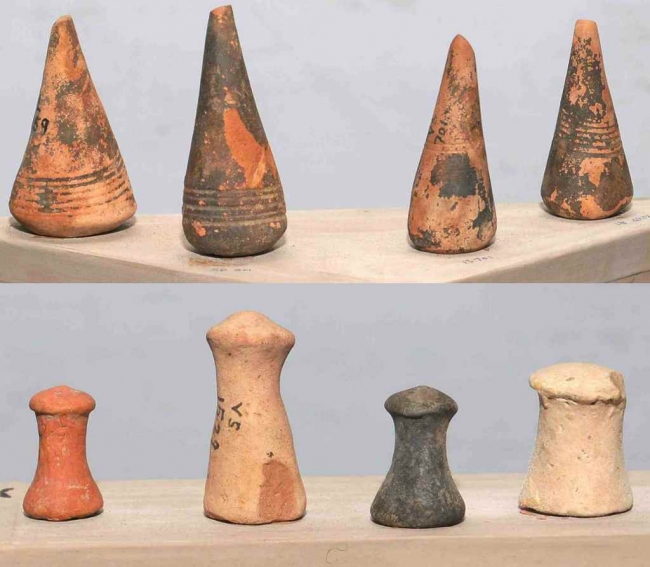
Gamesmen - courtesy Government
Museum, Chennai
There was significant trading with Afghanistan, Persia, North and Central India and Mesopotamia, and the bronze technology was introduced from the Middle East around 2,600 BC. Although there were these links with other communities, a very individual culture developed. They had their own language, and pictographic writing, the Indus Valley script that was developed about 3,000 BC, probably a little later than writing began in Mesopotamia and Ancient Egypt. It is found on the wheel thrown, red-ware, globular pottery of this date. Such inscriptions were dissimilar to any found on the pottery of other early civilisation – and they have still not been properly deciphered. The script later developed into an alphabet with 12 vowels and 18 consonants.
The Harappans were spinning and weaving cotton around 2,500 BC. They also produced the remarkable “Indus Seals” which were delicately carved soapstone or faience tablets used to impress marks onto clay labels used to identify produce – depictions include the dancing girls, early yoga and possibly the god Shiva.
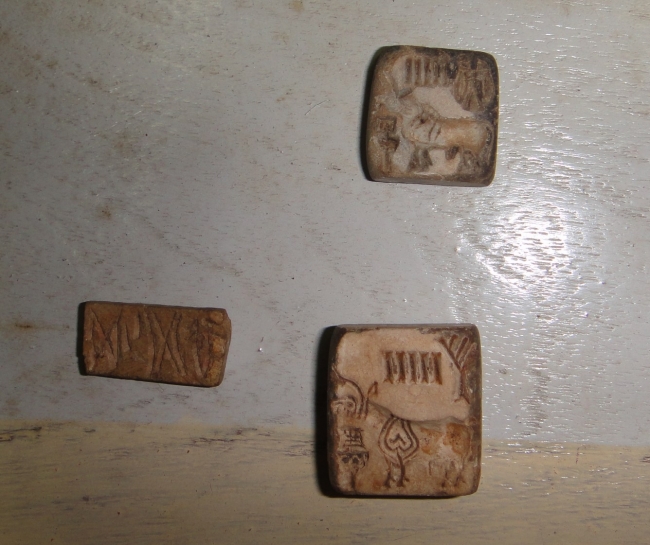
Faience Seals, 2,500 BC - courtesy
Government Museum, Chenna
Houses seem to be of relatively similar size, all with access to services, so it is likely this was an egalitarian society. Technology advanced, with great accuracy in measuring length, mass and time, as well as a keen knowledge of tides, waves and sea currents, permitting them to invent the tidal dock. They advanced their means of transport including the bullock cart, boats and canals, and became noted for their skills with metallurgy. By 2,600 BC they had domesticated numerous crops including peas, dates and cotton, and had invented the plough. They had also domesticated further animals including water buffalo.
By 2,000 BC they not only had an improved potter’s wheel, but open and closed kilns, they fired pots upright and inverted, using slipping, cording, burnishing and painting. Topics of decoration included geometric patterns, early religious symbols such as buffalo heads, together with fish and leaves. This pottery was widely dispersed outside the region due to the well-organised trading system. They continued to make a large number of terracotta figures of gods, including mother goddess figurines. The Indus Valley Culture and the subsequent Cultures were the basis for the later Indian Society, and in particular the major religious systems of Hinduism, Buddhism and Jainism.
| Page: 47 of 418 Go To Page: | |
◁◁ First | ◁ Previous | Next ▷ | Last ▷▷ |
Author: Dr. Stan Jones © Copyright 2010 -