

7. Pottery Technology 1
| 866 Page: 72 of 418 Go To Page: |  |
◁◁ First | ◁ Previous | Next ▷ | Last ▷▷ |
There are two main techniques of painting and glazing a pot: - underglaze, where the unglazed fired or unfired body is painted and the glaze applied subsequently, and overglaze where the body and first glaze have been fired and the painting is on top of this first glaze. Occasionally a third technique is used, where the item is painted on unfired glaze after it has been dipped and dried so that glaze and paint are fired at the same temperature. If underglaze painting was used on earthenware (using for example cobalt for blue) it would be applied to the biscuit body. Syrian potters developed underglaze technology using several colours under a transparent alkaline glaze in the early 12th century AD. This technology was transferred to China where it was used on porcelain to create the Yuan cobalt blue-and-white wares in the 14th century.
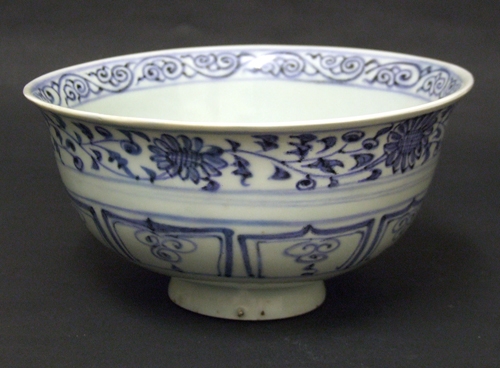
Chinese Yuan Early blue and White Bowl
- courtesy R&G McPherson Antiques
The design was painted on the body before glazing and firing if the piece is to be fired only once, as was usual in China. If it was blue and white ware, the blue cobalt oxide coloured paint was applied to the leather-hard body, the clear feldspathic glaze thinly applied, and the whole object finished with one firing at intense heat. Otherwise the design is painted on the fired biscuit porcelain body, which is then glazed and fired again. Only the Chinese were completely successful in the use of underglaze decoration on porcelain, and then limited to cobalt for blue and copper for red. Other colourant oxides cannot survive the high temperatures needed to properly fire these high-temperature bodies.
When coloured, low-temperature glazes were used over the glaze on earthenware they would be painted onto the fired, glazed body and fired for a third time in a low temperature kiln. This would fuse the second to the first glaze as the coloured glaze melts but the first glaze only softens. This is achieved by adding more flux to the metal oxide coloured glaze to lower its melting temperature. These coloured glazes are also referred to as “enamels”, and in the past used lead as the low temperature flux for overglazing, fired at a temperature of 7-900 degrees C. Typically the glazes are 10 to 20 microns thick. The earliest overglaze painting occurred around the 12th century AD both in Persia on earthenware and in China on stoneware. At first the most common colourants used with low-fired, lead-fluxed glaze were copper, which gives a rich apple green to dark green colour, and iron to give reddish-brown or brown. However, as they are subjected to a lower firing temperature these metal oxide coloured glazes can have a much greater variety of colours.
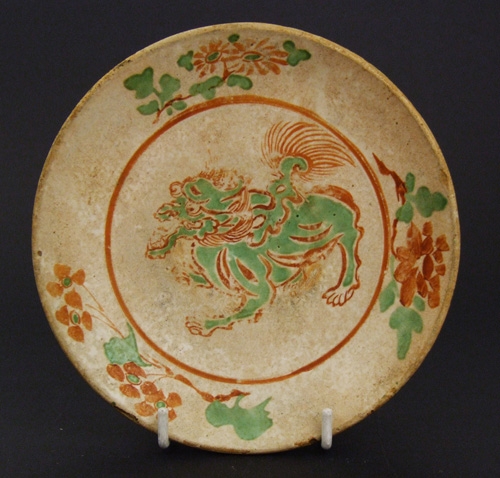
Chinese Jin or Yuan Polychrome Dish with
Buddhist Lion Decoration - courtesy
R&G McPherson Antiques
For example, manganese produces purple, cobalt blues and antimony provides an excellent yellow. The enamel may be suspended in a medium such as “Gum Arabic”, linseed oil or turpentine to help application. However, it is difficult to add another glaze over these enamels to further protect them, as any subsequent firing would have to be at such a low temperature. To maximise the potential decorative effect, pots are often found with both under and overglaze decoration.
| Page: 72 of 418 Go To Page: | |
◁◁ First | ◁ Previous | Next ▷ | Last ▷▷ |
Author: Dr. Stan Jones © Copyright 2010 -