

7. Pottery Technology 1
| 865 Page: 71 of 418 Go To Page: |  |
◁◁ First | ◁ Previous | Next ▷ | Last ▷▷ |
7.9 Painting
There are three basic methods of painting ceramic pots, using a wash, slip or coloured glaze. A wash is a mixture of a coloured pigment (metal oxide) and water. A slip used for painting is a mixture of clay, metal oxide for colour and water, so it is usually more viscous than a wash, but the distinction between the two is not very significant. A slip could be made from a clay of a different colour to the pot, the contrasting colours becoming a decorative feature without separately added metal oxide. The earliest pottery coloured slips/washes used to colour pots from before 5,000 BC were achieved this way, by seeking out clays having different natural colours because of the various metal oxides they happened to contain. The earliest washes/slips were applied using fingers or crushed reed brushes before or after firing. Gypsum was sometimes used after firing to give a contrasting white colouring, especially to highlight incised decoration, but any after-firing colouration was liable to wear.
Later, as the technology developed, the pigments were added from other sources. If applied before firing, heat resisting slips high in iron, manganese and, later, cobalt were used, giving yellow/red/brown, black/purple and blue colours respectively. Sometimes the slip would be used as an overall cover for the pot, called the “ground” onto which further coloured decoration could be applied. Slips were not only useful to cover blemishes in the original body surface, but also white or cream slips were used to hide the red earthenware body beneath, giving a good contrast for any further painting and later to imitate Chinese porcelain. Slip painting of designs was used very early on, with some fine work being carried out before 3,000 BC in Mesopotamia and China.
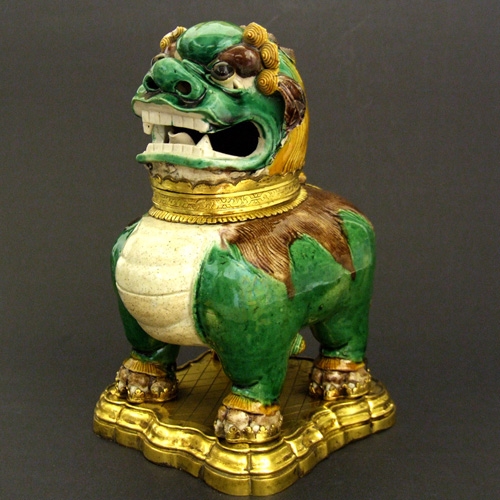
Chinese Kangxi Sancai Fu Dog or Buddhist
Lion - courtesy R&G McPherson Antiques
Similarly, clear glazes could be coloured with metal oxides thus providing two functions, glaze and colour. The advances in metal smelting increased the knowledge of metal oxides, greatly assisting the development of pigment technology. The various additives are frozen in suspension when the glass layer is formed. Colours achieved depended on firing conditions and type of glaze. As examples, copper gives a turquoise colour in an alkaline glaze and green in a lead one, while iron produces black or red if oxidised or pale green (celadon) in reducing conditions. They could be painted onto the biscuit body after firing, usually using a lead glaze base that was then refired at a lower temperature, around 950 degrees C. There is a variation of this technique, again used by the Chinese, which was to use a number of different coloured glazes to form a design directly onto the biscuit porcelain rather than cover the whole item with one colour. The glazes would run together a bit in firing, but this was sometimes considered attractive. These lower temperature glazes cannot be further overglazed, as the necessary firing temperature of this overglaze would burn them away. In the 7th and 8th century AD Tang China, this technique, using iron, copper and then cobalt colouring, created the famous green, yellow, brown and sometimes blue coloured Sancai pottery. This technique reappeared and became popular in the 18th century.
Subsequently, coloured glazes have been used widely on earthenware, stoneware and porcelain. Various effects can be obtained with coloured glazes, as they are more intense in hollows and thinner on edges and this can produce attractive patterns. Also allowing the glaze to run down pieces can give interesting effects.
| Page: 71 of 418 Go To Page: | |
◁◁ First | ◁ Previous | Next ▷ | Last ▷▷ |
Author: Dr. Stan Jones © Copyright 2010 -